


 Cart
Cart
 sales@molnova.com


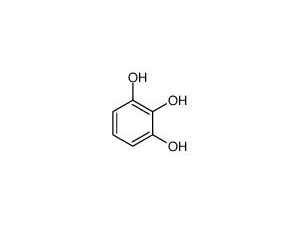
Pyrogallol
CAS No. 87-66-1
Pyrogallol( Pyrogallol | 2,3-Dihydroxyphenol | Benzene-1,2,3-triol | NSC 5035 )
Catalog No. M19211 CAS No. 87-66-1
Pyrogallol is a white crystalline powder and a powerful reducing agent prepared by heating gallic acid.
Purity : >98% (HPLC)
 COA
Datasheet
HNMR
HPLC
MSDS
Handing Instructions
COA
Datasheet
HNMR
HPLC
MSDS
Handing Instructions
| Size | Price / USD | Stock | Quantity |
| 1 mL x 10 mM in DMSO | 28 | In Stock |


|
| 100MG | Get Quote | In Stock |
|
| 200MG | Get Quote | In Stock |
|
| 500MG | 35 | In Stock |
|
| 1G | 42 | In Stock |
|
Biological Information
-
Product NamePyrogallol
-
NoteResearch use only, not for human use.
-
Brief DescriptionPyrogallol is a white crystalline powder and a powerful reducing agent prepared by heating gallic acid.
-
DescriptionPyrogallol is an organic compound with the formula C6H3(OH)3. It is a white solid although because of its sensitivity toward oxygen, samples are typically brownish. Pyrogallol can be used in hair dying, dying of suturing materials and for oxygen absorption in gas analysis. It also has antiseptic properties. Pyrogallol was also used as a developing agent in black-and-white developers, but its use is largely historical except for special purpose applications. (Hydroquinone is more commonly used today.)(In Vitro):Pyrogallol (PG) is a reductant that is able to generate free radicals, in particular superoxide anions (O2 -), so has frequently been used as a photographic developing agent and in the hair dying industry. Pyrogallol inhibits Calu-6 and A549 lung cancer cell growth via apoptosis and depletion of glutathione (GSH). Pyrogallol (PG) induces apoptosis in lung cancer cells via the overproduction of O2 - and affects mitogen activated protein kinases (MAPKs) in these cells. The effect of Pyrogallol on human pulmonary fibroblast (HPF) cell viability and necrotic cell death is examined. For these experiments, 0, 50 or 100 μM Pyrogallol is used to differentiate the levels of cell viability inhibition or death with or without a given MAPK inhibitor. Treatment with 50 and 100 μM Pyrogallol decreases HPF viability by ~40 and 65% at 24 h, respectively. Treatment with an MEK inhibitor slightly enhances the inhibition of cell viability in 50 μM Pyrogallol-treated HPF cells, whereas treatment with a p38 inhibitor mildly attenuates the inhibition of viability. In 100 μM Pyrogallol-treated HPF cells, all the MAPK inhibitors increase the inhibition of viability to a certain extent, with treatment with the p38 inhibitor alone augmenting HPF control cell viability. Necrotic cell death is determined by measuring lactate dehydrogenase (LDH) release from cells. While treatment with 50 μM Pyrogallol does not affect LDH release from HPF cells, 100 μM Pyrogallol significantly increases LDH release.
-
In VitroPyrogallol (PG) is a reductant that is able to generate free radicals, in particular superoxide anions (O2?-), so has frequently been used as a photographic developing agent and in the hair dying industry. Pyrogallol inhibits Calu-6 and A549 lung cancer cell growth via apoptosis and depletion of glutathione (GSH). Pyrogallol (PG) induces apoptosis in lung cancer cells via the overproduction of O2?- and affects mitogen activated protein kinases (MAPKs) in these cells. The effect of Pyrogallol on human pulmonary fibroblast (HPF) cell viability and necrotic cell death is examined. For these experiments, 0, 50 or 100 μM Pyrogallol is used to differentiate the levels of cell viability inhibition or death with or without a given MAPK inhibitor. Treatment with 50 and 100 μM Pyrogallol decreases HPF viability by ~40 and 65% at 24 h, respectively. Treatment with an MEK inhibitor slightly enhances the inhibition of cell viability in 50 μM Pyrogallol-treated HPF cells, whereas treatment with a p38 inhibitor mildly attenuates the inhibition of viability. In 100 μM Pyrogallol-treated HPF cells, all the MAPK inhibitors increase the inhibition of viability to a certain extent, with treatment with the p38 inhibitor alone augmenting HPF control cell viability. Necrotic cell death is determined by measuring lactate dehydrogenase (LDH) release from cells. While treatment with 50 μM Pyrogallol does not affect LDH release from HPF cells, 100 μM Pyrogallol significantly increases LDH release.
-
In Vivo——
-
SynonymsPyrogallol | 2,3-Dihydroxyphenol | Benzene-1,2,3-triol | NSC 5035
-
PathwayGPCR/G Protein
-
TargetHistamine Receptor
-
RecptorOthers
-
Research AreaCancer
-
Indication——
Chemical Information
-
CAS Number87-66-1
-
Formula Weight126.11
-
Molecular FormulaC6H6O3
-
Purity>98% (HPLC)
-
SolubilityDMSO : ≥ 100 mg/mL 792.96 mM H2O : 50 mg/mL 396.48 mM
-
SMILESC1=CC(=C(C(=C1)O)O)O
-
Chemical Name1,2,3-Trihydroxybenzene
Shipping & Storage Information
-
Storage(-20℃)
-
ShippingWith Ice Pack
-
Stability≥ 2 years
Reference
1.Guo TL,et al.Contact sensitizing potential of pyrogallol and 5-amino-o-cresol in female BALB/c mice.2013 Dec 15;314(2-3):202-8.
molnova catalog



related products
-
Clobenpropit dihydro...
Clobenpropit dihydrobromide is a potent ?antagonist and inverse agonist of histamine H3R (histamine H3LR,pEC50 of 8.07)Clobenpropit inhibited cell migration and increased apoptosis of pancreatic cancer cells in combination with gemcitabine.?
-
Vapitadine dihydroch...
Vapitadine dihydrochloride(R-129160 2HCl) is a novel, potent, selective and non-sedating compound with inhibitory effects on histamine H1.
-
Lodoxamide trometham...
Lodoxamide tromethamine is a mast cell stabilizer with anti-allergic properties and can be used in studies about the treatment of asthma and allergic conjunctivitis.
