


 Cart
Cart
 sales@molnova.com


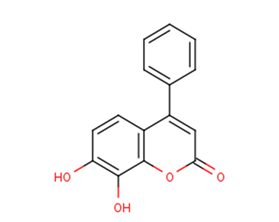
7,8-Dihydroxy-4-phenylcoumarin
CAS No. 842-01-3
7,8-Dihydroxy-4-phenylcoumarin( —— )
Catalog No. M19166 CAS No. 842-01-3
7,8-Dihydroxy-4-phenylcoumarin inhibits the activity of Staphylococcus aureus DNA helicase
Purity : >98% (HPLC)
 COA
Datasheet
HNMR
HPLC
MSDS
Handing Instructions
COA
Datasheet
HNMR
HPLC
MSDS
Handing Instructions
| Size | Price / USD | Stock | Quantity |
| 1 mL x 10 mM in DMSO | 41 | In Stock |


|
| 5MG | 36 | In Stock |
|
| 10MG | 48 | In Stock |
|
| 25MG | 68 | In Stock |
|
| 50MG | 86 | In Stock |
|
| 100MG | 119 | In Stock |
|
| 200MG | Get Quote | In Stock |
|
| 500MG | 303 | In Stock |
|
| 1G | Get Quote | In Stock |
|
Biological Information
-
Product Name7,8-Dihydroxy-4-phenylcoumarin
-
NoteResearch use only, not for human use.
-
Brief Description7,8-Dihydroxy-4-phenylcoumarin inhibits the activity of Staphylococcus aureus DNA helicase
-
Description7,8-Dihydroxy-4-phenylcoumarin inhibits the activity of Staphylococcus aureus DNA helicase.
-
In Vitro——
-
In Vivo——
-
Synonyms——
-
PathwayEndocrinology/Hormones
-
TargetOpioid Receptor
-
RecptorOthers
-
Research Area——
-
Indication——
Chemical Information
-
CAS Number842-01-3
-
Formula Weight254.24
-
Molecular FormulaC15H10O4
-
Purity>98% (HPLC)
-
SolubilityIn Vitro:?DMSO : 100 mg/mL (393.33 mM)
-
SMILESC1=CC=C(C=C1)C2=CC(=O)OC3=C2C=CC(=C3O)O
-
Chemical Name——
Shipping & Storage Information
-
Storage(-20℃)
-
ShippingWith Ice Pack
-
Stability≥ 2 years
Reference
molnova catalog



related products
-
AT-121 hydrochloride
AT-121 hydrochloride is a dual agonist of nociception and mu opioid receptor with Ki values of 3.67 and 16.49 nM, respectively.
-
Gluten Exorphin B5
Gluten exorphin B5 (GE-B5) is a food-derived opioid peptide identified in digests of wheat gluten.
-
Naltrexone hydrochlo...
A potent, competitive antagonist for μ, κ, δ, and σ-opioid receptors with Ki of 0.0825 nM, 0.509 nM, and 8.02 nM, for MOR, KOR, and DOR, respectively.
