


 Cart
Cart
 sales@molnova.com


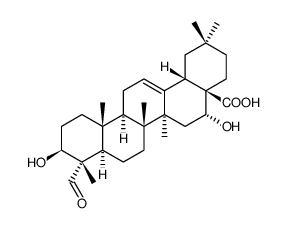
Quillaic Acid
CAS No. 631-01-6
Quillaic Acid( —— )
Catalog No. M18932 CAS No. 631-01-6
Quillaic acid is the major aglycone of the saponins in the Chilean indigenous tree Quillaja saponaria Mol.
Purity : >98% (HPLC)
 COA
Datasheet
HNMR
HPLC
MSDS
Handing Instructions
COA
Datasheet
HNMR
HPLC
MSDS
Handing Instructions
| Size | Price / USD | Stock | Quantity |
| 1 mL x 10 mM in DMSO | 67 | In Stock |


|
| 5MG | 60 | In Stock |
|
| 10MG | 86 | In Stock |
|
| 25MG | 140 | In Stock |
|
| 50MG | 200 | In Stock |
|
| 100MG | Get Quote | In Stock |
|
| 200MG | Get Quote | In Stock |
|
| 500MG | Get Quote | In Stock |
|
| 1G | Get Quote | In Stock |
|
Biological Information
-
Product NameQuillaic Acid
-
NoteResearch use only, not for human use.
-
Brief DescriptionQuillaic acid is the major aglycone of the saponins in the Chilean indigenous tree Quillaja saponaria Mol.
-
DescriptionQuillaic acid is the major aglycone of the saponins in the Chilean indigenous tree Quillaja saponaria Mol.
-
In Vitro——
-
In Vivo——
-
Synonyms——
-
PathwayGPCR/G Protein
-
TargetDopamine Receptor
-
RecptorOthers
-
Research AreaOthers-Field
-
Indication——
Chemical Information
-
CAS Number631-01-6
-
Formula Weight486.69
-
Molecular FormulaC30H46O5
-
Purity>98% (HPLC)
-
SolubilityIn Vitro:?DMSO : ≥ 41 mg/mL (84.24 mM)
-
SMILES[C@]12([C@H]([C@@]([C@H](CC1)O)(C=O)C)CC[C@@]1([C@@H]2CC=C2[C@]1(C[C@H]([C@@]1([C@H]2CC(CC1)(C)C)C(=O)O)O)C)C)C
-
Chemical Name——
Shipping & Storage Information
-
Storage(-20℃)
-
ShippingWith Ice Pack
-
Stability≥ 2 years
Reference
1. Arrau S, et al. J Ethnopharmacol. 2011 Jan 7;133(1):164-7.
molnova catalog



related products
-
Phenelzine
Phenelzine is an antidepressant and mania drug, which is a monoamine oxidase inhibitor. Its antidepressant effect is similar to that of niacinamide.
-
GBR-12935
GBR 12935 induced increase in the extracellular levels of dopamine to basal levels.
-
Tiaspirone hydrochlo...
Tiaspirone hydrochloride (BMY-13859 hydrochloride) exhibits antipsychotic activity. Tiaspirone hydrochloride influences the electrophysiological activity of dopaminergic neurons in the substantia nigra zona compacta (A9 DA cells) and ventral tegmental area (A10 DA cells) in the brain of the rat.
