


 Cart
Cart
 sales@molnova.com


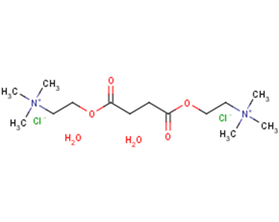
Succinylcholine Chloride Dihydrate
CAS No. 6101-15-1
Succinylcholine Chloride Dihydrate( —— )
Catalog No. M18889 CAS No. 6101-15-1
Succinylcholine Chloride Dihydrate is a nicotinic AChR agonist and also acts as a depolarizing neuromuscular blocker.
Purity : >98% (HPLC)
 COA
Datasheet
HNMR
HPLC
MSDS
Handing Instructions
COA
Datasheet
HNMR
HPLC
MSDS
Handing Instructions
| Size | Price / USD | Stock | Quantity |
| 1 mL x 10 mM in DMSO | 37 | In Stock |


|
| 10MG | 31 | In Stock |
|
| 25MG | 48 | In Stock |
|
| 50MG | 60 | In Stock |
|
| 100MG | 110 | In Stock |
|
| 200MG | 198 | In Stock |
|
| 500MG | 334 | In Stock |
|
| 1G | 496 | In Stock |
|
Biological Information
-
Product NameSuccinylcholine Chloride Dihydrate
-
NoteResearch use only, not for human use.
-
Brief DescriptionSuccinylcholine Chloride Dihydrate is a nicotinic AChR agonist and also acts as a depolarizing neuromuscular blocker.
-
DescriptionSuccinylcholine Chloride Dihydrate is a nicotinic AChR agonist and also acts as a depolarizing neuromuscular blocker.
-
In Vitro——
-
In Vivo——
-
Synonyms——
-
PathwayOthers
-
TargetAntioxidant
-
Recptornicotinic AChR
-
Research AreaNeurological Disease
-
Indication——
Chemical Information
-
CAS Number6101-15-1
-
Formula Weight397.34
-
Molecular FormulaC14H30N2O4·2Cl·2H2O
-
Purity>98% (HPLC)
-
Solubility——
-
SMILESO.O.[Cl-].[Cl-].C[N+](C)(C)CCOC(=O)CCC(=O)OCC[N+](C)(C)C
-
Chemical Name——
Shipping & Storage Information
-
Storage(-20℃)
-
ShippingWith Ice Pack
-
Stability≥ 2 years
Reference
molnova catalog



related products
-
Cosmosiin
Cosmosiin may be beneficial for diabetic complications through their enhanced adiponectin secretion, tyrosine phosphorylation of insulin receptor-β and GLUT4 translocation.
-
Asarylaldehyde
Asaraldehyde, a natural COX-2 inhibitor, exhibits 17-fold selectivity than COX-1.
-
Lecanoric acid
Lecanoric acid is a compound derived from Lecanoric acid, which has antioxidant activity and promotes the growth of probiotics.
