


 Cart
Cart
 sales@molnova.com


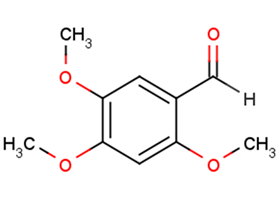
Asarylaldehyde
CAS No. 4460-86-0
Asarylaldehyde( Asaronaldehyde | Asaraldehyde )
Catalog No. M18557 CAS No. 4460-86-0
Asaraldehyde, a natural COX-2 inhibitor, exhibits 17-fold selectivity than COX-1.
Purity : >98% (HPLC)
 COA
Datasheet
HNMR
HPLC
MSDS
Handing Instructions
COA
Datasheet
HNMR
HPLC
MSDS
Handing Instructions
| Size | Price / USD | Stock | Quantity |
| 1 mL x 10 mM in DMSO | 37 | In Stock |


|
| 50MG | 38 | In Stock |
|
| 100MG | 53 | In Stock |
|
| 200MG | Get Quote | In Stock |
|
| 500MG | Get Quote | In Stock |
|
| 1G | Get Quote | In Stock |
|
Biological Information
-
Product NameAsarylaldehyde
-
NoteResearch use only, not for human use.
-
Brief DescriptionAsaraldehyde, a natural COX-2 inhibitor, exhibits 17-fold selectivity than COX-1.
-
DescriptionAsaraldehyde, a natural COX-2 inhibitor, exhibits 17-fold selectivity than COX-1.
-
In VitroAsarylaldehyde (2,4,5-TMBA) is a natural COX-2 inhibitor, which isolated from carrot (Daucus carota L.) seeds significantly inhibits cyclooxygenase II (COX-2) activity at the concentration of 100 μg/mL compared to three commercial nonsteroidal anti-inflammatory drugs Aspinin, Ibuprofen, and Naproxen at their IC50 values 180, 2.52, and 2.06 μg/mL, respectively. 2,4,5-TMBA, a natural inhibitor of cyclooxygenase-2, suppresses adipogenesis and oromotes lipolysis in 3T3-L1 adipocytes. 2,4,5-Trimethoxybenzaldehyde (2,4,5-TMBA) present in plant roots, seeds, and leaves is reported to be a significant inhibitor of cyclooxygenase-2 (COX-2) activity at the concentration of 100 μg/mL. Because COX-2 is associated with differentiation of preadipocytes, the murine 3T3-L1 cells are cultured with 100 μg/mL of 2,4,5-TMBA during differentiation and after the cells are fully differentiated to study the effect of 2,4,5-TMBA on adipogenesis and lipolysis. Oil Red O staining and triglyceride assay revealed that 2,4,5-TMBA inhibited the formation of lipid droplets during differentiation; moreover, 2,4,5-TMBA down-regulated the protein levels of adipogenic signaling molecules and transcription factors MAP kinase kinase (MEK), extracellular signal-regulated kinase (ERK), CCAAT/enhancer binding protein (C/EBP)α, β, and δ, peroxisome proliferator-activated receptor (PPAR)γ, adipocyte determination and differentiation-dependent factor 1 (ADD1), and the rate-limiting enzyme for lipid synthesis acetyl-CoA carboxylase (ACC). In fully differentiated adipocytes, treatment with 2,4,5-TMBA for 72 h significantly decreased lipid accumulation by increasing the hydrolysis of triglyceride through suppression of perilipin A (lipid droplet coating protein) and up-regulation of hormone-sensitive lipase (HSL). When treated with 100 μg/mL of 2,4,5-TMBA for 24, 48, or 72 h, the viability of fully differentiated 3T3-L1 adipocytes is decreased by 8.35, 15.54, and 27.26%, respectively. When the preadiocytes are treated with 100 μg/mL of 2,4,5-TMBA for 24 h before differentiation medium is supplemented, the cell viability is decreased by 26.46%. A COX-2 inhibitor 2,4,5-trimethoxybenzaldehyde (TMBA) is found to be the most abundant constituent, but is totally absent in its cultured broth and its natural host, C. kanehirae wood. 2,4,5-trimethoxybenzaldehyde (TMBA) is the major constituent in fruiting bodies.
-
In Vivo——
-
SynonymsAsaronaldehyde | Asaraldehyde
-
PathwayOthers
-
TargetAntioxidant
-
RecptorCOX-2
-
Research AreaInflammation/Immunology
-
Indication——
Chemical Information
-
CAS Number4460-86-0
-
Formula Weight196.2
-
Molecular FormulaC10H12O4
-
Purity>98% (HPLC)
-
SolubilityH2O : < 0.1 mg/mL
-
SMILESCOc1cc(c(cc1C=O)OC)OC
-
Chemical Name——
Shipping & Storage Information
-
Storage(-20℃)
-
ShippingWith Ice Pack
-
Stability≥ 2 years
Reference
1. Ni G, Yu DQ. Zhongguo Zhong Yao Za Zhi. 2013 Feb;38(4):569-73.
molnova catalog



related products
-
Astragaloside III
Astragaloside III has cardioprotective effects as well as causing improvement in cognitive function. It can be used in the prevention of cardio-cerebral vascular diseases. It also is antioxidant.
-
4-Chlorophenylhydraz...
4-Chlorophenylhydrazine?hydrochloride?is?used?as?a?pharmaceutical?intermediate.
-
Eburicoic acid
Eburicoic acid exhibits anti-inflammatory and antioxidant activity thereby protecting the liver from CCl4-induced hepatic damage and can be used in studies about anti-liver cancer.
