


 Cart
Cart
 sales@molnova.com


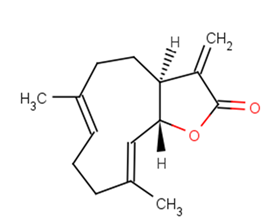
Costunolide
CAS No. 553-21-9
Costunolide( CCRIS 6754 | NSC 106404 | Costus lactone | (+)-Costunolide )
Catalog No. M18799 CAS No. 553-21-9
Costunolide has anti-inflammatory and anti-oxidant properties and mediates apoptosis.
Purity : >98% (HPLC)
 COA
Datasheet
HNMR
HPLC
MSDS
Handing Instructions
COA
Datasheet
HNMR
HPLC
MSDS
Handing Instructions
| Size | Price / USD | Stock | Quantity |
| 1 mL x 10 mM in DMSO | 46 | In Stock |


|
| 2MG | 29 | In Stock |
|
| 5MG | 43 | In Stock |
|
| 10MG | 65 | In Stock |
|
| 25MG | 116 | In Stock |
|
| 50MG | 169 | In Stock |
|
| 100MG | 245 | In Stock |
|
| 200MG | 364 | In Stock |
|
| 500MG | Get Quote | In Stock |
|
| 1G | Get Quote | In Stock |
|
Biological Information
-
Product NameCostunolide
-
NoteResearch use only, not for human use.
-
Brief DescriptionCostunolide has anti-inflammatory and anti-oxidant properties and mediates apoptosis.
-
DescriptionCostunolide, also known as (+)-Costunolide, CCRIS 6754 and NSC 106404, is a naturally occurring sesquiterpene lactone, first isolated in Saussurea costus roots in 1960. It is also found in lettuce. Costunolide has been reported for the wide spectrum of biological effects, including anti-inflammatory, anticancer, antiviral, antimicrobial, antifungal, antioxidant, antidiabetic, antiulcer, and anthelmintic activities. In recent years, it have caused extensive interest in researchers due to its potential anti-cancer activities for various types of cancer, and their anti-cancer mechanisms, including causing cell cycle arrest, inducing apoptosis and differentiation, promoting the aggregation of microtubule protein, inhibiting the activity of telomerase, inhibiting metastasis and invasion, reversing multidrug resistance, restraining angiogenesis has been studied.
-
In VitroCell Viability Assay Cell Line:H1299 cells Concentration:6.7 μM, 13.5 μM, 26.9 μM, 107.6 μM, 215.2 μM Incubation Time:24 hours Result:Inhibited the viability of H1299 cells (MTT assay).Apoptosis Analysis Cell Line:H1299 cells Concentration:0 μM, 12.0 μM, 24.0 μM, 48.0 μM Incubation Time:48 hours Result:Significantly promoted apoptosis at 24.0 μM and 48.0 μM.RT-PCR Cell Line:H1299 cells Concentration:0 μM, 12.0 μM, 24.0 μM, 48.0 μM Incubation Time:6 hours, 12 hours Result:Regulated the metastasis- and proliferation-associated mRNA levels in a dose-dependent manner.Western Blot Analysis Cell Line:H1299 cells Concentration:0 μM, 12.0 μM, 24.0 μM, 48.0 μM Incubation Time:48 hours Result:Significantly inhibited the EMT of H1299 cells.
-
In VivoAnimal Model:4 weeks old female BALB/c nude mice, MDA-MB-231 cells xenograft mouse models Dosage:20?mg/kg Administration:Intraperitoneal injection, daily, for 30 days Result:Reduced the expression levels of c-Myc and p-AKT and elevated the expression levels of p53 and p-14-3-3.
-
SynonymsCCRIS 6754 | NSC 106404 | Costus lactone | (+)-Costunolide
-
PathwayOthers
-
TargetOther Targets
-
RecptorFPTase| Telomerase (MCF-7)| Telomerase (MDA-MB-231)
-
Research AreaCancer
-
Indication——
Chemical Information
-
CAS Number553-21-9
-
Formula Weight232.32
-
Molecular FormulaC15H20O2
-
Purity>98% (HPLC)
-
SolubilityDMSO : ≥ 49 mg/mL; 210.92 mM
-
SMILESO1[C@H]2[C@H](C(=C)C1=O)CC/C(=C/CC/C(=C/2)/C)/C
-
Chemical Name(3aS,6E,10E,11aR)-6,10-dimethyl-3-methylene-3a,4,5,8,9,11a-hexahydrocyclodeca[b]furan-2(3H)-one
Shipping & Storage Information
-
Storage(-20℃)
-
ShippingWith Ice Pack
-
Stability≥ 2 years
Reference
1. Cheon YH, et al. PhytOthers Res. 2014 Apr;28(4):586-92.
molnova catalog



related products
-
pTH (73-84) (human)
pTH (73-84) (human) is a polypeptide that can be found by peptide screening. Peptide screening is a research tool that pools active peptides primarily by immunoassay. Peptide screening can be used for protein interaction, functional analysis, epitope screening, especially in the field of agent research and development.
-
33-Dimethylglutaric ...
33-Dimethylglutaric acid is a compound found in human urine.
-
DMHCA
DMHCA is a selective LXR agonist with anti-inflammatory activity, which induces ABCA1 expression and upregulates FASN and SREBP-1alpha gene expression.
