


 Cart
 sales@molnova.com


Pancreatic Polypeptide, rat
CAS No. 90419-12-8
Pancreatic Polypeptide, rat( Rat pancreatic polypeptide )
Catalog No. M29743 CAS No. 90419-12-8
Pancreatic Polypeptide, rat is an agonist of NPY receptor, with high affinity at NPYR4. Pancreatic polypeptide (PP) is a 36-amino acid, C-terminally amidated peptide, and is a member of the PP-fold peptide family. It is produced and secreted by the PP cells of the islets of Langerhans.
Purity : >98% (HPLC)
 COA
Datasheet
HNMR
HPLC
MSDS
Handing Instructions
| Size | Price / USD | Stock | Quantity |
| 5MG | 972 | Get Quote |


|
| 100MG | Get Quote | Get Quote |
|
| 200MG | Get Quote | Get Quote |
|
| 500MG | Get Quote | Get Quote |
|
| 1G | Get Quote | Get Quote |
|
Biological Information
-
Product NamePancreatic Polypeptide, rat
-
NoteResearch use only, not for human use.
-
Brief DescriptionPancreatic Polypeptide, rat is an agonist of NPY receptor, with high affinity at NPYR4. Pancreatic polypeptide (PP) is a 36-amino acid, C-terminally amidated peptide, and is a member of the PP-fold peptide family. It is produced and secreted by the PP cells of the islets of Langerhans.
-
DescriptionPancreatic Polypeptide, rat is an agonist of NPY receptor, with high affinity at NPYR4. Pancreatic polypeptide (PP) is a 36-amino acid, C-terminally amidated peptide, and is a member of the PP-fold peptide family. It is produced and secreted by the PP cells of the islets of Langerhans.(In Vitro):Pancreatic Polypeptide, rat is an agonist of NPY receptor, with high affinity at NPYR4. Pancreatic Polypeptide (1 μM) does not alter proliferation in BRIN BD11 or 1.1B4 beta-cells, but reverses the decreased cell viability in BRIN BD11 cells induced by streptozotocin. Pancreatic Polypeptide (0.1 nM-1 μM) shows no effect on insulin secretion from isolated mouse islets, and does not affect the membrane potential and (Ca2+)i levels in BRIN BD11 cells at 1 μM.(In Vivo):Pancreatic Polypeptide (25 nmol/kg bw, i.p.) reduces glucose-stimulated insulin concentrations but shows no effect on acute feeding behaviour in overnight fasted mice.
-
In VitroPancreatic Polypeptide, rat is an agonist of NPY receptor, with high affinity at NPYR4. Pancreatic Polypeptide (1 μM) does not alter proliferation in BRIN BD11 or 1.1B4 beta-cells, but reverses the decreased cell viability in BRIN BD11 cells induced by streptozotocin. Pancreatic Polypeptide (0.1 nM-1 μM) shows no effect on insulin secretion from isolated mouse islets, and does not affect the membrane potential and (Ca2+)i levels in BRIN BD11 cells at 1 μM.
-
In VivoPancreatic Polypeptide (25 nmol/kg bw, i.p.) reduces glucose-stimulated insulin concentrations but shows no effect on acute feeding behaviour in overnight fasted mice.
-
SynonymsRat pancreatic polypeptide
-
PathwayOthers
-
TargetOther Targets
-
RecptorNPYR4
-
Research Area——
-
Indication——
Chemical Information
-
CAS Number90419-12-8
-
Formula Weight4398.87
-
Molecular FormulaC195H298N58O57S
-
Purity>98% (HPLC)
-
Solubility——
-
SMILES——
-
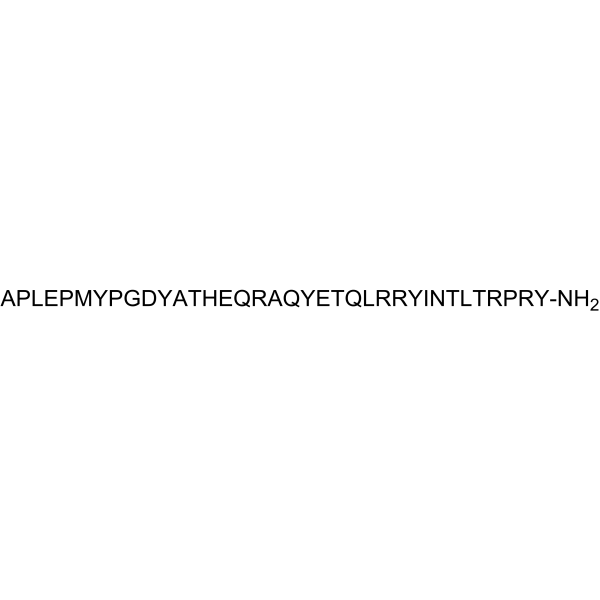
Chemical NameSequence:Ala-Pro-Leu-Glu-Pro-Met-Tyr-Pro-Gly-Asp-Tyr-Ala-Thr-His-Glu-Gln-Arg-Ala-Gln-Tyr-Glu-Thr-Gln-Leu-Arg-Arg-Tyr-Ile-Asn-Thr-Leu-Thr-Arg-Pro-Arg-Tyr-NH2
Shipping & Storage Information
-
Storage(-20℃)
-
ShippingWith Ice Pack
-
Stability≥ 2 years
Reference
Khan D, et al. Influence of neuropeptide Y and pancreatic polypeptide on islet function and beta-cell survival. Biochim Biophys Acta. 2017 Apr;1861(4):749-758.
molnova catalog



related products
-
Thymine
Thymine is found in the nucleic acid DNA. In RNA thymine is replaced with uracil in most cases. In DNA, thymine binds to adenine via two hydrogen bonds to assist in stabilizing the nucleic acid structures.
-
Eflucimibe
Eflucimibe (L0081) is an acyl coenzyme A: cholesterol acyltransferase inhibitor for the treatment of cardiovascular disease and endocrine and metabolic disorders, and can be used to study atherosclerosis and hyperlipidemia.
-
TCMDC-135051
TCMDC-135051 is a potent and selective PfCLK3 protein kinase inhibitor demonstrating significant antiparasiticidal activity (EC50=320 nM) while exhibiting minimal off-target toxicity.
