


 Cart
Cart
 sales@molnova.com


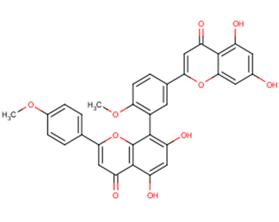
ISOGINKGETIN
CAS No. 548-19-6
ISOGINKGETIN( Isoginkgetin | IGG )
Catalog No. M18783 CAS No. 548-19-6
Isoginkgetin, a compound derived from the leaves of Ginkgo biloba, to up-regulate adiponectin secretion with potency comparable to that of rosiglitazone, a known modulator of adiponectin production.
Purity : >98% (HPLC)
 COA
Datasheet
HNMR
HPLC
MSDS
Handing Instructions
COA
Datasheet
HNMR
HPLC
MSDS
Handing Instructions
| Size | Price / USD | Stock | Quantity |
| 5MG | 46 | In Stock |


|
| 100MG | Get Quote | In Stock |
|
| 200MG | Get Quote | In Stock |
|
| 500MG | Get Quote | In Stock |
|
| 1G | Get Quote | In Stock |
|
Biological Information
-
Product NameISOGINKGETIN
-
NoteResearch use only, not for human use.
-
Brief DescriptionIsoginkgetin, a compound derived from the leaves of Ginkgo biloba, to up-regulate adiponectin secretion with potency comparable to that of rosiglitazone, a known modulator of adiponectin production.
-
DescriptionIsoginkgetin, a compound derived from the leaves of Ginkgo biloba, to up-regulate adiponectin secretion with potency comparable to that of rosiglitazone, a known modulator of adiponectin production. Isoginkgetin has anti-tumor activity, the mechanistic basis is splicing inhibition , thus, pre-mRNA splicing inhibitors may represent a novel avenue for development of new anti-cancer agents.Isoginkgetin can inhibit tumor cell invasion by regulating phosphatidylinositol 3-kinase/Akt-dependent matrix metalloproteinase-9 expression. Isoginkgetin (0.3mg/kg ip for 3d) can reduce the level of O2·- in plasma and erythroeyte and sometimes increase the activity of SOD in anoxic rats, the action being stronger than aspirin.
-
In VitroIsoginkgetin (0-20 μM, 24 h) inhibits cell invasion in a dose-dependent manner.Isoginkgetin (10 μM, 0-24 h) induces the accumulation of ubiquitinated protein cargo into perinuclear aggregates, activates autophagy and induces lysosomal swelling, repositioning, and acidification.Isoginkgetin (10 μM, 0-6 h) induces ER stress, impairs the unfolded protein response, and results in accumulation of ERAD substrates.Isoginkgetin directly inhibits the chymotrypsin-, trypsin-, and caspase-like activities of the 20S proteasome and impairs NF-κB signaling.Isoginkgetin (30 μM, 0-24 h) induces apoptosis in MM cell lines. Cell Invasion Assay Cell Line:MDA-MB-231 and B16F10 Concentration:0, 5, 10 and 20 μM Incubation Time:24 h Result:Inhibited cell invasion in a dose-dependent manner.Western Blot AnalysisCell Line:HeLa cells and MM cell lines (MM1S, 8826, OPM2, H929, JJN3 and U266)Concentration:10?μM in HeLa cells, 30 μM in MM cell linesIncubation Time:0-24 hResult:Induced the expression of cleaved PARP-1 and Casp-3. Increased the protein levels of both ATF4 and ATF3. Decreased the level of LC3 I. Increased TFEB activation. Prevented the degradation of IκBα in response to stimulation with TNF-α.Cell Viability Assay Cell Line:MM1S, 8826, OPM2, H929, JJN3 and U266 cells Concentration:Incubation Time:72?h Result:Inhibited cell viability with IC50 values of 3.992, 3.716, 4.749, 2.564, 3.806 and 4.147 μM against MM1S, 8826, OPM2, H929, JJN3 and U266 cells, respectively.
-
In VivoIsoginkgetin (4 mg/kg; i.p.; daily for 14 days) shows anti-inflammatory effects. Animal Model:Adult male Kunming mice (age 8–10weeks, 30–50 g)Dosage:4 mg/kg Administration:Daily for 14 days by intraperitoneally (i.p.) prior to LPS (0.83mg/kg) administration.Result:Markedly suppressed the production of IL-1β, IL-6, tumor necrosis factor-alpha, cyclooxygenase-2, inducible nitric oxide, and reactive oxygen species.
-
SynonymsIsoginkgetin | IGG
-
PathwayOthers
-
TargetOther Targets
-
RecptorOthers
-
Research AreaCancer
-
Indication——
Chemical Information
-
CAS Number548-19-6
-
Formula Weight566.51
-
Molecular FormulaC32H22O10
-
Purity>98% (HPLC)
-
SolubilityDMSO : ≥ 83.3 mg/mL; 147.04 mM
-
SMILESCOC1=CC=C(C=C1)C2=CC(=O)C3=C(O2)C(=C(C=C3O)O)C4=C(C=CC(=C4)C5=CC(=O)C6=C(C=C(C=C6O5)O)O)OC
-
Chemical Name8-[5-(5,7-Dihydroxy-4-oxochromen-2-yl)-2-methoxyphenyl]-5,7-dihydroxy-2-(4-methoxyphenyl)chromen-4-one
Shipping & Storage Information
-
Storage(-20℃)
-
ShippingWith Ice Pack
-
Stability≥ 2 years
Reference
molnova catalog



related products
-
p3K, (Lys 58 Lys 60 ...
p3K, (Lys 58 Lys 60 Lys 63) Ea(52–68)
-
FGIN-1-43
FGIN-1-43 is a potent and specific ligand for the mitochondrial DBI receptor.
-
Lysozyme
Lysozyme areenzyme(EC3.2.1.17) that damage bacterial cell walls by catalyzinghydrolysisof 1,4-beta-linkages betweenN-acetylmuramic acidandN-acetyl-D-glucosamineresidues in apeptidoglycanand betweenN-acetyl-D-glucosamineresidues inchitodextrins.
