


 Cart
Cart
 sales@molnova.com


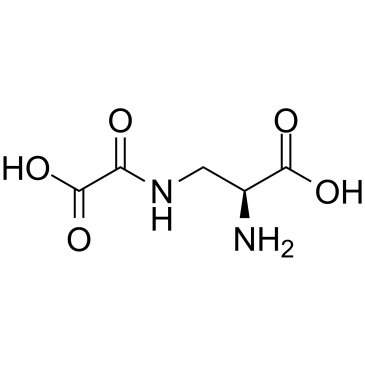
dencichine
CAS No. 5302-45-4
dencichine( β-ODAP | Dencichine | BRN-2259036 | Ox-Dapro )
Catalog No. M18743 CAS No. 5302-45-4
Dencichine is a neurotoxic agent. Dencichine is a haemostatic agent, the hemostatic effect relates to modulation of the coagulation system, platelet aggregation and fibrinolytic system.
Purity : >98% (HPLC)
 COA
Datasheet
HNMR
HPLC
MSDS
Handing Instructions
COA
Datasheet
HNMR
HPLC
MSDS
Handing Instructions
| Size | Price / USD | Stock | Quantity |
| 1 mL x 10 mM in DMSO | 103 | In Stock |


|
| 5MG | 93 | In Stock |
|
| 10MG | 163 | In Stock |
|
| 25MG | 350 | In Stock |
|
| 50MG | 509 | In Stock |
|
| 100MG | 733 | In Stock |
|
| 200MG | 1004 | In Stock |
|
| 500MG | Get Quote | In Stock |
|
| 1G | Get Quote | In Stock |
|
Biological Information
-
Product Namedencichine
-
NoteResearch use only, not for human use.
-
Brief DescriptionDencichine is a neurotoxic agent. Dencichine is a haemostatic agent, the hemostatic effect relates to modulation of the coagulation system, platelet aggregation and fibrinolytic system.
-
DescriptionDencichin, also known as β-ODAP, has been shown to alleviate metabolism disorder, improve renal function, relieve pathological alterations in the glomerulus of diabetic neuropathy in rats, decrease extracellular matrix deposition and increase the ratio of matrix metalloproteinase (MMP)-9 to tissue inhibitor of metalloproteinase (TIMP)-1 both in vivo and in vitro.
-
In VitroDencichin (β-ODAP, 10 μM, 50 μM, 100 μM and 200 μM) increases HRE expression by 1.3±0.09, 2.5±0.07, 4.2±0.15 and 1.3±0.07 fold respectively compared to control. Dencichin has intermolecular interactions with PHD-2. Dencichin (10 μM, 100 μM, 1 mM) significantly inhibits cell proliferation and extracellular matrix (ECM) proteins accumulation of HBZY-1 cells, and reduces the secretion of collagen I (Col I), collagen IV (Col IV), and fibronectin (FN).
-
In VivoDencichin improves metabolism disorder in diabetic nephropathy (DN) secondary to type II diabetes mellitus (DM) model. Dencichin (80, 160 mg/kg/day, p.o.) significantly prevents the up-regulation of TCH, TG, LDL, and HbAlc and the down-regulation of HDL in DN rats induced by STZ injection. Dencichin also attenuates renal injury induced in the DN secondary to type II DM model. Dencichin alleviates pancreas damage in the STZ-induced DN model. Dencichin regulates protein expression in the TGF-β/Smad signalling pathway in STZ-induced DN models.
-
Synonymsβ-ODAP | Dencichine | BRN-2259036 | Ox-Dapro
-
PathwayMAPK/ERK Signaling
-
Targetp38 MAPK
-
RecptorOthers
-
Research AreaOthers-Field
-
Indication——
Chemical Information
-
CAS Number5302-45-4
-
Formula Weight176.13
-
Molecular FormulaC5H8N2O5
-
Purity>98% (HPLC)
-
SolubilityIn Vitro:?H2O : 5 mg/mL (28.39 mM)
-
SMILESC([C@@H](C(=O)O)N)NC(=O)C(=O)O
-
Chemical NameOxamic acid, (2-amino-2-carboxyethyl)-, L-
Shipping & Storage Information
-
Storage(-20℃)
-
ShippingWith Ice Pack
-
Stability≥ 2 years
Reference
1. Xie G X, et al. Journal of Pharmaceutical & Biomedical Analysis, 2007, 43(3):920-925.
molnova catalog



related products
-
16,17-Epoxypregnenol
16,17-Epoxypregnenol
-
Eudesmin
Eudesmin shows antiinflammatory neuritogenic anticonvulsant and sedative effects the mechanism of eudesmin may be related to up-regulation of GABAA and GAD65 expressions and anti-apoptosis of neuron the in brain.50 microM (+)-eudesmin can induce neurite outgrowth and enhance nerve growth factor (NGF)-mediated neurite outgrowth from PC12 cells by stimulating up-stream MAPK PKC and PKA pathways.
-
SD 169
SD 169 is a selective and ATP competitive the MAP kinases p38α and p38β?inhibitor.
