


 Cart
Cart
 sales@molnova.com


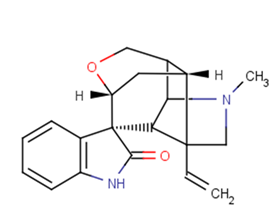
Gelsemine
CAS No. 509-15-9
Gelsemine( —— )
Catalog No. M18681 CAS No. 509-15-9
Gelsemine has marked antinociception in inflammatory, neuropathic and bone cancer pains without inducing antinociceptive tolerance.
Purity : >98% (HPLC)
 COA
Datasheet
HNMR
HPLC
MSDS
Handing Instructions
COA
Datasheet
HNMR
HPLC
MSDS
Handing Instructions
| Size | Price / USD | Stock | Quantity |
| 1 mL x 10 mM in DMSO | 42 | In Stock |


|
| 5MG | 38 | In Stock |
|
| 10MG | 61 | In Stock |
|
| 25MG | 104 | In Stock |
|
| 50MG | 152 | In Stock |
|
| 100MG | Get Quote | In Stock |
|
| 200MG | Get Quote | In Stock |
|
| 500MG | Get Quote | In Stock |
|
| 1G | Get Quote | In Stock |
|
Biological Information
-
Product NameGelsemine
-
NoteResearch use only, not for human use.
-
Brief DescriptionGelsemine has marked antinociception in inflammatory, neuropathic and bone cancer pains without inducing antinociceptive tolerance.
-
DescriptionGelsemine has antitumor activity. Gelsemine has anti-oxidative activity. Gelsemine has anti-hyperlipidemic activity. Gelsemine has marked antinociception in inflammatory, neuropathic and bone cancer pains without inducing antinociceptive tolerance. (In Vivo):Gelsemine is an effective agent for treatment of both neuropathic pain and sleep disturbance in partial sciatic nerve ligation (PSNL) mice. Gelsemine (4 mg/kg) exerts analgesic effects on PSNL-induced mechanical allodynia and thermal hyperalgesia. In PSNL mice, Gelsemine (2 and 4 mg/kg) increases the mechanical threshold for 4 h and prolonged the thermal latencies for 3 h. Furthermore, Gelsemine (4 mg/kg, administered at 6:30 AM) increases non-rapid eye movement (non-REM, NREM) sleep, decreases wakefulness, but does not affect rapid eye movement (REM) sleep during the first 3 h in PSNL mice.Immunohistochemical study shows that PSNL increases c-Fos expression in the neurons of the anterior cingulate cortex, and Gelsemine (4 mg/kg) decreases c-Fos expression by 58%.
-
In Vitro——
-
In VivoGelsemine is an effective agent for treatment of both neuropathic pain and sleep disturbance in partial sciatic nerve ligation (PSNL) mice. Gelsemine (4 mg/kg) exerts analgesic effects on PSNL-induced mechanical allodynia and thermal hyperalgesia. In PSNL mice, Gelsemine (2 and 4 mg/kg) increases the mechanical threshold for 4 h and prolonged the thermal latencies for 3 h. Furthermore, Gelsemine (4 mg/kg, administered at 6:30 AM) increases non-rapid eye movement (non-REM, NREM) sleep, decreases wakefulness, but does not affect rapid eye movement (REM) sleep during the first 3 h in PSNL mice. Immunohistochemical study shows that PSNL increases c-Fos expression in the neurons of the anterior cingulate cortex, and Gelsemine (4 mg/kg) decreases c-Fos expression by 58%.
-
Synonyms——
-
PathwayOthers
-
TargetOther Targets
-
RecptorOthers
-
Research AreaOthers-Field
-
Indication——
Chemical Information
-
CAS Number509-15-9
-
Formula Weight322.4
-
Molecular FormulaC20H22N2O2
-
Purity>98% (HPLC)
-
SolubilityIn Vitro:?DMSO : 100 mg/mL (310.17 mM)
-
SMILESCN1CC2(C3CC4C5(C2C1C3CO4)C6=CC=CC=C6NC5=O)C=C
-
Chemical Name——
Shipping & Storage Information
-
Storage(-20℃)
-
ShippingWith Ice Pack
-
Stability≥ 2 years
Reference
molnova catalog



related products
-
[D-Tyr11]-Neurotensi...
[D-Tyr11]-Neurotensin
-
(rel)-Myrislignan
(rel)-Myrislignan is a relative configuration of Myrislignan. Myrislignan is a lignan isolated from Myristica fragrans Houtt.
-
IMM-01
IMM-01 is a novel class of small-molecule agonists of the mammalian Diaphanous (mDia)-related formins, which act downstream of Rho GTPases to assemble actin filaments, and their organization with microfilaments to establish and maintain cell polarity during migration and asymmetric division.
