


 Cart
Cart
 sales@molnova.com


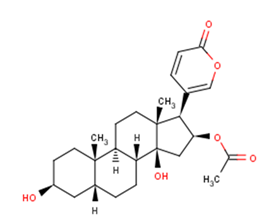
Bufotaline
CAS No. 471-95-4
Bufotaline( —— )
Catalog No. M18583 CAS No. 471-95-4
Bufotaline is a kind of poisonous secretions of toads.
Purity : >98% (HPLC)
 COA
Datasheet
HNMR
HPLC
MSDS
Handing Instructions
COA
Datasheet
HNMR
HPLC
MSDS
Handing Instructions
| Size | Price / USD | Stock | Quantity |
| 1 mL x 10 mM in DMSO | 84 | In Stock |


|
| 5MG | 84 | In Stock |
|
| 10MG | 140 | In Stock |
|
| 25MG | 236 | In Stock |
|
| 50MG | 342 | In Stock |
|
| 100MG | 505 | In Stock |
|
| 200MG | Get Quote | In Stock |
|
| 500MG | Get Quote | In Stock |
|
| 1G | Get Quote | In Stock |
|
Biological Information
-
Product NameBufotaline
-
NoteResearch use only, not for human use.
-
Brief DescriptionBufotaline is a kind of poisonous secretions of toads.
-
DescriptionBufotaline is a kind of poisonous secretions of toads.
-
In VitroBufotalin (0.1-2.5 μM; 12-96 hours) treatment dose- and time-dependently inhibits MG-63 osteoblastoma cell survival. Bufotalin (0.5-2.5 μM; 48 hours) treatment dose-dependently increases the percentage of Annexin V positive cells (apoptotic cells) and caspase-12 activity in MG-63 cells. Bufotalin-induced osteoblastoma cell apoptosis is associated with caspase-12 activation. Bufotalin (0.5-2.5 μM; 12 hours) treatment dose-dependently induces C/EBP homologous protein (CHOP) expression as well as PERK and IRE1 phosphorylation in MG-63 cells. Bufotalin induces endoplasmic reticulum (ER) stress activation in cells. Bufotalin treatment induces cell cycle arrest at G2/M phase through down-regulation of Aurora A, CDC25, CDK1, cyclin A and cyclin B1, as well as up-regulation of p53 and p21 in HepG2 cells. Bufotalin treatment also induces apoptosis which was accompanied by decrease in mitochondrial membrane potential, increases in intracellular calcium level and reactive oxygen species production, activations of caspase-9 and -3, cleavage of poly ADP-ribose polymerase (PARP) as well as changes in the expressions of bcl-2 and bax.Cell Viability Assay Cell Line:MG-63 osteoblastoma cells Concentration:0.1 μM, 0.5 μM, 1 μM, 2.5 μM Incubation Time:12 hours, 24 hours, 48 hours, 72 hours, 96 hours Result:Inhibited MG-63 osteoblastoma cell survival. Apoptosis Analysis Cell Line:MG-63 cells Concentration:0.5 μM, 1 μM, 2.5 μM Incubation Time:48 hours Result:Dose-dependently increased the percentage of Annexin V positive cells (apoptotic cells) and caspase-12 activity in MG-63 cells.Western Blot Analysis Cell Line:MG-63 cells Concentration:0.5 μM, 1 μM, 2.5 μM Incubation Time:12 hours Result:Dose-dependently induced CHOP expression as well as PERK and IRE1 phosphorylation in MG-63 cells.
-
In VivoBufotalin (0.5-1 mg/kg; intraperitoneal injection; twice daily; for 7 days) treatment shows a significantly reduced tumor growth in mice. Animal Model:SCID male mice (4-6 weeks old) injected with U2OS cells Dosage:0.5 mg/kg, 1 mg/kg Administration:Intraperitoneal injection; twice daily; for 7 days Result:Inhibited U2OS osteoblastoma cell growth in mice.
-
Synonyms——
-
PathwayOthers
-
TargetOther Targets
-
RecptorOthers
-
Research AreaCancer
-
Indication——
Chemical Information
-
CAS Number471-95-4
-
Formula Weight444.56
-
Molecular FormulaC26H36O6
-
Purity>98% (HPLC)
-
SolubilityDMSO : ≥ 4.6 mg/mL; 10.35 mM
-
SMILESCC(=O)OC1CC2(C3CCC4CC(CCC4(C3CCC2(C1C5=COC(=O)C=C5)C)C)O)O
-
Chemical Name——
Shipping & Storage Information
-
Storage(-20℃)
-
ShippingWith Ice Pack
-
Stability≥ 2 years
Reference
molnova catalog



related products
-
TLC2976-0103
ROCK1-IN-1 is an inhibitor of ROCK1 with a K i value of 540 nM. ROCK1-IN-1 can be used in the research of hypertension, glaucoma and erectile dysfunction .
-
[pSer2, pSer5, pSer7...
[pSer2, pSer5, pSer7]-CTD (TFA) is a substrate for CDK7(cyclin-dependent protein kinase), a phosphorylated polypeptide at ser2, ser5, and ser7 of RNA polymerase II carboxyl terminus (CTD).
-
Gingerglycolipid A
Gingerglycolipid A is a monoacyldigalactosyl glycerol.
