


 Cart
Cart
 sales@molnova.com


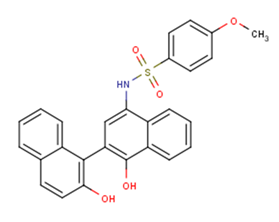
C188-9
CAS No. 432001-19-9
C188-9( C188-9 | C 188-9 | C-188-9 )
Catalog No. M18547 CAS No. 432001-19-9
C188-9 is a Stat3 inhibitor with an IC50 of 4-7 μM.
Purity : >98% (HPLC)
 COA
Datasheet
HNMR
HPLC
MSDS
Handing Instructions
COA
Datasheet
HNMR
HPLC
MSDS
Handing Instructions
| Size | Price / USD | Stock | Quantity |
| 1 mL x 10 mM in DMSO | 92 | In Stock |


|
| 2MG | 51 | In Stock |
|
| 5MG | 85 | In Stock |
|
| 10MG | 119 | In Stock |
|
| 25MG | 250 | In Stock |
|
| 50MG | 389 | In Stock |
|
| 100MG | 581 | In Stock |
|
| 200MG | Get Quote | In Stock |
|
| 500MG | 1237 | In Stock |
|
| 1G | Get Quote | In Stock |
|
Biological Information
-
Product NameC188-9
-
NoteResearch use only, not for human use.
-
Brief DescriptionC188-9 is a Stat3 inhibitor with an IC50 of 4-7 μM.
-
DescriptionC188-9 is a STAT3 inhibitor. HDM-induced airway inflammation, remodeling, and Th2/Th17-type cell accumulation involve STAT3 activation that can be prevented by C188-9 treatment. STAT3 inhibition with C188-9 resulted in attenuated skin fibrosis, myofibroblast accumulation, pro-fibrotic gene expression and collagen deposition in both mouse models of skin fibrosis. C188-9 decreased in vitro dermal fibroblast production of fibrotic genes induced by IL-6 trans-signalling and TGF-β. Finally, TGF-β induced phosphotyrosylation of STAT3 in a SMAD3-dependent manner.(In Vitro):C188-9 is a Stat3 inhibitor, with a Kd of 4.7 nM. The IC50s of C188-9 to inhibit Stat3 activation in AML cell lines are in the range of 4-7 μM, and in primary AML samples the IC50s are in the range of 8-18 μM. For apoptosis studies, AML cell lines and primary samples are treated for 24 hours with C188-9, then apoptotic cells are quantified by FACS analysis for annexin V-labeled cells. The EC50s for apoptosis induction are quite variable, ranging from 6 μM to over 50 μM.(In Vivo):Of the approximately 13,528 discernible genes, levels of 37 gene transcripts are altered by C188 (17 down and 20 up-regulated, fdr <0.01, fold change≥1.5), of which 7 are known STAT3 gene targets. In comparison, C188-9 affects a much greater number of genes involved in oncogenesis (384 total, 95 down- and 289 up-regulated), including 76 genes previously reported as regulated by STAT3 (38 down-regulated and 38 up-regulated). Among the 38 genes previously shown to be upregulated by STAT3, 24 (63%) genes are downregulated by C188-9 treatment, as expected. Additionally, 10 more genes downregulated by C188-9 (fdr <0.01, fold change≥1.5) that previously are shown to be upregulated by STAT1. Thus, 40 of 48 (83.3%) genes downregulated by C188-9 previously are shown to be positively regulated by STAT1, including sixteen genes shown to be co-regulated by STAT3 and STAT1. This analysis raises the possibility that the effect of C188-9 on gene transcript levels in HNSCC tumors is mediated by its effects on both STAT3 and STAT1.
-
In VitroC188-9 is a Stat3 inhibitor, with a Kd of 4.7 nM. The IC50s of C188-9 to inhibit Stat3 activation in AML cell lines are in the range of 4-7 μM, and in primary AML samples the IC50s are in the range of 8-18 μM. For apoptosis studies, AML cell lines and primary samples are treated for 24 hours with C188-9, then apoptotic cells are quantified by FACS analysis for annexin V-labeled cells. The EC50s for apoptosis induction are quite variable, ranging from 6 μM to over 50 μM.
-
In VivoOf the approximately 13,528 discernible genes, levels of 37 gene transcripts are altered by C188 (17 down and 20 up-regulated, fdr <0.01, fold change≥1.5), of which 7 are known STAT3 gene targets. In comparison, C188-9 affects a much greater number of genes involved in oncogenesis (384 total, 95 down- and 289 up-regulated), including 76 genes previously reported as regulated by STAT3 (38 down-regulated and 38 up-regulated). Among the 38 genes previously shown to be upregulated by STAT3, 24 (63%) genes are downregulated by C188-9 treatment, as expected. Additionally, 10 more genes downregulated by C188-9 (fdr <0.01, fold change≥1.5) that previously are shown to be upregulated by STAT1. Thus, 40 of 48 (83.3%) genes downregulated by C188-9 previously are shown to be positively regulated by STAT1, including sixteen genes shown to be co-regulated by STAT3 and STAT1. This analysis raises the possibility that the effect of C188-9 on gene transcript levels in HNSCC tumors is mediated by its effects on both STAT3 and STAT1.
-
SynonymsC188-9 | C 188-9 | C-188-9
-
PathwayOthers
-
TargetOther Targets
-
RecptorSTAT3
-
Research AreaCancer
-
Indication——
Chemical Information
-
CAS Number432001-19-9
-
Formula Weight471.52
-
Molecular FormulaC27H21NO5S
-
Purity>98% (HPLC)
-
SolubilityDMSO : ≥ 62 mg/mL; 131.49 mM
-
SMILESO=S(=O)(Nc4cc(c1c2ccccc2ccc1O)c(O)c3ccccc34)c5ccc(OC)cc5
-
Chemical NameN-(1',2-dihydroxy-[1,2'-binaphthalen]-4'-yl)-4-methoxybenzenesulfonamide
Shipping & Storage Information
-
Storage(-20℃)
-
ShippingWith Ice Pack
-
Stability≥ 2 years
Reference
1.Redell MS, et al. Blood. 2011 May 26;117(21):5701-9.
molnova catalog



related products
-
6-O-acetylsaikosapon...
6''-O-acetylsaikosaponin A is an acetyl saikosaponin isolated from the roots of Bupleurum chinense. Itshows some osteoclast-inhibiting activities.
-
Qinyangshengenin-3-O...
Qinyangshengenin-3-O-glycoside
-
GIP (3 - 42), human
GIP (3 - 42), human
