


 Cart
Cart
 sales@molnova.com


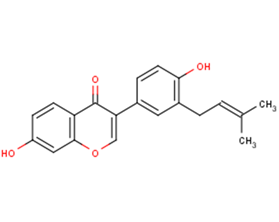
Neobavaisoflavone
CAS No. 41060-15-5
Neobavaisoflavone( Neobavaisoflavone )
Catalog No. M18530 CAS No. 41060-15-5
Neobavaisoflavone is isolated as a DNA polymerase inhibitor.
Purity : >98% (HPLC)
 COA
Datasheet
HNMR
HPLC
MSDS
Handing Instructions
COA
Datasheet
HNMR
HPLC
MSDS
Handing Instructions
| Size | Price / USD | Stock | Quantity |
| 1 mL x 10 mM in DMSO | 42 | In Stock |


|
| 5MG | 38 | In Stock |
|
| 10MG | 61 | In Stock |
|
| 25MG | 101 | In Stock |
|
| 50MG | 144 | In Stock |
|
| 100MG | 212 | In Stock |
|
| 200MG | Get Quote | In Stock |
|
| 500MG | 528 | In Stock |
|
| 1G | Get Quote | In Stock |
|
Biological Information
-
Product NameNeobavaisoflavone
-
NoteResearch use only, not for human use.
-
Brief DescriptionNeobavaisoflavone is isolated as a DNA polymerase inhibitor.
-
DescriptionNeobavaisoflavone is a natural isoflavone that was first isolated from seeds of P. corylifolia, which are used in traditional herbal medicine to treat various skin diseases. Neobavaisoflavone sensitizes apoptosis via the inhibition of metastasis in TRAIL-resistant human glioma U373MG cells.
-
In VitroNeobavaisoflavone (1-50 μM; 20 h) decreases NO (ED50=25 μM) and cytokine (ED50s=23.11, 5.03, 5.23, 5.26 and 18.80 μM for IL-1β, IL-6, IL-12p40, IL-12p70 and TNF-α, respectively) production in LPS plus IFN-γ-stimulated RAW264.7 macrophages.Neobavaisoflavone (1-100 μM; 30 min) decreases the chemiluminescence in PMA-stimulated RAW264.7 macrophages, with an ED50 of 19.94 μM in activated RAW264.7 cells.Neobavaisoflavone (1-100 μM); 20 h) has no effect on the viability and is not toxic to RAW264.7 cells.Neobavaisoflavone (20-50 μM; 48 h) inhibits prostate cancer cell proliferation by inducing cytotoxicity and apoptosis in a dose-dependent manner. Neobavaisoflavone (2-8 μM; 7 d) inhibitsRANKL‐mediated osteoclastogenesis in bone marrow monocytes (BMMCs) and RAW264.7 cells dose dependently at the early stage.
-
In VivoNeobavaisoflavone (30 mg/kg; i.p. for 6 weeks) inhibits osteoclastogenesis, promotes osteogenesis and ameliorates bone loss in ovariectomized mice. Animal Model:C57BL/6 female mice (8 weeksd; 20-25 g) were removed bilateral ovaries Dosage:30 mg/kg Administration:I.p. for 6 weeks Result:Attenuated bone loss by inhibiting osteoclast activation and promoting osteogenesis in ovariectomized mice.
-
SynonymsNeobavaisoflavone
-
PathwayOthers
-
TargetOther Targets
-
RecptorDNA polymerase
-
Research AreaOthers-Field
-
Indication——
Chemical Information
-
CAS Number41060-15-5
-
Formula Weight322.36
-
Molecular FormulaC20H18O4
-
Purity>98% (HPLC)
-
SolubilityDMSO : ≥ 31 mg/mL; 96.17 mM
-
SMILESCC(=CCC1=C(C=CC(=C1)C2=COC3=C(C2=O)C=CC(=C3)O)O)C
-
Chemical Name7-hydroxy-3-[4-hydroxy-3-(3-methyl-2-buten-1-yl)phenyl]-4H-1-benzopyran-4-one
Shipping & Storage Information
-
Storage(-20℃)
-
ShippingWith Ice Pack
-
Stability≥ 2 years
Reference
molnova catalog



related products
-
16,25-Diacetate cycl...
Reference standard.
-
Isoshinanolone
Isoshinanolone is a natural product that can be extracted from Plumbago capensis. Isoshinanolone has mosquito larvicidal activity against fourth instar larvae of A. aegypti, with an IC50 value of 1.26 μg/mL.
-
ACTH?(7-38) (human)
ACTH (7-38) (human) is the 7-38 fragment of human ACTH (1-39). human ACTH (1-39), known as a corticotropin inhibitory peptide (CIP), is an antagonist of the ACTH receptor and has no any corticosteroid activity.
