


 Cart
Cart
 sales@molnova.com


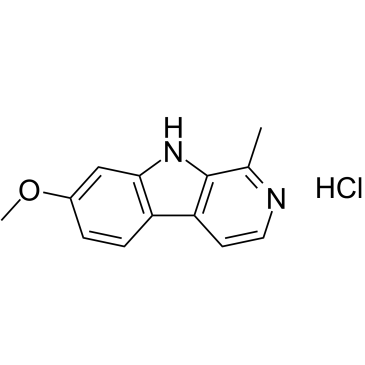
Harmine hydrochloride
CAS No. 343-27-1
Harmine hydrochloride( —— )
Catalog No. M18449 CAS No. 343-27-1
Harmine hydrochloride is extracted from Peganum Harmala Genus.
Purity : >98% (HPLC)
 COA
Datasheet
HNMR
HPLC
MSDS
Handing Instructions
COA
Datasheet
HNMR
HPLC
MSDS
Handing Instructions
| Size | Price / USD | Stock | Quantity |
| 50MG | 38 | In Stock |


|
| 100MG | 61 | In Stock |
|
| 200MG | Get Quote | In Stock |
|
| 500MG | Get Quote | In Stock |
|
| 1G | Get Quote | In Stock |
|
Biological Information
-
Product NameHarmine hydrochloride
-
NoteResearch use only, not for human use.
-
Brief DescriptionHarmine hydrochloride is extracted from Peganum Harmala Genus.
-
DescriptionHarmine hydrochloride is extracted from Peganum Harmala Genus.(In Vitro):Harmine inhibits tau phosphorylation by DYRK1A by selected DANDYs, with an IC50 of 190 nM. Harmine negatively regulates homologous recombination (HR) by interfering Rad51 recruitment, resulting in severe cytotoxicity in hepatoma cells. Furthermore, NHEJ inhibitor Nu7441 markedly sensitizes Hep3B cells to the anti-proliferative effects of Harmine.(In Vivo):It is shown that brain water content is significantly increased in the TBI group. Treatment with Harmine significantly reduces the tissue water content at 1, 3 and 5 days, compared with the TBI group. Harmine treatment significantly reduces the escape latency at 3 and 5 days, compared with the TBI group. Post-TBI administration of Harmine significantly improves the motor function recovery of the rats at 1, 3 and 5 days following TBI, compared with the TBI group without Harmine treatment. The neuronal survival rate in the Harmine-treated group is significantly increased, compared with the TBI group. Administration of Harmine results in marked elevation in the expression of GLT-1, compared with the TBI group. The administration of Harmine significantly reduces the expression of caspase 3, compared with the TBI group.
-
In VitroHarmine inhibits tau phosphorylation by DYRK1A by selected DANDYs, with an IC50 of 190 nM. Harmine negatively regulates homologous recombination (HR) by interfering Rad51 recruitment, resulting in severe cytotoxicity in hepatoma cells. Furthermore, NHEJ inhibitor Nu7441 markedly sensitizes Hep3B cells to the anti-proliferative effects of Harmine.
-
In VivoIt is shown that brain water content is significantly increased in the TBI group. Treatment with Harmine significantly reduces the tissue water content at 1, 3 and 5 days, compared with the TBI group. Harmine treatment significantly reduces the escape latency at 3 and 5 days, compared with the TBI group. Post-TBI administration of Harmine significantly improves the motor function recovery of the rats at 1, 3 and 5 days following TBI, compared with the TBI group without Harmine treatment. The neuronal survival rate in the Harmine-treated group is significantly increased, compared with the TBI group. Administration of Harmine results in marked elevation in the expression of GLT-1, compared with the TBI group. The administration of Harmine significantly reduces the expression of caspase 3, compared with the TBI group.
-
Synonyms——
-
PathwayOthers
-
TargetOther Targets
-
RecptorGluR1
-
Research AreaOthers-Field
-
Indication——
Chemical Information
-
CAS Number343-27-1
-
Formula Weight248.71
-
Molecular FormulaC13H13ClN2O
-
Purity>98% (HPLC)
-
SolubilityIn Vitro:?H2O : 10 mg/mL (40.21 mM助)
-
SMILESCOc1ccc2c(c1)[nH]c1c2ccnc1C.Cl
-
Chemical Name——
Shipping & Storage Information
-
Storage(-20℃)
-
ShippingWith Ice Pack
-
Stability≥ 2 years
Reference
1. Sun P, et al. Neurosci Lett. 2014 Nov 7;583:32-6.
molnova catalog



related products
-
Sulbactum Sodium
Sulbactum Sodium is synthesized from cytidine monophosphate (CMP) or uridine monophosphate (UMP) by the transfer of phosphoryl group, catalyzed by the enzyme uridylate kinase (UMPK).
-
Crilvastatin
Crilvastatin (PMD 387) is a novel, non-competitive hydroxymethylglutaryl coenzyme A reductase inhibitor with cholesterol-lowering activity, inhibiting cholesterol uptake in rats with hereditary hypercholesterolemia.
-
Astragaloside
Astragaloside may protect against brain contusion and neuronal apoptosis after TBI by attenuating microglia activation in male rats.
