


 Cart
Cart
 sales@molnova.com


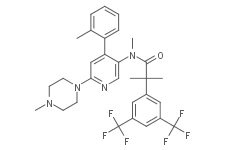
Netupitant
CAS No. 290297-26-6
Netupitant( AGE94200 | AGE 94200 | Ro 67-3189 | Netupitant )
Catalog No. M18372 CAS No. 290297-26-6
Netupitant is a specific neurokinin 1 (NK1) receptor antagonist (Ki: 0.95 nM).
Purity : >98% (HPLC)
 COA
Datasheet
HNMR
HPLC
MSDS
Handing Instructions
COA
Datasheet
HNMR
HPLC
MSDS
Handing Instructions
| Size | Price / USD | Stock | Quantity |
| 5MG | 45 | In Stock |


|
| 10MG | 65 | In Stock |
|
| 25MG | 116 | In Stock |
|
| 50MG | 195 | In Stock |
|
| 100MG | 352 | In Stock |
|
| 200MG | 519 | In Stock |
|
| 500MG | 824 | In Stock |
|
| 1G | Get Quote | In Stock |
|
Biological Information
-
Product NameNetupitant
-
NoteResearch use only, not for human use.
-
Brief DescriptionNetupitant is a specific neurokinin 1 (NK1) receptor antagonist (Ki: 0.95 nM).
-
DescriptionNetupitant is a selective neurokinin 1 (NK1) receptor antagonist with potential antiemetic activity. Netupitant competitively binds to and blocks the activity of the human substance P/NK1 receptors in the central nervous system (CNS), thereby inhibiting NK1-receptor binding of the endogenous tachykinin neuropeptide substance P (SP), which may result in the prevention of chemotherapy-induced nausea and vomiting (CINV).(In Vitro):Netupitant (CID-6451149) binds with high affinity the human NK1 receptor (pKi=9.0) with more than 1000 fold selectivity over the NK2 and NK3 (pKi=5.8 for both sites).Netupitant (1, 10, 100 nM) concentration-dependently antagonizes the stimulatory effects of substance P (SP) showing insurmountable antagonism (pKB=8.87) in CHO NK1 cells.(In Vivo):Netupitant (CID-6451149; 1-10 mg/kg; ip) dose-dependently inhibits SP-elicited the typical scratching, biting and licking response in mice. In gerbils, foot tapping behavior evoked by the intracerebroventricular injection of a NK1 agonist is dose-dependently counteracted by Netupitant given intraperitoneally (ID50 1.5mg/kg) or orally (ID50 0.5mg/kg).Netupitant (0.1-3 mg/kg; i.v.) produces a concentration-dependent inhibition (mean pKB=9.24) of the responses to SP-methylester (SP-OMe) in the detrusor muscle. Netupitant decreases the frequency of reflex bladder contractions.
-
In VitroNetupitant (CID-6451149) binds with high affinity the human NK1 receptor (pKi=9.0) with more than 1000 fold selectivity over the NK2 and NK3 (pKi=5.8 for both sites). Netupitant (1, 10, 100 nM) concentration-dependently antagonizes the stimulatory effects of substance P (SP) showing insurmountable antagonism (pKB=8.87) in CHO NK1 cells.
-
In VivoNetupitant (CID-6451149; 1-10 mg/kg; ip) dose-dependently inhibits SP-elicited the typical scratching, biting and licking response in mice. In gerbils, foot tapping behavior evoked by the intracerebroventricular injection of a NK1 agonist is dose-dependently counteracted by Netupitant given intraperitoneally (ID50 1.5mg/kg) or orally (ID50 0.5mg/kg). Netupitant (0.1-3 mg/kg; i.v.) produces a concentration-dependent inhibition (mean pKB=9.24) of the responses to SP-methylester (SP-OMe) in the detrusor muscle. Netupitant decreases the frequency of reflex bladder contractions.
-
SynonymsAGE94200 | AGE 94200 | Ro 67-3189 | Netupitant
-
PathwayOthers
-
TargetOther Targets
-
RecptorNK1
-
Research AreaNeurological Disease
-
Indication——
Chemical Information
-
CAS Number290297-26-6
-
Formula Weight578.59
-
Molecular FormulaC30H32F6N4O
-
Purity>98% (HPLC)
-
SolubilityDMSO : 23.2 mg/mL; 40.10 mM
-
SMILESCc1ccccc1c1cc(ncc1N(C)C(=O)C(C)(C)c1cc(cc(c1)C(F)(F)F)C(F)(F)F)N1CCN(CC1)C
-
Chemical Name2-(3,5-bis(trifluoromethyl)phenyl)-N,2-dimethyl-N-(6-(4-methylpiperazin-1-yl)-4-(o-tolyl)pyridin-3-yl)propanamide
Shipping & Storage Information
-
Storage(-20℃)
-
ShippingWith Ice Pack
-
Stability≥ 2 years
Reference
1.Rizzi A,etal.In vitro and in vivo pharmacological characterization of the novel NK? receptor selective antagonist Netupitant.Peptides. 2012 Sep;37(1):86-97.
molnova catalog



related products
-
5-Fluoro-5-deoxyaden...
5'-Fluoro-5'-deoxyadenosine (5'-Fluoro-5'-deoxy-adenosine) is utilized commonly as a tool for studying the Actinomycete bacterium Streptomyces cattleya.
-
Tlatlancuayin
The herbs of Iresine herbstii.
-
Hellebrigenin
Hellebrigenin has anti-hepatoma activities, it induces cell cycle arrest and apoptosis in human hepatocellular carcinoma HepG2 cells through inhibition of Akt.
