


 Cart
Cart
 sales@molnova.com


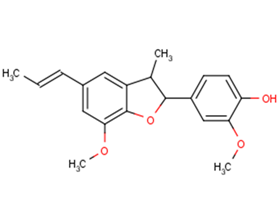
Dehydrodiisoeugenol
CAS No. 2680-81-1
Dehydrodiisoeugenol( —— )
Catalog No. M18337 CAS No. 2680-81-1
Dehydrodiisoeugenol inhibited the expression of the COX-2 in RAW264.7 murine macrophages stimulated with LPS.
Purity : >98% (HPLC)
 COA
Datasheet
HNMR
HPLC
MSDS
Handing Instructions
COA
Datasheet
HNMR
HPLC
MSDS
Handing Instructions
| Size | Price / USD | Stock | Quantity |
| 1 mL x 10 mM in DMSO | 67 | In Stock |


|
| 5MG | 61 | In Stock |
|
| 10MG | 107 | In Stock |
|
| 25MG | 185 | In Stock |
|
| 50MG | 293 | In Stock |
|
| 100MG | 442 | In Stock |
|
| 200MG | Get Quote | In Stock |
|
| 500MG | Get Quote | In Stock |
|
| 1G | Get Quote | In Stock |
|
Biological Information
-
Product NameDehydrodiisoeugenol
-
NoteResearch use only, not for human use.
-
Brief DescriptionDehydrodiisoeugenol inhibited the expression of the COX-2 in RAW264.7 murine macrophages stimulated with LPS.
-
DescriptionDehydrodiisoeugenol has anti-inflammatory activity. (1). Dehydrodiisoeugenol inhibited the expression of the COX-2 in RAW264.7 murine macrophages stimulated with LPS. (2). Dehydrodiisoeugenol inhibited LPS-stimulated phosphorylation-dependent proteolysis of inhibitor κB-α and transcriptional activity of NF-κB in the cells.
-
In Vitro——
-
In Vivo——
-
Synonyms——
-
PathwayOthers
-
TargetOther Targets
-
RecptorOthers
-
Research AreaOthers-Field
-
Indication——
Chemical Information
-
CAS Number2680-81-1
-
Formula Weight326.39
-
Molecular FormulaC20H22O4
-
Purity>98% (HPLC)
-
SolubilityIn Vitro:?DMSO : 100 mg/mL (306.38 mM)
-
SMILESCC=CC1=CC2=C(C(=C1)OC)OC(C2C)C3=CC(=C(C=C3)O)OC
-
Chemical Name——
Shipping & Storage Information
-
Storage(-20℃)
-
ShippingWith Ice Pack
-
Stability≥ 2 years
Reference
molnova catalog



related products
-
Pterosin C
Pterosin C is a natural product isolated and purified from the rhizome Pteridium aquilinum (L.) Kuhn.
-
Poricoic acid B
Poricoic acid B shows inhibitory activity against TPA-induced ear inflammatory oedema.
-
VLAL
VLAL
