


 Cart
Cart
 sales@molnova.com


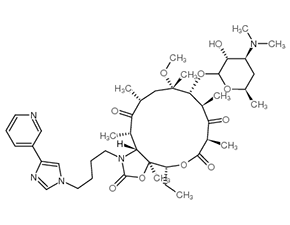
Telithromycin
CAS No. 191114-48-4
Telithromycin( Telithromycin | HMR-3647 | HMR 3647 )
Catalog No. M18169 CAS No. 191114-48-4
Telithromycin is a ketolide antibiotic to treat community acquired pneumonia of mild to moderate severity. Antibacterial Telithromycin prevents bacteria from growing, by interfering with their protein synthesis.
Purity : >98% (HPLC)
 COA
Datasheet
HNMR
HPLC
MSDS
Handing Instructions
COA
Datasheet
HNMR
HPLC
MSDS
Handing Instructions
| Size | Price / USD | Stock | Quantity |
| 5MG | 88 | In Stock |


|
| 10MG | 160 | In Stock |
|
| 25MG | 365 | In Stock |
|
| 50MG | 587 | In Stock |
|
| 100MG | Get Quote | In Stock |
|
| 200MG | Get Quote | In Stock |
|
| 500MG | Get Quote | In Stock |
|
| 1G | Get Quote | In Stock |
|
Biological Information
-
Product NameTelithromycin
-
NoteResearch use only, not for human use.
-
Brief DescriptionTelithromycin is a ketolide antibiotic to treat community acquired pneumonia of mild to moderate severity. Antibacterial Telithromycin prevents bacteria from growing, by interfering with their protein synthesis.
-
DescriptionTelithromycin is a ketolide antibiotic to treat community acquired pneumonia of mild to moderate severity. Antibacterial Telithromycin prevents bacteria from growing, by interfering with their protein synthesis. Telithromycin binds to the subunit 50S of the bacterial ribosome, and blocks the progression of the growing polypeptide chain. Telithromycin has over 10 times higher affinity to the subunit 50S than erythromycin. In addition, telithromycin strongly bind simultaneously to two domains of 23S RNA of the 50 S ribosomal subunit, where older macrolides bind strongly only to one domain and weakly to the second domain. Telithromycin can also inhibit the formation of ribosomal subunits 50S and 30S.(In Vitro):Telithromycin (HMR3647) (0-50 μg/mL, 30 min) suppress C. pneumoniae-induced MUC5AC production.Telithromycin (0-50 μg/mL, 30 min) suppress C. pneumoniae-induced NF-kB activation.Telithromycin (10 mg/mL, 1 h) inhibits the production of MIP-2 and TNF-α in a dose-dependent manner by LPS-stimulated RAW 264.7 macrophages.Telithromycin (10 mg/mL, 1 h) inhibits NF-kB activation, increases apoptosis in cell and decreases the LPS-induced influx of neutrophils in BAL fluid.(In Vivo):Telithromycin (HMR3647) (20 mg/kg, ip., single) reduces protein, nitrite, MIP-2, and TNF-α levels in the BAL fluid of LPS-nebulized animals.
-
In VitroTelithromycin (HMR3647) (0-50 μg/mL, 30 min) suppress C. pneumoniae-induced MUC5AC production.Telithromycin (0-50 μg/mL, 30 min) suppress C. pneumoniae-induced NF-kB activation.Telithromycin (10 mg/mL, 1 h) inhibits the production of MIP-2 and TNF-α in a dose-dependent manner by LPS-stimulated RAW 264.7 macrophages.Telithromycin (10 mg/mL, 1 h) inhibits NF-kB activation, increases apoptosis in cell and decreases the LPS-induced influx of neutrophils in BAL fluid:RT-PCR Cell Line:NCI-H292 cells Concentration: 0-50 μg/mL Incubation Time:30 min Result:Suppressed C. pneumoniae-induced MUC5AC production in dose-dependently and significantly decreased MUC5AC production at 50 mg/mL.Suppressed p65 and p50 activation in NCI-H292 cells.Apoptosis Analysis Cell Line:RAW 264.7 and MLE-12 cells Concentration:10 mg/mL Incubation Time:1 h Result:Increased the apoptotic activity in cells induced with supernatants from LPS-treated RAW 264.7 macrophages and in LPS-induced cells.
-
In VivoTelithromycin (HMR3647) (20 mg/kg, ip., single) reduces protein, nitrite, MIP-2, and TNF-α levels in the BAL fluid of LPS-nebulized animals. Animal Model:LPS-Nebulized MiceDosage:20 mg/kg Administration:20 mg/kg, ip., single Result:Increased the protein concentration, reduced the concentrations of nitrite and the levels of TNF-α and induced significant reductions the levels of MIP-2.
-
SynonymsTelithromycin | HMR-3647 | HMR 3647
-
PathwayEndocrinology/Hormones
-
Target5-HT Receptor
-
RecptorAntibacterial
-
Research AreaInfection
-
Indication——
Chemical Information
-
CAS Number191114-48-4
-
Formula Weight812
-
Molecular FormulaC43H65N5O10
-
Purity>98% (HPLC)
-
SolubilityDMSO : ≥ 100 mg/mL; 123.15 mM
-
SMILESCC[C@H]1OC(=O)[C@H](C)C(=O)[C@H](C)[C@@H](O[C@@H]2O[C@H](C)C[C@@H]([C@H]2O)N(C)C)[C@@](C)(C[C@@H](C)C(=O)[C@H](C)[C@H]2N(CCCCn3cnc(c3)-c3cccnc3)C(=O)O[C@]12C)OC
-
Chemical Name(3aS,4R,7R,9R,10R,11R,13R,15R,15aR)-10-(((2S,3R,4S,6R)-4-(dimethylamino)-3-hydroxy-6-methyltetrahydro-2H-pyran-2-yl)oxy)-4-ethyl-11-methoxy-3a,7,9,11,13,15-hexamethyl-1-(4-(4-(pyridin-3-yl)-1H-imidazol-1-yl)butyl)octahydro-2H-[1]oxacyclotetradecino[4,3-d]oxazole-2,6,8,14(1H,7H,9H)-tetraone
Shipping & Storage Information
-
Storage(-20℃)
-
ShippingWith Ice Pack
-
Stability≥ 2 years
Reference



-
Amikacin disulfate
Amikacin sulfate(BAY416651 sulfate) is a semi-synthetic aminoglycoside antibiotic derived from kanamycin A.
-
CART (62-76) (rat, h...
Cocaine- and amphetamine-regulated transcript (CART) peptide fragment that inhibits food intake. Attenuates NPY-induced feeding and decreases food intake in food-restricted goldfish, and induces anxiogenic-like effects in elevated plus-maze test in rats. Modulates the activity of striatal noradrenergic, and corticostrial and hypothalamic serotoninergic systems, with no major effect on dopaminergic pathways in rat brain.
-
L-Stepholidine
L-Stepholidine (Stepholidine) exhibits mixed dopamine D1 receptor agonist and D2 antagonist properties. L-Stepholidine has neuroprotective effect and inhibits Heroin-induced reinstatement. L-Stepholidine is a potential medication for the research of opiate addiction.
