


 Cart
Cart
 sales@molnova.com


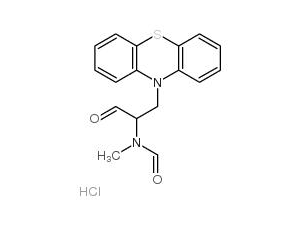
Dioxopromethazine hydrochloride
CAS No. 15374-15-9
Dioxopromethazine hydrochloride( —— )
Catalog No. M18073 CAS No. 15374-15-9
Dioxopromethazine is a target-based classification of drug and available in a number of countries worldwide.
Purity : >98% (HPLC)
 COA
Datasheet
HNMR
HPLC
MSDS
Handing Instructions
COA
Datasheet
HNMR
HPLC
MSDS
Handing Instructions
| Size | Price / USD | Stock | Quantity |
| 1 mL x 10 mM in DMSO | 28 | In Stock |


|
| 25MG | 29 | In Stock |
|
| 50MG | 41 | In Stock |
|
| 100MG | 75 | In Stock |
|
| 200MG | Get Quote | In Stock |
|
| 500MG | 228 | In Stock |
|
| 1G | Get Quote | In Stock |
|
Biological Information
-
Product NameDioxopromethazine hydrochloride
-
NoteResearch use only, not for human use.
-
Brief DescriptionDioxopromethazine is a target-based classification of drug and available in a number of countries worldwide.
-
DescriptionDioxopromethazine is a target-based classification of drug and available in a number of countries worldwide.
-
In Vitro——
-
In Vivo——
-
Synonyms——
-
PathwayOthers
-
TargetOther Targets
-
RecptorH1 receptor
-
Research Area——
-
Indication——
Chemical Information
-
CAS Number15374-15-9
-
Formula Weight348.85
-
Molecular FormulaC17H20N2O2S·HCl
-
Purity>98% (HPLC)
-
Solubility——
-
SMILESCC(CN1c2ccccc2S(=O)(=O)c2ccccc12)N(C)C.Cl
-
Chemical Name——
Shipping & Storage Information
-
Storage(-20℃)
-
ShippingWith Ice Pack
-
Stability≥ 2 years
Reference
1. He LL, et al. J Fluoresc. 2011 Sep;21(5):1847-56.
molnova catalog



related products
-
Ciproxifan
Ciproxifan is a highly effective and specific histamin H3-receptor antagonist (IC50: 9.2 nM).
-
PDGF β-Receptor (739...
PDGF β-Receptor (739-746) (phosphorylated)
-
Neuropeptide Y (29-6...
Neuropeptide Y (29-64), amide, human (TFA) is involved in Alzheimer's disease (AD) and protects rat cortical neurons against β-Amyloid toxicity.It is showed that Neuropeptide Y (29-64), amide, human (TFA) is able to protect cortical neurons from Aβ25-35 toxicity.
