


 Cart
Cart
 sales@molnova.com


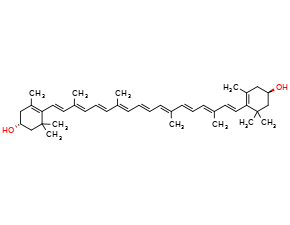
Zeaxanthin
CAS No. 144-68-3
Zeaxanthin( beta-Carotene-3,3'-diol | Zeaxanthin | Anchovyxanthin )
Catalog No. M18024 CAS No. 144-68-3
Lutein and Zeaxanthin in neural tissue may have biological effects that include antioxidation, anti-inflammation, and structural actions.
Purity : >98% (HPLC)
 COA
Datasheet
HNMR
HPLC
MSDS
Handing Instructions
COA
Datasheet
HNMR
HPLC
MSDS
Handing Instructions
| Size | Price / USD | Stock | Quantity |
| 5MG | 155 | In Stock |


|
| 10MG | 250 | In Stock |
|
| 25MG | 432 | In Stock |
|
| 50MG | 635 | In Stock |
|
| 100MG | 863 | In Stock |
|
| 200MG | Get Quote | In Stock |
|
| 500MG | Get Quote | In Stock |
|
| 1G | Get Quote | In Stock |
|
Biological Information
-
Product NameZeaxanthin
-
NoteResearch use only, not for human use.
-
Brief DescriptionLutein and Zeaxanthin in neural tissue may have biological effects that include antioxidation, anti-inflammation, and structural actions.
-
DescriptionZeaxanthin is one of the most common carotenoid alcohols found in nature. It is important in the xanthophyll cycle. Synthesized in plants and some micro-organisms, it is the pigment that gives paprika (made from bell peppers), corn, saffron, wolfberries, and many other plants and microbes their characteristic color.
-
In Vitro——
-
In Vivo——
-
Synonymsbeta-Carotene-3,3'-diol | Zeaxanthin | Anchovyxanthin
-
PathwayEndocrinology/Hormones
-
TargetAChR
-
RecptorAntioxidant
-
Research AreaOthers-Field
-
Indication——
Chemical Information
-
CAS Number144-68-3
-
Formula Weight568.88
-
Molecular FormulaC40H56O2
-
Purity>98% (HPLC)
-
SolubilityIn Vitro:?THF : ≥ 10 mg/mL (17.58 mM)DM)
-
SMILESCC1=C(C(CC(C1)O)(C)C)C=CC(=CC=CC(=CC=CC=C(C)C=CC=C(C)C=CC2=C(CC(CC2(C)C)O)C)C)C
-
Chemical Name4-[18-(4-hydroxy-2,6,6-trimethyl-1-cyclohexenyl)-3,7,12,16-tetramethyl-octadeca-1,3,5,7,9,11,13,15,17-nonaenyl]-3,5,5-trimethyl-cyclohex-3-en-1-ol
Shipping & Storage Information
-
Storage(-20℃)
-
ShippingWith Ice Pack
-
Stability≥ 2 years
Reference
molnova catalog



related products
-
Aclidinium bromide
Aclidinium Bromide inhibits human muscarinic AChR M1, M2, M3, M4 and M5 with Ki of 0.1 nM, 0.14 nM, 0.14 nM, 0.21 nM and 0.16 nM, respectively.
-
Sinapine thiocyanate
Sinapine Thiocyanate, is a derivative of Sinapine (S486605), an alkaloidal amine found in black mustard seeds. It is the choline ester of Sinapic Acid (S486800).
-
Oxybutynin
Oxybutynin is an anticholinergic medication used to relieve urinary and bladder difficulties.
