


 Cart
Cart
 sales@molnova.com


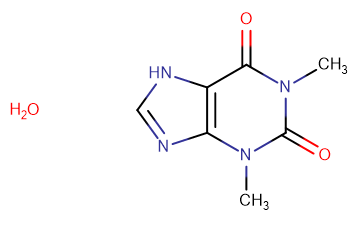
Theophylline monohydrate
CAS No. 5967-84-0
Theophylline monohydrate( —— )
Catalog No. M15215 CAS No. 5967-84-0
A methylxanthine derivative from tea with diuretic, smooth muscle relaxant, bronchial dilation, cardiac and central nervous system stimulant activities.
Purity : >98% (HPLC)
 COA
Datasheet
HNMR
HPLC
MSDS
Handing Instructions
COA
Datasheet
HNMR
HPLC
MSDS
Handing Instructions
| Size | Price / USD | Stock | Quantity |
| 1 mL x 10 mM in DMSO | 43 | In Stock |


|
| 25MG | 36 | In Stock |
|
| 50MG | 47 | In Stock |
|
| 100MG | 60 | In Stock |
|
| 200MG | 110 | In Stock |
|
| 500MG | 151 | In Stock |
|
| 1G | Get Quote | In Stock |
|
Biological Information
-
Product NameTheophylline monohydrate
-
NoteResearch use only, not for human use.
-
Brief DescriptionA methylxanthine derivative from tea with diuretic, smooth muscle relaxant, bronchial dilation, cardiac and central nervous system stimulant activities.
-
DescriptionA methylxanthine derivative from tea with diuretic, smooth muscle relaxant, bronchial dilation, cardiac and central nervous system stimulant activities. Mechanistically, theophylline acts as a phosphodiesterase inhibitor, adenosine receptor blocker, and histone deacetylase activator. Theophylline is marketed under several brand names such as Uniphyl and Theochron, and it is indicated mainly for asthma, bronchospasm, and COPD.(In Vitro):Theophylline (1,3-Dimethylxanthine) (1-1000 μM) inhibits cAMP hydrolysis by PDE in homogenates of bronchial tissue to relax human bronchus and pulmonary arteries.Theophylline (1,3-Dimethylxanthine) (10 μg/mL; 24 h; eosinophils) induces apoptosis through a reduction in the antiapoptotic protein Bcl-2.Theophylline (1,3-Dimethylxanthine) (0-500 μM; 2 h; A549 cells) inhibits NF-κB activation, I kappa B alpha (I-κBα) degradation and decreases the level of IL-6 in a concentration-dependent manner.Theophylline (1,3-Dimethylxanthine) (0-1000 μM; 30 min; A549 cells) induces histone deacetylase activity to decrease inflammatory gene expression.(In Vivo):Theophylline (1,3-Dimethylxanthine) (100 mg/kg; i.p.; daily, for 9 d; male Swiss mice) has anti-inflammatory activity in mice and increases IL-6 and IL-10 levels and inhibits TNF-α and NO.
-
In VitroTheophylline (1,3-Dimethylxanthine) monohydrate (1-1000 μM) inhibits cAMP hydrolysis by PDE in homogenates of bronchial tissue to relax human bronchus and pulmonary arteries.Theophylline (1,3-Dimethylxanthine) monohydrate (10 μg/mL; 24 h; eosinophils) induces apoptosis through a reduction in the antiapoptotic protein Bcl-2.Theophylline (1,3-Dimethylxanthine) monohydrate (0-500 μM; 2 h; A549 cells) inhibits NF-κB activation, I kappa B alpha (I-κBα) degradation and decreases the level of IL-6 in a concentration-dependent manner.Theophylline (1,3-Dimethylxanthine) monohydrate (0-1000 μM; 30 min; A549 cells) induces histone deacetylase activity to decrease inflammatory gene expression. Western Blot Analysis Cell Line:A549 cells Concentration:0, 20, 100 and 500 μM Incubation Time:2 hours Result:Decreased the expression of NF-κB p65 and I-κBα degradation in a concentration-dependent manner.Western Blot Analysis Cell Line:Eosinophils Concentration:10 μg/mL Incubation Time:24 hours Result:Decreased the expression of Bcl-2.
-
In VivoTheophylline (1,3-Dimethylxanthine) (100 mg/kg; i.p.; daily, for 9 d; male Swiss mice) has anti-inflammatory activity in mice and increases IL-6 and IL-10 levels and inhibits TNF-α and NO. Animal Model:Male Swiss mice Dosage:100 mg/kg Administration:Intraperitoneal injection; daily, for 9 daysResult:Increased IL-6 and IL-10 levels and inhibited TNF-α and NO.
-
Synonyms——
-
PathwayEndocrinology/Hormones
-
TargetAChR
-
RecptorAdenosine receptor| HDAC2| PDE
-
Research Area——
-
Indication——
Chemical Information
-
CAS Number5967-84-0
-
Formula Weight198.18
-
Molecular FormulaC7H8N4O2·H2O
-
Purity>98% (HPLC)
-
SolubilitySoluble in Water
-
SMILESO.CN1C2=C(NC=N2)C(=O)N(C)C1=O
-
Chemical Name——
Shipping & Storage Information
-
Storage(-20℃)
-
ShippingWith Ice Pack
-
Stability≥ 2 years
Reference
1.Nantwi KD, et al. J Spinal Cord Med. 2003 Winter;26(4):364-7
molnova catalog



related products
-
BNC210
BNC210?is a α7 nAChR negative allosteric modulator.?BNC210 has potent activity in animal models of anxiety and depression.?
-
Gallamine triethiodi...
Gallamine Triethiodide is a synthetic nondepolarizing blocking drug.
-
Decamethonium bromid...
Decamethonium Bromide is a nicotinic AChR partial agonist and neuromuscular blocking agent.
