


 Cart
Cart
 sales@molnova.com


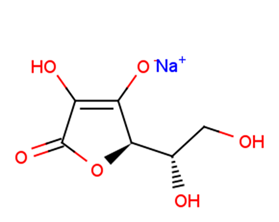
Sodium ascorbate
CAS No. 134-03-2
Sodium ascorbate( Ascorbate | Sodium Ascorbate | Vitamin C sodium )
Catalog No. M17962 CAS No. 134-03-2
Sodium Ascorbate is a more bioavailable form of vitamin C that is an alternative to taking ascorbic acid as a supplement.
Purity : >98% (HPLC)
 COA
Datasheet
HNMR
HPLC
MSDS
Handing Instructions
COA
Datasheet
HNMR
HPLC
MSDS
Handing Instructions
| Size | Price / USD | Stock | Quantity |
| 1 mL x 10 mM in DMSO | 37 | In Stock |


|
| 100MG | Get Quote | In Stock |
|
| 200MG | 28 | In Stock |
|
| 500MG | 37 | In Stock |
|
| 1G | 45 | In Stock |
|
Biological Information
-
Product NameSodium ascorbate
-
NoteResearch use only, not for human use.
-
Brief DescriptionSodium Ascorbate is a more bioavailable form of vitamin C that is an alternative to taking ascorbic acid as a supplement.
-
DescriptionAscorbate, also known as Ascorbicin, is a DNase I inhibitor. Ascorbate is an antioxidant which functions as a reducing agent and coenzyme in several metabolic pathways.(In Vitro):The conditioned medium for B16F10 cells significantly inhibits cell apoptosis induced by L-Ascorbic acid sodium salt (Sodium L-ascorbate) (10 mM), and the effective ingredients in the medium show a relative molecular mass below 5,000.(In Vivo):Tg rats treated with L-Ascorbic acid sodium salt (Sodium L-ascorbate) show a higher incidence of carcinoma (29.6%), compared to those without L-Ascorbic acid sodium salt (15.4%). Independent of the L-Ascorbic acid sodium salt treatment, transgenic rats exhibit various kinds of malignant tumors in various organs.After 12 weeks of PEITC-treatment, both simple hyperplasia and papillary or nodular (PN) hyperplasia have developed in all animals, but the majority of these lesions have disappeared at week 48, irrespective of the L-Ascorbic acid sodium salt-treatment. The same lesions after 24 weeks of PEITC-treatment have progressed to dysplasia and carcinoma, in a small number of cases by week 48, but enhancement by the L-Ascorbic acid sodium salt-treatment is evident only with simple hyperplasias and PN hyperplasias in rats.
-
In VitroThe conditioned?medium?for?B16F10?cells significantly inhibits?cell?apoptosis?induced by?L-Ascorbic acid sodium salt (Sodium?L-ascorbate) (10 mM), and the effective ingredients in the?medium?show a relative molecular mass below 5,000.
-
In VivoTg rats treated with L-Ascorbic acid sodium salt (Sodium?L-ascorbate) show a higher incidence of carcinoma (29.6%), compared to those without L-Ascorbic acid sodium salt (15.4%). Independent of the L-Ascorbic acid sodium salt treatment, transgenic rats exhibit various kinds of malignant tumors in various organs. After 12 weeks of PEITC-treatment, both simple hyperplasia and papillary or nodular (PN) hyperplasia have developed in all animals, but the majority of these lesions have disappeared at week 48, irrespective of the L-Ascorbic acid sodium salt-treatment. The same lesions after 24 weeks of PEITC-treatment have progressed to dysplasia and carcinoma, in a small number of cases by week 48, but enhancement by the L-Ascorbic acid sodium salt-treatment is evident only with simple hyperplasias and PN hyperplasias in rats.
-
SynonymsAscorbate | Sodium Ascorbate | Vitamin C sodium
-
PathwayEndocrinology/Hormones
-
Target5-HT Receptor
-
RecptorOthers
-
Research AreaCancer
-
Indication——
Chemical Information
-
CAS Number134-03-2
-
Formula Weight201.13
-
Molecular FormulaC6H8O6·Na
-
Purity>98% (HPLC)
-
SolubilityH2O : ≥ 41 mg/mL; 206.96 mM
-
SMILES[Na].[H][C@@]1(OC(=O)C(O)C1O)[C@@H](O)CO
-
Chemical NameSodium (2R)-2-[(1S)-1,2-dihydroxyethyl]-4-hydroxy-5-oxo-2H-furan-3-olate
Shipping & Storage Information
-
Storage(-20℃)
-
ShippingWith Ice Pack
-
Stability≥ 2 years
Reference
1. Noto V, et al. Cancer, 1989, 63(5), 901-906.
molnova catalog



related products
-
Eucalyptol
Eucalyptol inhibits 5-HT-evoked currents in oocytes expressing 5-HT3 receptors with an IC50 of 258 μM.
-
4i
4i is a 5-HT3 receptor antagonist,It modulates the serotonergic system.
-
Tropisetron hydrochl...
Tropisetron is a selective 5-HT3 receptor antagonist and α7-nicotinic receptor agonist.
