


 Cart
Cart
 sales@molnova.com


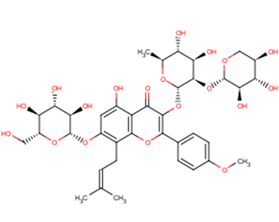
Epimedin B
CAS No. 110623-73-9
Epimedin B( —— )
Catalog No. M17818 CAS No. 110623-73-9
Epimedin B has potential activity against osteoporosis by stimulating osteoblasts.
Purity : >98% (HPLC)
 COA
Datasheet
HNMR
HPLC
MSDS
Handing Instructions
COA
Datasheet
HNMR
HPLC
MSDS
Handing Instructions
| Size | Price / USD | Stock | Quantity |
| 1 mL x 10 mM in DMSO | 80 | In Stock |


|
| 2MG | 34 | In Stock |
|
| 5MG | 54 | In Stock |
|
| 10MG | 86 | In Stock |
|
| 25MG | 140 | In Stock |
|
| 50MG | 200 | In Stock |
|
| 100MG | 296 | In Stock |
|
| 200MG | 436 | In Stock |
|
| 500MG | Get Quote | In Stock |
|
| 1G | Get Quote | In Stock |
|
Biological Information
-
Product NameEpimedin B
-
NoteResearch use only, not for human use.
-
Brief DescriptionEpimedin B has potential activity against osteoporosis by stimulating osteoblasts.
-
DescriptionEpimedin B has potential activity against osteoporosis by stimulating osteoblasts.
-
In Vitro——
-
In Vivo——
-
Synonyms——
-
PathwayAngiogenesis
-
TargetEGFR
-
RecptorOthers
-
Research AreaOthers-Field
-
Indication——
Chemical Information
-
CAS Number110623-73-9
-
Formula Weight808.78
-
Molecular FormulaC38H48O19
-
Purity>98% (HPLC)
-
SolubilityDMSO : 33.33 mg/mL. 41.21 mM;
-
SMILESCC1C(C(C(C(O1)OC2=C(OC3=C(C2=O)C(=CC(=C3CC=C(C)C)OC4C(C(C(C(O4)CO)O)O)O)O)C5=CC=C(C=C5)OC)OC6C(C(C(CO6)O)O)O)O)O
-
Chemical Name——
Shipping & Storage Information
-
Storage(-20℃)
-
ShippingWith Ice Pack
-
Stability≥ 2 years
Reference
molnova catalog



related products
-
Erlotinib hydrochlor...
Erlotinib (CP-358774;OSI-774;NSC 718781) is a potent, selective inhibitor of EGFR with IC50 of 2 nM.
-
BMS-599626
A potent, selective inhibitor of EGFR and HER2 with IC50 of 20 nM and 30 nM.
-
Nimotuzumab
Nimotuzumab is a humanized therapeutic monoclonal antibody against epidermal growth factor receptor EGFR).
