


 Cart
Cart
 sales@molnova.com


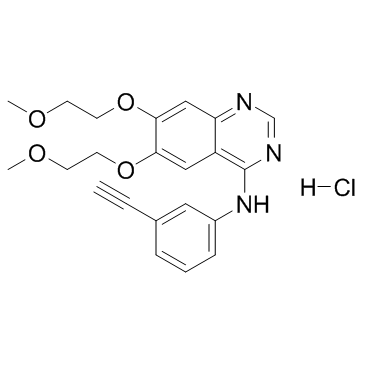
Erlotinib hydrochloride
CAS No. 183319-69-9
Erlotinib hydrochloride( CP-358774 | OSI-774 | NSC 718781 )
Catalog No. M12828 CAS No. 183319-69-9
Erlotinib (CP-358774;OSI-774;NSC 718781) is a potent, selective inhibitor of EGFR with IC50 of 2 nM.
Purity : >98% (HPLC)
 COA
Datasheet
HNMR
HPLC
MSDS
Handing Instructions
COA
Datasheet
HNMR
HPLC
MSDS
Handing Instructions
| Size | Price / USD | Stock | Quantity |
| 1 mL x 10 mM in DMSO | 56 | In Stock |


|
| 50MG | 33 | In Stock |
|
| 100MG | 45 | In Stock |
|
| 200MG | Get Quote | In Stock |
|
| 500MG | 71 | In Stock |
|
| 1G | 110 | In Stock |
|
Biological Information
-
Product NameErlotinib hydrochloride
-
NoteResearch use only, not for human use.
-
Brief DescriptionErlotinib (CP-358774;OSI-774;NSC 718781) is a potent, selective inhibitor of EGFR with IC50 of 2 nM.
-
DescriptionErlotinib (CP-358774;OSI-774;NSC 718781) is a potent, selective inhibitor of EGFR with IC50 of 2 nM; reduces EGFR autophosphorylation in intact tumor cells with an IC50 of 20 nM; inhibits the proliferation of DiFi human colon tumor cells at submicromolar concentrations in cell culture and blocks cell cycle progression at the G1 phase; 100mg/kg completely prevents EGF-induced autophosphorylation of EGFR in human HN5 tumors growing as xenografts in athymic mice and of the hepatic EGFR of the treated mice; orally active.Lung Cancer Approved(In Vitro):Erlotinib Hydrochloride (CP-358774 Hydrochloride) is also a potent inhibitor of the recombinant intracellular (kinase) domain of the EGFR, with an IC50 of 1 nM. The proliferation of DiFi cells is strongly inhibited by Erlotinib with an IC50 of 100 nM for an 8-day proliferation assay. The combination of B-DIM and Erlotinib (2 μM) results in a significant inhibition of colony formation in BxPC-3 cells when compared with either agent alone. The combination of B-DIM and Erlotinib (2 μM) results in a significant induction of apoptosis only in BxPC-3 cells when compare with the apoptotic effect of either agent alone. (In Vivo):There is a 1.49-fold statistically significant difference between AUC0-inf after p.o. administration of Erlotinib (5 mg/kg) comparing Bcrp1/Mdr1a/1b-/- and WT mice (7,419±1,720 versus 4,957±1,735 ng*h/mL respectively, P=0.01). The administration of Erlotinib (10 mg/kg/day, or 20 mg/kg/day) to Bleomycin (BLM)-treated rats shows no exacerbation of lung injuries in indices such as macroscopic findings, lung weights, histopathological scores (lung lesion density and lung fibrosis score), and pulmonary hydroxyproline (HyP) level. The result suggests that Erlotinib does not have any exacerbating effects on lung injuries induced by BLM in rats.
-
In VitroErlotinib Hydrochloride (CP-358774 Hydrochloride) is also a potent inhibitor of the recombinant intracellular (kinase) domain of the EGFR, with an IC50 of 1 nM. The proliferation of DiFi cells is strongly inhibited by Erlotinib with an IC50 of 100 nM for an 8-day proliferation assay. The combination of B-DIM and Erlotinib (2 μM) results in a significant inhibition of colony formation in BxPC-3 cells when compared with either agent alone. The combination of B-DIM and Erlotinib (2 μM) results in a significant induction of apoptosis only in BxPC-3 cells when compare with the apoptotic effect of either agent alone.
-
In VivoThere is a 1.49-fold statistically significant difference between AUC0-inf after p.o. administration of Erlotinib (5 mg/kg) comparing Bcrp1/Mdr1a/1b-/- and WT mice (7,419±1,720 versus 4,957±1,735 ng*h/mL respectively, P=0.01). The administration of Erlotinib (10 mg/kg/day, or 20 mg/kg/day) to Bleomycin (BLM)-treated rats shows no exacerbation of lung injuries in indices such as macroscopic findings, lung weights, histopathological scores (lung lesion density and lung fibrosis score), and pulmonary hydroxyproline (HyP) level. The result suggests that Erlotinib does not have any exacerbating effects on lung injuries induced by BLM in rats.
-
SynonymsCP-358774 | OSI-774 | NSC 718781
-
PathwayAngiogenesis
-
TargetEGFR
-
RecptorEGFR/HER1
-
Research AreaCancer
-
IndicationLung Cancer
Chemical Information
-
CAS Number183319-69-9
-
Formula Weight429.8967
-
Molecular FormulaC22H24ClN3O4
-
Purity>98% (HPLC)
-
SolubilityDMSO: ≥ 4.3 mg/mL; DMSO: 6.2 mg/mL (Need ultrasonic and warming)
-
SMILESCl.COCCOC1=C(OCCOC)C=C2C(NC3=CC=CC(=C3)C#C)=NC=NC2=C1
-
Chemical Name4-Quinazolinamine, N-(3-ethynylphenyl)-6,7-bis(2-methoxyethoxy)-, hydrochloride (1:1)
Shipping & Storage Information
-
Storage(-20℃)
-
ShippingWith Ice Pack
-
Stability≥ 2 years
Reference
1. Ng SS, et al. Mol Cancer Ther. 2002 Aug;1(10):777-83.
2. Moyer JD, et al. Cancer Res. 1997 Nov 1;57(21):4838-48.
3. Pollack VA, et al. J Pharmacol Exp Ther. 1999 Nov;291(2):739-48.
molnova catalog



related products
-
HS-10296
Hs-10296 is an inhibitor of EGFR activation mutation and tolerant mutation of EGFR T790M which has only limited activity against wild-type EGFR.
-
Afatinib
Afatinib is an orally bioavailable anilino-quinazoline derivative and inhibitor of the receptor tyrosine kinase (RTK) epidermal growth factor receptor (ErbB; EGFR) family, with antineoplastic activity.
-
EGFR-IN-1 hydrochlor...
EGFR-IN-1 hydrochloride is an irreversible and specific inhibitor of L858R/T790M mutant EGFR, with 100-fold selectivity over wild-type EGFR.
