


 Cart
Cart
 sales@molnova.com


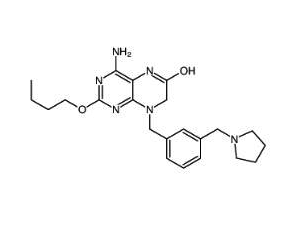
Vesatolimod
CAS No. 1228585-88-3
Vesatolimod( GS-9620 | GS 9620 | GS9620 | Vesatolimod )
Catalog No. M17205 CAS No. 1228585-88-3
GS-9620 is an effective and specific orally active agonist of Toll-like receptor 7.
Purity : >98% (HPLC)
 COA
Datasheet
HNMR
HPLC
MSDS
Handing Instructions
COA
Datasheet
HNMR
HPLC
MSDS
Handing Instructions
| Size | Price / USD | Stock | Quantity |
| 1 mL x 10 mM in DMSO | 48 | In Stock |


|
| 5MG | 43 | In Stock |
|
| 10MG | 82 | In Stock |
|
| 25MG | 164 | In Stock |
|
| 50MG | 229 | In Stock |
|
| 100MG | 369 | In Stock |
|
| 200MG | Get Quote | In Stock |
|
| 500MG | Get Quote | In Stock |
|
| 1G | Get Quote | In Stock |
|
Biological Information
-
Product NameVesatolimod
-
NoteResearch use only, not for human use.
-
Brief DescriptionGS-9620 is an effective and specific orally active agonist of Toll-like receptor 7.
-
DescriptionVesatolimod, also known as GS-9620, is a potent and oral agonist of Toll-like receptor-7 developed for finite treatment of chronic hepatitis B viral (HBV) infection, with the goal of inducing a liver-targeted antiviral effect without inducing the adverse effects associated with current systemic interferon-α (IFN-α) therapies. GS-9620 demonstrate interferon-stimulated gene induction without detectable serum interferon at low oral doses. GS-9620 can induce a sustained antiviral response in the woodchuck model of CHB.(In Vitro):Vesatolimod (GS-9620) rapidly internalizes into cells and preferentially localizes to and signals from endo-lysosomal compartments. To test this hypothesis, the kinetics of cellular uptake of the compound in Daudi cells using tritiated Vesatolimod (3H-GS-9620) is measured. The kinetics of 3H-GS-9620 accumulation is rapid, reaching concentration-dependent steady-state equilibrium in approximately thirty minutes. Measured intracellular concentration of 3H-Vesatolimod is 5-fold higher than the extracellular concentration of 3H-GS-9620 used to treat cells. Increases in intracellular 3H-Vesatolimod concentrations are roughly proportional with increasing concentrations of 3H-GS-9620.(In Vivo):Single oral doses of Vesatolimod (GS-9620) at 0.3 and 1 mg/kg in uninfected chimpanzees demonstrates a dose- and exposure-related induction of serum IFN-α, select cytokines/chemokines, and IFN-stimulated genes (ISG) in the peripheral blood and liver. Following oral administration at 0.3 (n=3), and 1 mg/kg (n=3 and n=4), Vesatolimod (GS-9620) Cmax is 3.6±3.5, 36.8±34.5, and 55.4±81.0 nM, respectively. Peak serum IFN responses occur at 8 h post-dose. The mean peak levels of induced serum IFN-α are 66 and 479 pg/mL at doses of 0.3 and 1 mg/kg, respectively. Vesatolimod (GS-9620) treatment induces ISG transcripts including ISG15, OAS-1, MX1, IP-10 (CXCL10), and I-TAC (CXCL11) in peripheral blood mononuclear cells (PBMC) at 0.3 mg/kg and in both PBMC and the liver at 1 mg/kg.
-
In VitroVesatolimod (GS-9620) rapidly internalizes into cells and preferentially localizes to and signals from endo-lysosomal compartments. To test this hypothesis, the kinetics of cellular uptake of the compound in Daudi cells using tritiated Vesatolimod (3H-GS-9620) is measured. The kinetics of 3H-GS-9620 accumulation is rapid, reaching concentration-dependent steady-state equilibrium in approximately thirty minutes. Measured intracellular concentration of 3H-Vesatolimod is 5-fold higher than the extracellular concentration of 3H-GS-9620 used to treat cells. Increases in intracellular 3H-Vesatolimod concentrations are roughly proportional with increasing concentrations of 3H-GS-9620.
-
In VivoSingle oral doses of Vesatolimod (GS-9620) at 0.3 and 1 mg/kg in uninfected chimpanzees demonstrates a dose- and exposure-related induction of serum IFN-α, select cytokines/chemokines, and IFN-stimulated genes (ISG) in the peripheral blood and liver. Following oral administration at 0.3 (n=3), and 1 mg/kg (n=3 and n=4), Vesatolimod (GS-9620) Cmax is 3.6±3.5, 36.8±34.5, and 55.4±81.0 nM, respectively. Peak serum IFN responses occur at 8 h post-dose. The mean peak levels of induced serum IFN-α are 66 and 479 pg/mL at doses of 0.3 and 1 mg/kg, respectively. Vesatolimod (GS-9620) treatment induces ISG transcripts including ISG15, OAS-1, MX1, IP-10 (CXCL10), and I-TAC (CXCL11) in peripheral blood mononuclear cells (PBMC) at 0.3 mg/kg and in both PBMC and the liver at 1 mg/kg.
-
SynonymsGS-9620 | GS 9620 | GS9620 | Vesatolimod
-
PathwayOthers
-
TargetOther Targets
-
RecptorTLR7
-
Research AreaInflammation/Immunology
-
Indication——
Chemical Information
-
CAS Number1228585-88-3
-
Formula Weight410.51
-
Molecular FormulaC22H30N6O2
-
Purity>98% (HPLC)
-
SolubilityDMSO : 4.8 mg/mL. 11.69 mM;
-
SMILESCCCCOc1nc2c(c(n1)N)NC(=O)CN2Cc1cc(ccc1)CN1CCCC1
-
Chemical Name4-amino-2-butoxy-8-(3-(pyrrolidin-1-ylmethyl)benzyl)-7,8-dihydropteridin-6(5H)-one
Shipping & Storage Information
-
Storage(-20℃)
-
ShippingWith Ice Pack
-
Stability≥ 2 years
Reference
1.Lanford RE. Gastroenterology. 2013 Feb 13. pii: S0016-5085(13)00169-8.
molnova catalog



related products
-
Granuliberin R
Granuliberin R is a new mast cell degranulating peptide comes from amphibian, can be isolated from the skin of frog Rana rugosa. Granuliberin R is a dodecapeptide, can act on rat peritoneal mast cell to liberate granules and release histamine.
-
Malvidin-3-O-arabino...
Malvidin-3-O-arabinoside chloride has antioxidant activity.It has potential preventive effect in colorectal diseases.
-
DL-Methionine Methyl...
DL-Methionine Methylsulfonium Chloride is a natural product?used in the treatment of peptic ulcers colitis and gastritis.
