


 Cart
Cart
 sales@molnova.com


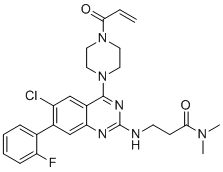
1-AM
CAS No. ——
1-AM( KRAS G12C inhibitor 1 AM )
Catalog No. M16990 CAS No. ——
A potent, selective, covalent KRAS G12C inhibitor that selectively inhibit KRAS G12C-dependent signaling and cancer cell growth at sub-micromolar concentrations.
Purity : >98% (HPLC)
 COA
Datasheet
HNMR
HPLC
MSDS
Handing Instructions
COA
Datasheet
HNMR
HPLC
MSDS
Handing Instructions
| Size | Price / USD | Stock | Quantity |
| 100MG | Get Quote | Get Quote |


|
| 200MG | Get Quote | Get Quote |
|
| 500MG | Get Quote | Get Quote |
|
| 1G | Get Quote | Get Quote |
|
Biological Information
-
Product Name1-AM
-
NoteResearch use only, not for human use.
-
Brief DescriptionA potent, selective, covalent KRAS G12C inhibitor that selectively inhibit KRAS G12C-dependent signaling and cancer cell growth at sub-micromolar concentrations.
-
DescriptionA potent, selective, covalent KRAS G12C inhibitor that selectively inhibit KRAS G12C-dependent signaling and cancer cell growth at sub-micromolar concentrations.
-
In Vitro——
-
In Vivo——
-
SynonymsKRAS G12C inhibitor 1 AM
-
PathwayMAPK/ERK Signaling
-
TargetRas
-
RecptorRas
-
Research Area——
-
Indication——
Chemical Information
-
CAS Number——
-
Formula Weight510.998
-
Molecular FormulaC26H28ClFN6O2
-
Purity>98% (HPLC)
-
Solubility——
-
SMILES——
-
Chemical Name3-((4-(4-acryloylpiperazin-1-yl)-6-chloro-7-(2-fluorophenyl)quinazolin-2-yl)amino)-N,N-dimethylpropanamide
Shipping & Storage Information
-
Storage(-20℃)
-
ShippingWith Ice Pack
-
Stability≥ 2 years
Reference
1. Zeng M, et al. Cell Chem Biol. 2017 Aug 17;24(8):1005-1016.e3.
molnova catalog



related products
-
ML-210
A small-molecule probe that selectively kills cells induced to express mutant RAS; inhibits BJeLR (expressing HRAS G12V) cell lines with IC50 of 25 nM.
-
CMC2.24
CMC2.24 (TRB-N0224) is a novel tricarbonylmethane agent that inhibits the Ras-RAF-MEK-ERK pathway.
-
RAS inhibitor Abd-7
RAS inhibitor Abd-7 is a potent RAS-binding compound (Kd=51 nM) that interacts with RAS in cells.
