


 Cart
Cart
 sales@molnova.com


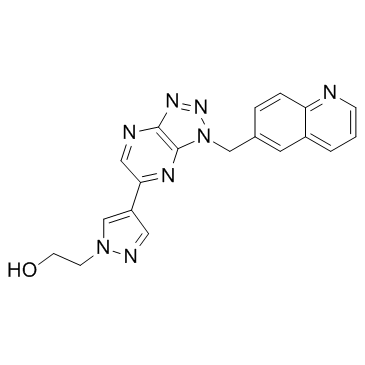
PF-04217903
CAS No. 956905-27-4
PF-04217903( PF04217903 | PF 04217903 )
Catalog No. M16830 CAS No. 956905-27-4
PF-04217903 is a potent, selective, ATP-competitive c-Met kinase inhibitor with Ki of 4.8 nM.
Purity : >98% (HPLC)
 COA
Datasheet
HNMR
HPLC
MSDS
Handing Instructions
COA
Datasheet
HNMR
HPLC
MSDS
Handing Instructions
| Size | Price / USD | Stock | Quantity |
| 1 mL x 10 mM in DMSO | 55 | In Stock |


|
| 2MG | 31 | In Stock |
|
| 5MG | 48 | In Stock |
|
| 10MG | 81 | In Stock |
|
| 25MG | 140 | In Stock |
|
| 50MG | 206 | In Stock |
|
| 100MG | Get Quote | In Stock |
|
| 200MG | Get Quote | In Stock |
|
| 500MG | Get Quote | In Stock |
|
| 1G | Get Quote | In Stock |
|
Biological Information
-
Product NamePF-04217903
-
NoteResearch use only, not for human use.
-
Brief DescriptionPF-04217903 is a potent, selective, ATP-competitive c-Met kinase inhibitor with Ki of 4.8 nM.
-
DescriptionPF-04217903 is a potent, selective, ATP-competitive c-Met kinase inhibitor with Ki of 4.8 nM, inhibits HGF-stimulated tyrosine phosphorylation of wild type c-Met with IC50 of 7.3 nM in cell-based assays; shows similar potency for inhibition of c-Met phosphorylation in mIMCD3 mouse epithelial cells (IC50=6.9 nM) and MDCK cell (IC50=9.5 nM); also exhibits inhibitory activities against c-Met mutations including V1092I, H1094R, M1250T, R988C, and T11010I (IC50=530 nM), but has little to no activity against mutants Y1230C and Y1235D; inhibits tumor cell proliferation, survival, migration/invasion both in vitro and in vivo.Solid Tumors Phase 1 Discontinued(In Vitro):PF-04217903 (0.1-10000 nM; 48-72 hours) inhibits proliferation of c-Met–amplified human GTL-16 gastric carcinoma and H1993 NSCLC cells with IC50 values of 12 and 30 nM, respectively.PF-04217903 (1.5-3333 nM; 48 hours) induces apoptosis of GTL-16 cells (IC50=31 nM).PF-04217903 also inhibits HGF-mediated cell migration and Matrigel invasion in several c-Met–overexpressing tumor cell lines such as human NCI-H441 lung carcinoma and HT29 colon carcinoma with IC50 values comparable with those for inhibition of c-Met phosphorylation in these cell lines (IC50=7-12.5 nM). PF-04217903 displays similar potency to inhibit the activity of c-Met-H1094R, c-Met-R988C, and c-Met-T1010I with IC50 of 3.1 nM, 6.4 nM, and 6.7 nM, respectively, but has no inhibitory activity against c-Met-Y1230C with IC50 of >10 μM. (In Vivo):PF-04217903 (1-30 mg/kg; p.o.; daily for 16 days) shows dose-dependent tumor growth inhibition, which correlated with the inhibition in c-Met phosphorylation in these tumors.PF-04217903 (5-50 mg/kg, p.o.; once daily for 3 days) dose dependently inhibits c-Met, Gab-1, Erk1/2, and AKT phosphorylation and induced apoptosis (cleaved caspase-3) in U87MG xenograft tumors at all dose levels. PF-04217903 phenolsulfonate shows a significant dose-dependent reduction of human IL-8 levels in both the U87MG and GTL-16 models and decreases human VEGFA levels in the GTL-16 model. PF-04217903 strongly induces phospho-PDGFRβ levels in U87MG xenograft tumors.
-
In VitroPF-04217903 (0.1-10000 nM; 48-72 hours) inhibits proliferation of c-Met–amplified human GTL-16 gastric carcinoma and H1993 NSCLC cells with IC50 values of 12 and 30 nM, respectively.PF-04217903 (1.5-3333 nM; 48 hours) induces apoptosis of GTL-16 cells (IC50=31 nM).PF-04217903 also inhibits HGF-mediated cell migration and Matrigel invasion in several c-Met–overexpressing tumor cell lines such as human NCI-H441 lung carcinoma and HT29 colon carcinoma with IC50 values comparable with those for inhibition of c-Met phosphorylation in these cell lines (IC50=7-12.5 nM).PF-04217903 displays similar potency to inhibit the activity of c-Met-H1094R, c-Met-R988C, and c-Met-T1010I with IC50 of 3.1 nM, 6.4 nM, and 6.7 nM, respectively, but has no inhibitory activity against c-Met-Y1230C with IC50 of >10 μM. Cell Proliferation Assay Cell Line:GTL-16, H1993 cells Concentration:0.1, 1, 10, 100, 1000, 10000 nM Incubation Time:48-72 hours Result:Inhibited proliferation of c-Met–amplified human GTL-16 gastric carcinoma and H1993 NSCLC cells with IC50 values of 12 and 30 nM, respectively.Apoptosis Analysis Cell Line:GTL-16 cells Concentration:1.5-3333 nM Incubation Time:48 hours Result:Induced apoptosis of GTL-16 cells (IC50=31 nM).
-
In VivoPF-04217903 (1-30 mg/kg; p.o.; daily for 16 days) shows dose-dependent tumor growth inhibition, which correlated with the inhibition in c-Met phosphorylation in these tumors.PF-04217903 (5-50 mg/kg, p.o.; once daily for 3 days) dose dependently inhibits c-Met, Gab-1, Erk1/2, and AKT phosphorylation and induced apoptosis (cleaved caspase-3) in U87MG xenograft tumors at all dose levels. PF-04217903 phenolsulfonate shows a significant dose-dependent reduction of human IL-8 levels in both the U87MG and GTL-16 models and decreases human VEGFA levels in the GTL-16 model. PF-04217903 strongly induces phospho-PDGFRβ levels in U87MG xenograft tumors. Animal Model:Female nu/nu mice (GTL-16 xenograft model)Dosage:1, 3, 10, 30 mg/kg Administration:Oral; daily for 16 days Result:Showed dose-dependent tumor growth inhibition, and was correlated with the inhibition in c-Met phosphorylation in these tumors.
-
SynonymsPF04217903 | PF 04217903
-
PathwayAngiogenesis
-
Targetc-Met/HGFR
-
Recptorc-Met
-
Research AreaCancer
-
IndicationSolid Tumors
Chemical Information
-
CAS Number956905-27-4
-
Formula Weight372.3833
-
Molecular FormulaC19H16N8O
-
Purity>98% (HPLC)
-
Solubility10 mM in DMSO
-
SMILESOCCN1C=C(C=N1)C1=CN=C2N=NN(CC3=CC4=C(C=C3)N=CC=C4)C2=N1
-
Chemical Name1H-Pyrazole-1-ethanol, 4-[1-(6-quinolinylmethyl)-1H-1,2,3-triazolo[4,5-b]pyrazin-6-yl]-
Shipping & Storage Information
-
Storage(-20℃)
-
ShippingWith Ice Pack
-
Stability≥ 2 years
Reference
1. Zou HY, et al. Mol Cancer Ther. 2012 Apr;11(4):1036-47.
2. Sennino B, et al. Cancer Res. 2013 Jun 15;73(12):3692-703.
3. Cui JJ, et al. J Med Chem. 2012 Sep 27;55(18):8091-109.
4. Yeh I, et al. Nat Commun. 2015 May 27;6:7174.
molnova catalog



related products
-
AMG-208
AMG-208 is a potent, small-molecule c-Met inhibitor with IC50 of 5.2 nM against wt MET kinase, also inhibits VEGFR2 with IC50 of 112 nM.
-
Dihexa
Dihexa is an activator of the hepatocyte growth factor/c-Met (HGF/c-Met) systemit binds to HGF (Kd = 65 pM)and an analog of the peptide angiotensin IV.
-
LMTK3-IN-1
Lmtk3-in-1 is a potent ATP-competitive lemur tyrosine kinase 3 (LMTK3) (Kd=2.5 μM) inhibitor that degrades LMTK3 through the ubiquitin proteasome pathway.
