


 Cart
Cart
 sales@molnova.com


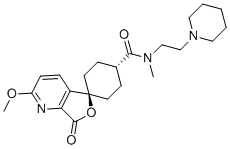
MK-7288
CAS No. 936626-07-2
MK-7288( MK7288 | MK 7288 )
Catalog No. M16708 CAS No. 936626-07-2
A novel histamine H3 receptor inverse agonist for the treatment of sleep apnoea syndrome.
Purity : >98% (HPLC)
 COA
Datasheet
HNMR
HPLC
MSDS
Handing Instructions
COA
Datasheet
HNMR
HPLC
MSDS
Handing Instructions
| Size | Price / USD | Stock | Quantity |
| 5MG | 873 | Get Quote |


|
| 50MG | 1782 | Get Quote |
|
| 100MG | 2250 | Get Quote |
|
| 200MG | Get Quote | Get Quote |
|
| 500MG | Get Quote | Get Quote |
|
| 1G | Get Quote | Get Quote |
|
Biological Information
-
Product NameMK-7288
-
NoteResearch use only, not for human use.
-
Brief DescriptionA novel histamine H3 receptor inverse agonist for the treatment of sleep apnoea syndrome.
-
DescriptionA novel histamine H3 receptor inverse agonist for the treatment of sleep apnoea syndrome; significantly prolongs MWT sleep latency, and improves car driving simulation standard deviation of lane position in clinical trials.Sleep Disorder Phase 1 Clinical.
-
In Vitro——
-
In Vivo——
-
SynonymsMK7288 | MK 7288
-
PathwayGPCR/G Protein
-
TargetHistamine Receptor
-
RecptorHistamine Receptor
-
Research AreaNeurological Disease
-
IndicationSleep Disorder
Chemical Information
-
CAS Number936626-07-2
-
Formula Weight401.507
-
Molecular FormulaC22H31N3O4
-
Purity>98% (HPLC)
-
Solubility——
-
SMILESCN(CCN1CCCCC1)C(=O)C2CCC3(CC2)C4=C(C(=O)O3)N=C(C=C4)OC
-
Chemical Name(1r,4r)-2'-methoxy-N-methyl-7'-oxo-N-(2-(piperidin-1-yl)ethyl)-7'H-spiro[cyclohexane-1,5'-furo[3,4-b]pyridine]-4-carboxamide
Shipping & Storage Information
-
Storage(-20℃)
-
ShippingWith Ice Pack
-
Stability≥ 2 years
Reference
1. Sun H, et al. J Clin Pharmacol. 2013 Dec;53(12):1294-302.
molnova catalog



related products
-
Cimetidine
Cimetidine is a histamine-2 (H2) receptor antagonist.
-
S 38093 HCl
S 38093 is a novel brain-penetrant antagonist/inverse agonist of H3 receptors.
-
Pitolisant
A potent and selective antagonist of H3 receptor with Ki/EC50 of 0.16/1.5 nM; no effect on H1, H2, H4 receptors (IC50>10 uM).
