


 Cart
Cart
 sales@molnova.com


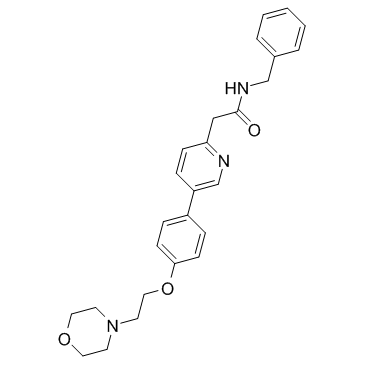
KX2-391
CAS No. 897016-82-9
KX2-391( KX 01 )
Catalog No. M16454 CAS No. 897016-82-9
KX2-391, the first clinical Src inhibitor (peptidomimetic class) that targets the peptide substrate site of Src, with GI50 of 9-60 nM in cancer cell lines.
Purity : >98% (HPLC)
 COA
Datasheet
HNMR
HPLC
MSDS
Handing Instructions
COA
Datasheet
HNMR
HPLC
MSDS
Handing Instructions
| Size | Price / USD | Stock | Quantity |
| 1 mL x 10 mM in DMSO | 58 | In Stock |


|
| 5MG | 55 | In Stock |
|
| 10MG | 67 | In Stock |
|
| 25MG | 145 | In Stock |
|
| 50MG | 260 | In Stock |
|
| 100MG | 437 | In Stock |
|
| 200MG | 626 | In Stock |
|
| 500MG | Get Quote | In Stock |
|
| 1G | Get Quote | In Stock |
|
Biological Information
-
Product NameKX2-391
-
NoteResearch use only, not for human use.
-
Brief DescriptionKX2-391, the first clinical Src inhibitor (peptidomimetic class) that targets the peptide substrate site of Src, with GI50 of 9-60 nM in cancer cell lines.
-
DescriptionKX2-391, the first clinical Src inhibitor (peptidomimetic class) that targets the peptide substrate site of Src, with GI50 of 9-60 nM in cancer cell lines. Phase 2.(In Vitro):Tirbanibulin (KX2-391) is a Src inhibitor that is directed to the Src substrate pocket. Tirbanibulin (KX2-391) shows steep dose-response curves against Huh7 (GI50=9 nM), PLC/PRF/5 (GI50=13 nM), Hep3B (GI50=26 nM), and HepG2 (GI50=60 nM), four hepatic cell cancer (HCC) cell lines. Tirbanibulin (KX2-391) is found to inhibit certain leukemia cells that are resistant to current commercially available drugs, such as those derived from chronic leukemia cells with the T3151 mutation. Tirbanibulin (KX2-391) is evaluated in engineered Src driven cell growth assays inNIH3T3/c-Src527F and SYF/c-Src527F cells and exhibits GI50 with 23 nM and 39 nM, respectively.(In Vivo):Orally administered Tirbanibulin (KX2-391) is shown to inhibit primary tumor growth and to suppress metastasis, in pre-clinical animal models of cancer.
-
In VitroTirbanibulin (KX2-391) is a Src inhibitor that is directed to the Src substrate pocket. Tirbanibulin (KX2-391) shows steep dose-response curves against Huh7 (GI50=9 nM), PLC/PRF/5 (GI50=13 nM), Hep3B (GI50=26 nM), and HepG2 (GI50=60 nM), four hepatic cell cancer (HCC) cell lines. Tirbanibulin (KX2-391) is found to inhibit certain leukemia cells that are resistant to current commercially available drugs, such as those derived from chronic leukemia cells with the T3151 mutation. Tirbanibulin (KX2-391) is evaluated in engineered Src driven cell growth assays inNIH3T3/c-Src527F and SYF/c-Src527F cells and exhibits GI50 with 23 nM and 39 nM, respectively.
-
In VivoOrally administered Tirbanibulin (KX2-391) is shown to inhibit primary tumor growth and to suppress metastasis, in pre-clinical animal models of cancer.
-
SynonymsKX 01
-
PathwayTyrosine Kinase
-
TargetSrc
-
RecptorSrc (Hep 3B)| Src (Hep G2)| Src (HuH7)| Src (PLC/PRF/5)
-
Research AreaCancer
-
IndicationSolid Tumors
Chemical Information
-
CAS Number897016-82-9
-
Formula Weight431.53
-
Molecular FormulaC26H29N3O3
-
Purity>98% (HPLC)
-
SolubilityDMSO:86 mg/mL (199.29 mM); Ethanol:<1 mg/mL (<1 mM); Water:<1 mg/mL (<1 mM)
-
SMILESO=C(NCC1=CC=CC=C1)C2=NC=C(C3=CC=C(OCCN4CCOCC4)C=C3)C=C2
-
Chemical NameN-benzyl-5-(4-(2-morpholinoethoxy)phenyl)picolinamide
Shipping & Storage Information
-
Storage(-20℃)
-
ShippingWith Ice Pack
-
Stability≥ 2 years
Reference
1.Lau GM, et al, Dig Dis Sci, 2009, 54(7), 1465-1474.
molnova catalog



related products
-
N-Acetyl-O-phosphono...
Phosphopeptide ligand for the src SH2 domain (IC50 = 1 μM). Blocks src interactions with EGFR and FAK.
-
Neochlorogenic acid
Chlorogenic acid has resistance to the brown rot fungus, may by interfering with fungal melanin production.
-
DGY-06-116
DGY-06-116 is an selective and irreversible covalent inhibitor of Src and FGFR1 with IC50 value of 3nM and 8340 nM, respectively.
