


 Cart
Cart
 sales@molnova.com


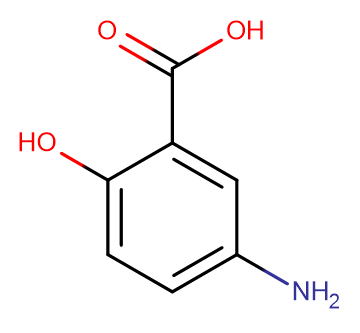
Mesalamine
CAS No. 89-57-6
Mesalamine( 5-ASA | Mesalamine | Mesalazine )
Catalog No. M16448 CAS No. 89-57-6
5-aminosalicylic acid (5-ASA), also known as mesalamine or Mesalazine is an anti-inflammatory drug used to treat inflammatory bowel disease.
Purity : >98% (HPLC)
 COA
Datasheet
HNMR
HPLC
MSDS
Handing Instructions
COA
Datasheet
HNMR
HPLC
MSDS
Handing Instructions
| Size | Price / USD | Stock | Quantity |
| 100MG | Get Quote | In Stock |


|
| 200MG | Get Quote | In Stock |
|
| 500MG | 42 | In Stock |
|
| 1G | Get Quote | In Stock |
|
Biological Information
-
Product NameMesalamine
-
NoteResearch use only, not for human use.
-
Brief Description5-aminosalicylic acid (5-ASA), also known as mesalamine or Mesalazine is an anti-inflammatory drug used to treat inflammatory bowel disease.
-
Description5-aminosalicylic acid (5-ASA), also known as mesalamine or Mesalazine is an anti-inflammatory drug used to treat inflammatory bowel disease, such as ulcerative colitis and mild-to-moderate Crohn's disease.(In Vitro):5-Aminosalicylic acid (5-ASA) is a specific agonist for PPARγ, and only PPARγ but not PPARα or PPARδ induces p65 degradation. 5-Aminosalicylic acid induces degradation of p65 protein indicative of PPARγ's E3 ubiquitin ligase activity. 5-Aminosalicylic acid also inhibits PAK1 at the mRNA level which is suggestive of an additional mechanism independent of PPARγ ligand activation. 5-Aminosalicylic acid blocks NF-κB in intestinal epithelial cells (IECs) through inhibition of PAK1. Pretreatment with 5-Aminosalicylic acid (5-ASA) or Nimesulide at different concentration (10-1000 μmol/L) for 12-96 h, inhibits the growth of HT-29 colon carcinoma cells in a dose and time-dependent manner. However, the suppression of 5-Aminosalicylic acid or Nimesulide has no statistical significance. The growth of HT-29 colon carcinoma cells is inhibited dose-dependently when pretreated with different doses of combined 5-Aminosalicylic acid and Nimesulide. Combined 5-Aminosalicylic acid (final concentration 100 μM) and Nimesulide (final concentration 10-1000 μM) inhibits the proliferation of HT-29 colon carcinoma cells in a dose-dependent manner, being more potent than corresponding dose of Nimesulide. Similarly, combined Nimesulide (final concentration 100 μM) and 5-Aminosalicylic acid (final concentration 10-1000 μM) also inhibits the proliferation of these cells dose-dependently, being more potent than corresponding dose of 5-Aminosalicylic acid. (In Vivo):5-Aminosalicylic acid (5-ASA) has an antineoplastic effect in a xenograft tumor model. To evaluate the in vivo antineoplasic effect of 5-Aminosalicylic acid, SCID mice engrafted with HT-29 colon cancer cells are treated daily for 21 consecutive days with 5-Aminosalicylic acid at 50 mM. At the end of the treatment, a reduction of 80-86% of tumor weight and volume is observed in SCID mice receiving 5-Aminosalicylic acid compared with control mice or mice treated with GW9662 alone. The antineoplastic effect of 5-Aminosalicylic acid is already detectable after 10 days of 5-Aminosalicylic acid treatment. Similar results are obtained with mice treated with 5-Aminosalicylic acid at 5 mM. Antitumorigenic effect of 5-Aminosalicylic acid is completely abolished at 21 days by simultaneous intraperitoneal administration of GW9662. Thus, the observed antineoplastic effect of 5-Aminosalicylic acid is at least partially dependent on PPARγ.
-
In Vitro5-Aminosalicylic acid (5-ASA) is a specific agonist for PPARγ, and only PPARγ but not PPARα or PPARδ induces p65 degradation. 5-Aminosalicylic acid induces degradation of p65 protein indicative of PPARγ's E3 ubiquitin ligase activity. 5-Aminosalicylic acid also inhibits PAK1 at the mRNA level which is suggestive of an additional mechanism independent of PPARγ ligand activation. 5-Aminosalicylic acid blocks NF-κB in intestinal epithelial cells (IECs) through inhibition of PAK1. Pretreatment with 5-Aminosalicylic acid (5-ASA) or Nimesulide at different concentration (10-1000 μmol/L) for 12-96 h, inhibits the growth of HT-29 colon carcinoma cells in a dose and time-dependent manner. However, the suppression of 5-Aminosalicylic acid or Nimesulide has no statistical significance. The growth of HT-29 colon carcinoma cells is inhibited dose-dependently when pretreated with different doses of combined 5-Aminosalicylic acid and Nimesulide. Combined 5-Aminosalicylic acid (final concentration 100 μM) and Nimesulide (final concentration 10-1000 μM) inhibits the proliferation of HT-29 colon carcinoma cells in a dose-dependent manner, being more potent than corresponding dose of Nimesulide. Similarly, combined Nimesulide (final concentration 100 μM) and 5-Aminosalicylic acid (final concentration 10-1000 μM) also inhibits the proliferation of these cells dose-dependently, being more potent than corresponding dose of 5-Aminosalicylic acid.
-
In Vivo5-Aminosalicylic acid (5-ASA) has an antineoplastic effect in a xenograft tumor model. To evaluate the in vivo antineoplasic effect of 5-Aminosalicylic acid, SCID mice engrafted with HT-29 colon cancer cells are treated daily for 21 consecutive days with 5-Aminosalicylic acid at 50 mM. At the end of the treatment, a reduction of 80-86% of tumor weight and volume is observed in SCID mice receiving 5-Aminosalicylic acid compared with control mice or mice treated with GW9662 alone. The antineoplastic effect of 5-Aminosalicylic acid is already detectable after 10 days of 5-Aminosalicylic acid treatment. Similar results are obtained with mice treated with 5-Aminosalicylic acid at 5 mM. Antitumorigenic effect of 5-Aminosalicylic acid is completely abolished at 21 days by simultaneous intraperitoneal administration of GW9662. Thus, the observed antineoplastic effect of 5-Aminosalicylic acid is at least partially dependent on PPARγ.
-
Synonyms5-ASA | Mesalamine | Mesalazine
-
PathwayChromatin/Epigenetic
-
TargetCOX
-
RecptorCOX| ALOX5| MPO| NF-κB| PPARγ
-
Research AreaInflammation/Immunology
-
Indication——
Chemical Information
-
CAS Number89-57-6
-
Formula Weight153.14
-
Molecular FormulaC7H7NO3
-
Purity>98% (HPLC)
-
SolubilityEthanol: 31 mg/mL (202.42 mM); DMSO: 31 mg/mL (202.42 mM)
-
SMILESO=C(O)C1=CC(N)=CC=C1O
-
Chemical Name5-amino-2-hydroxybenzoic acid
Shipping & Storage Information
-
Storage(-20℃)
-
ShippingWith Ice Pack
-
Stability≥ 2 years
Reference
1.Mifflin RC, et al. Mol Pharmacol. 2004 Feb;65(2):470-8.
molnova catalog



related products
-
NS-398
COX-2 inhibitor and anti-inflammatory agent.
-
Acetylsalicylic acid
Aspirin (Acetylsalicylic acid) is a potent and selective inhibitor of cyclooxygenase (COX) with a broad range of pharmacological activities including anti-inflammation and pain relief.
-
Sulfasalazine
Sulfasalazine, a sulfa agent and a derivative of mesalazine, is used primarily as an anti-inflammatory agent.
