


 Cart
Cart
 sales@molnova.com


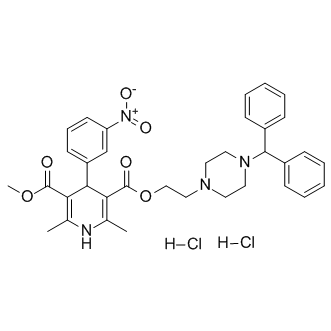
Manidipine dihydrochloride
CAS No. 89226-75-5
Manidipine dihydrochloride( CV-4093 )
Catalog No. M16434 CAS No. 89226-75-5
A dihydropyridine type calcium channel blocker that is used as an antihypertensive.
Purity : >98% (HPLC)
 COA
Datasheet
HNMR
HPLC
MSDS
Handing Instructions
COA
Datasheet
HNMR
HPLC
MSDS
Handing Instructions
| Size | Price / USD | Stock | Quantity |
| 1 mL x 10 mM in DMSO | 44 | In Stock |


|
| 50MG | 39 | In Stock |
|
| 100MG | 63 | In Stock |
|
| 200MG | 90 | In Stock |
|
| 500MG | Get Quote | In Stock |
|
| 1G | Get Quote | In Stock |
|
Biological Information
-
Product NameManidipine dihydrochloride
-
NoteResearch use only, not for human use.
-
Brief DescriptionA dihydropyridine type calcium channel blocker that is used as an antihypertensive.
-
DescriptionA dihydropyridine type calcium channel blocker that is used as an antihypertensive.Hypertension Approved.
-
In Vitro——
-
In VivoAnimal Model:IFNAR-/- miceDosage:10 mg/kg Administration:Intraperitoneal injection (i.p. ), b.i.d. at day 4, day 5 Result:Exhibited a modest, but statistically significant increase in the survival rate of lethal animal model with SFTSV infection, significantly reduced viral titers in the spleen and kidney.Animal Model:Adult female BALB/c mice (age, 4 weeks) Dosage:25 mg/kg Administration:Intraperitoneal injection (i.p. ), b.i.d. for 2 days, then daily for 19 days Result:Reduced the mortality rate from 73% to 20%, significantly reduced the viral load in infected mice while remarkably alleviated brain damage phenomena. Had little effect on peripheral JEV infection, which indicated that manidipine protected the mice against JEV-induced lethality by decreasing the viral load in the brain.Animal Model:8-week-old male Wistar rats Dosage:3 mg/kg Administration:Intragastric gavage (i.g.), once per day for 7 d Result:Prevented isoproterenol-induced left ventricular hypertrophy (2.26±0.02 g/kg;p<0.01) as isoproterenol increased left ventricular weight (2.40±0.04 g/kg; p<0.01). Inhibited expression of mRNA of ANP (0.9-fold of the control value; p<0.01), collagen types I (1.1-fold; p<0.01) and type III (1.6-fold; p<0.01), and fibronectin (1.1-fold; p<0.01).
-
SynonymsCV-4093
-
PathwayGPCR/G Protein
-
TargetCalcium Channel
-
RecptorCalciumChannel
-
Research AreaCardiovascular Disease
-
IndicationHypertension
Chemical Information
-
CAS Number89226-75-5
-
Formula Weight683.6213
-
Molecular FormulaC35H40Cl2N4O6
-
Purity>98% (HPLC)
-
Solubility10 mM in DMSO
-
SMILES[H+].[H+].[Cl-].[Cl-].COC(=O)C1=C(C)NC(C)=C(C1C1=CC(=CC=C1)[N+]([O-])=O)C(=O)OCCN1CCN(CC1)C(C1=CC=CC=C1)C1=CC=CC=C1
-
Chemical Name3,5-Pyridinedicarboxylic acid, 1,4-dihydro-2,6-dimethyl-4-(3-nitrophenyl)-, 3-[2-[4-(diphenylmethyl)-1-piperazinyl]ethyl] 5-methyl ester, hydrochloride (1:2)
Shipping & Storage Information
-
Storage(-20℃)
-
ShippingWith Ice Pack
-
Stability≥ 2 years
Reference
1. Cheer SM, et al. Drugs. 2001;61(12):1777-99.
2. Roca-Cusachs A, et al. Drugs. 2005;65 Suppl 2:11-9.
molnova catalog



related products
-
Carboxyamidotriazole...
Carboxyamidotriazole Orotate is a cytostatic inhibitor of nonvoltage-operated calcium channels and calcium channel-mediated signaling pathways.
-
Zonisamide
Zonisamide is a sulfonamide anticonvulsant approved for use as an adjunctive therapy in adults with partial-onset seizures.
-
Ethyl cinnamate
Ethyl cinnamate has antifungal, and vasorelaxant effects. Ethyl cinnamate can lead to the damage of cell membrane system and metabolic disorder through inducing lipid peroxidation via initiating ROS overproduction.
