


 Cart
Cart
 sales@molnova.com


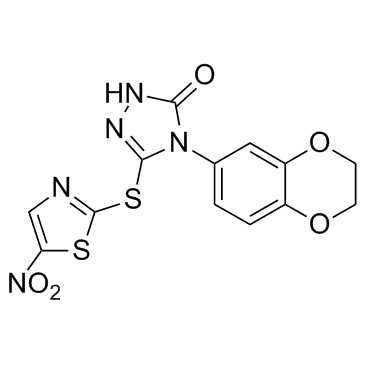
BI-78D3
CAS No. 883065-90-5
BI-78D3( BI 78D3 | BI78D3 )
Catalog No. M16401 CAS No. 883065-90-5
A small molecule JIP1 mimic that functions as substrate competitive inhibitor of JNK with IC50 of 500 nM.
Purity : >98% (HPLC)
 COA
Datasheet
HNMR
HPLC
MSDS
Handing Instructions
COA
Datasheet
HNMR
HPLC
MSDS
Handing Instructions
| Size | Price / USD | Stock | Quantity |
| 1 mL x 10 mM in DMSO | 55 | In Stock |


|
| 2MG | 31 | In Stock |
|
| 5MG | 49 | In Stock |
|
| 10MG | 81 | In Stock |
|
| 25MG | 163 | In Stock |
|
| 50MG | 257 | In Stock |
|
| 100MG | 407 | In Stock |
|
| 200MG | Get Quote | In Stock |
|
| 500MG | Get Quote | In Stock |
|
| 1G | Get Quote | In Stock |
|
Biological Information
-
Product NameBI-78D3
-
NoteResearch use only, not for human use.
-
Brief DescriptionA small molecule JIP1 mimic that functions as substrate competitive inhibitor of JNK with IC50 of 500 nM.
-
DescriptionA small molecule JIP1 mimic that functions as substrate competitive inhibitor of JNK with IC50 of 500 nM; targets the JNK-JIP interaction site and dose-dependently inhibits the phosphorylation of JNK substrates both in vitro and in cell; blocks JNK dependent Con A-induced liver damage, restores insulin sensitivity in mouse models of type 2 diabetes.
-
In VitroBI-78D3, dose-dependently inhibits the phosphorylation of JNK substrates both in vitro and in cell. BI-78D3 is able to compete with the D-domain of JIP1 (amino acids 153-163; pepJIP1) for JNK1 binding (IC50=500 nM). Using the same in vitro LanthaScreen kinase assay and the same ATF2 substrate, BI-78D3 is found to be 100-fold less active vs. p38α, a member of the MAPK family with high structural similarity to JNK, and completely inactive against mTOR and PI3-kinase (α-isoform), both unrelated protein kinases. Furthermore, Lineweaver-Burk analysis clearly indicates that BI-78D3 is competitive with ATF2 for binding to JNK1 with an apparent Ki value of 200 nM. In an attempt to profile the properties of BI-78D3 in the context of a complex cellular milieu, the cell-based LanthaScreen kinase assay is used. In this assay BI-78D3 is able to inhibit TNF-α stimulated phosphorylation of c-Jun in cell (EC50=12.4 μM).
-
In VivoThe link between ConA-induced liver failure, TNF receptor signaling, and JNK function has been established by studies employing JNK1-/- and JNK2-/- mice. For this analysis, insulin insensitive mice are injected only once with 25 mg/kg BI-78D3, 30 min before insulin injection. The effect of insulin on blood glucose levels is then measured. BI-78D3 results in a statistically significant reduction in blood glucose levels as compared with the vehicle control. Thus, the ability of BI-78D3 to abrogate ConA-induced liver damage and restore insulin sensitivity is consistent with its proposed function as an effective JNK inhibitor. Liquid chromatography/mass spectrometry bio-availability analysis demonstrates that BI-78D3 has favorable microsome and plasma stability (T1/2=54 min).
-
SynonymsBI 78D3 | BI78D3
-
PathwayMAPK/ERK Signaling
-
TargetJNK
-
RecptorJNK
-
Research AreaCancer
-
Indication——
Chemical Information
-
CAS Number883065-90-5
-
Formula Weight379.37106
-
Molecular FormulaC13H9N5O5S2
-
Purity>98% (HPLC)
-
SolubilityDMSO: ≥ 31 mg/mL
-
SMILESO=C1NN=C(SC2=NC=C([N+]([O-])=O)S2)N1C3=CC=C(OCCO4)C4=C3
-
Chemical Name3H-1,2,4-Triazol-3-one, 4-(2,3-dihydro-1,4-benzodioxin-6-yl)-2,4-dihydro-5-[(5-nitro-2-thiazolyl)thio]-
Shipping & Storage Information
-
Storage(-20℃)
-
ShippingWith Ice Pack
-
Stability≥ 2 years
Reference
1. Stebbins JL, et al. Proc Natl Acad Sci U S A. 2008 Oct 28;105(43):16809-13.
2. Strittmatter F, et al. Br J Pharmacol. 2012 Jul;166(6):1926-35.
3. Posthumadeboer J, et al. Oncotarget. 2012 Oct;3(10):1169-81.
molnova catalog



related products
-
JNK-IN-11
JNK-IN-11 (compound 1) is a potent inhibitor of JNK, with IC50 values of 2.2 μM, 21.4 μM, and 1.8 μM for JNK1, JNK2, and JNK3, respectively, showing potential for Alzheimer's and Parkinson's disease research.
-
CC-401
CC-401 (JNK-401) is a potent, selective, ATP-competitive pan-JNK inhibitor with Ki of 25-50 nM.
-
BSJ-04-122
BSJ-04-122 is a covalent dual inhibitor of MKK4 and MKK7, demonstrating IC50 values of 4 nM and 181 nM, respectively. [BSJ-04-122] can be used for cancer research.
