


 Cart
Cart
 sales@molnova.com


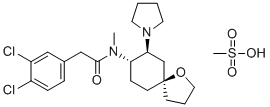
Spiradoline mesylate
CAS No. 87173-97-5
Spiradoline mesylate( U 62066 )
Catalog No. M16337 CAS No. 87173-97-5
Spiradoline (U 62066) is a potent, highly selective κ-opioid agonist that has analgesic diuretic and antitussive effects.
Purity : >98% (HPLC)
 COA
Datasheet
HNMR
HPLC
MSDS
Handing Instructions
COA
Datasheet
HNMR
HPLC
MSDS
Handing Instructions
| Size | Price / USD | Stock | Quantity |
| 100MG | Get Quote | Get Quote |


|
| 200MG | Get Quote | Get Quote |
|
| 500MG | Get Quote | Get Quote |
|
| 1G | Get Quote | Get Quote |
|
Biological Information
-
Product NameSpiradoline mesylate
-
NoteResearch use only, not for human use.
-
Brief DescriptionSpiradoline (U 62066) is a potent, highly selective κ-opioid agonist that has analgesic diuretic and antitussive effects.
-
DescriptionSpiradoline (U 62066) is a potent, highly selective κ-opioid agonist that has analgesic diuretic and antitussive effects.Pain Phase 2 Discontinued.
-
In VitroUsing the patch-clamp method in isolated rat cardiac myocytes, indicated that Spiradoline mesylate (15 to 500 μM) produces its antiarrythmic effect via blockade of sodium channels (and at the higher doses also of potassium currents) in myocardial tissue. Thus, Spiradoline mesylate reduces the peak sodium current, increased the decay rate of the transient outward potassium current, and reduced the sustained plateau potassium amplitude.
-
In VivoSpiradoline mesylate (U-62066; 0.1-0.4 mg/kg; subcutaneous injection; once; Sprague-Dawley rats) treatment dose-dependently reduces social behaviors in non-stressed adults, producing social avoidance at the highest dose tested, while younger animals displays reduced sensitivity to this socially suppressing effect of Spiradoline mesylate. In stressed animals, the socially suppressing effects of the Spiradoline mesylate are blunted at all ages, with juveniles and adolescents exhibiting increased social preference in response to certain doses of U-62066. Animal Model:Juvenile, adolescent and adult Sprague-Dawley male and female rats exposured to repeated restraint Dosage:0.1 mg/kg, 0.2 mg/kg, 0.3 mg/kg, and 0.4?mg/kg Administration:Subcutaneous injection; once Result:Dose-dependently reduced social behaviors in non-stressed adults, producing social avoidance at the highest dose tested.
-
SynonymsU 62066
-
PathwayEndocrinology/Hormones
-
TargetOpioid Receptor
-
RecptorOpioid Receptor
-
Research AreaNeurological Disease
-
IndicationPain
Chemical Information
-
CAS Number87173-97-5
-
Formula Weight521.494
-
Molecular FormulaC23H34Cl2N2O5S
-
Purity>98% (HPLC)
-
Solubility——
-
SMILESClC1=C(Cl)C=CC(CC(N(C)[C@H]2CC[C@]3(OCCC3)C[C@@H]2N4CCCC4)=O)=C1.CS(O)(=O)=O
-
Chemical Name2-(3,4-dichlorophenyl)-N-methyl-N-[(5R,7S,8S)-7-pyrrolidin-1-yl-1-oxaspiro[4.5]decan-8-yl]acetamide mesylate
Shipping & Storage Information
-
Storage(-20℃)
-
ShippingWith Ice Pack
-
Stability≥ 2 years
Reference
1. Peters GR, et al. J Pharmacol Exp Ther. 1987 Jan;240(1):128-31.
2. Kamei J, et al. Eur J Pharmacol. 1990 Oct 9;187(2):281-6.
3. Kunihara M, et al. Life Sci. 1989;45(13):1191-8.
molnova catalog



related products
-
Naltrexone hydrochlo...
A potent, competitive antagonist for μ, κ, δ, and σ-opioid receptors with Ki of 0.0825 nM, 0.509 nM, and 8.02 nM, for MOR, KOR, and DOR, respectively.
-
Deltorphin
Deltorphin (Dermenkephalin) is Isolated from the skin of Phyllomedusa Sauvage. It also has an affinity to the opioid receptor.
-
Cebranopadol
Cebranopadol (GRT-6005, GRT6005) is a potent analgesic nociceptin/orphanin FQ peptide (NOP) and opioid receptor agonist with Ki/EC50 of 0.9/13 nM (human NOP receptor), 0.7/1.2 nM (mu-opioid receptor).
