


 Cart
Cart
 sales@molnova.com


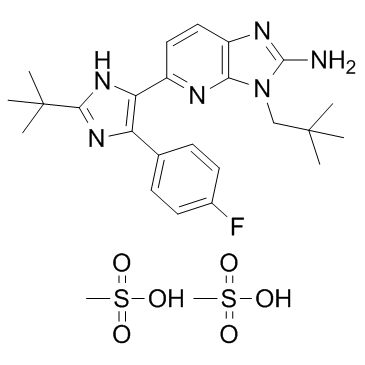
LY2228820 dimesylate
CAS No. 862507-23-1
LY2228820 dimesylate( Ralimetinib dimesylate | LY2228820 | LY-2228820 )
Catalog No. M16242 CAS No. 862507-23-1
LY2228820 dimesylate (Ralimetinib) is a potent, selective, orally available inhibitor p38 MAPK with IC50 of 5.3 and 3.2 nM for p38α and p38β, respectively.
Purity : >98% (HPLC)
 COA
Datasheet
HNMR
HPLC
MSDS
Handing Instructions
COA
Datasheet
HNMR
HPLC
MSDS
Handing Instructions
| Size | Price / USD | Stock | Quantity |
| 1 mL x 10 mM in DMSO | 96 | In Stock |


|
| 5MG | 73 | In Stock |
|
| 10MG | 126 | In Stock |
|
| 25MG | 240 | In Stock |
|
| 50MG | 361 | In Stock |
|
| 100MG | 461 | In Stock |
|
| 200MG | Get Quote | In Stock |
|
| 500MG | Get Quote | In Stock |
|
| 1G | Get Quote | In Stock |
|
Biological Information
-
Product NameLY2228820 dimesylate
-
NoteResearch use only, not for human use.
-
Brief DescriptionLY2228820 dimesylate (Ralimetinib) is a potent, selective, orally available inhibitor p38 MAPK with IC50 of 5.3 and 3.2 nM for p38α and p38β, respectively.
-
DescriptionLY2228820 dimesylate (Ralimetinib) is a potent, selective, orally available inhibitor p38 MAPK with IC50 of 5.3 and 3.2 nM for p38α and p38β, respectively; potently and selectively inhibits phosphorylation of MK2 (Thr334) in anisomycin-stimulated HeLa cells and mouse RAW264.7 macrophages (IC50=35.3 nM), with no changes in phosphorylation of p38α MAPK, JNK, ERK1/2, c-Jun, ATF2, or c-Myc; also reduces TNF-α secretion by LPS/IFN-γ–stimulated macrophages with IC50 of 6.3 nM; produces significant tumor growth delay in multiple in vivo cancer models (melanoma, non-small cell lung cancer, ovarian, glioma, myeloma, breast).Ovarian Cancer Phase 2 Clinical(In Vitro):Ralimetinib dimesylate inhibits p38α, as well as the level of phosphoMAPKAPK-2 (pMK2) in RAW 264.7 cells, with IC50 values of 7 nM and 34.3 nM, respectively. Furthermore, Ralimetinib dimesylate inhibits lipopolysaccharide (LPS)-induced TNFα formation in murine peritoneal macrophages, with IC50 of 5.2 nM. In multiple myeloma (MM) cells, including INA6, RPMI-8226, U266, and RPMI-Dox40, Ralimetinib dimesylate (LY2228820) (200 nM-800 nM) significantly blocks p38MAPK signaling, as revealed by its inhibition on phosphorylation of HSP27, a downstream target of p38MAPK, without affecting the expression level of HSP27. Ralimetinib dimesylate (200 nM-400 nM) enhances bortezomib-induced cytotoxicity and apoptosis, but Ralimetinib dimesylate alone doesn't inhibit the growth of MM.1S cells. Ralimetinib dimesylate (200 nM-800 nM) also inhibits secretion of IL-6 and MIP-1α in long-term BM stromal cells (LT-BMSCs), BM mononuclear cells (BMMNCs), peripheral blood (PB) CD138+, CD138- or PB CD14+ cells. Ralimetinib dimesylate (400 nM-800 nM) also blocks osteoclastogenesis from CD14+ cells. (In Vivo):In LPS-induced mice, Ralimetinib dimesylate effectively inhibits the formation of TNFα with a threshold minimum 50% effective dose (TMED50) less than 1 mg/kg. In a rat model of collagen-inducedarthritis (CIA), Ralimetinib dimesylate displays potent effects on paw swelling, bone erosion, and cartilage destruction, with a threshold minimum 50% effective dose (TMED50)of 1.5 mg/kg. Ralimetinib dimesylate inhibits tumor phospho-MK2 in a dose-dependent manner (TED50=1.95 mg/kg, TED70=11.17 mg/kg) in mice implanted with B16-F10 melanoma. Ralimetinib dimesylate inhibits MK2 phosphorylation: mouse in vivo TED50=1.01 mg/kg (compound exposure approximately 100 nM) and human ex vivo IC50=0.12 μM with either mouse or human PBMC.
-
In VitroRalimetinib dimesylate inhibits p38α, as well as the level of phosphoMAPKAPK-2 (pMK2) in RAW 264.7 cells, with IC50 values of 7 nM and 34.3 nM, respectively. Furthermore, Ralimetinib dimesylate inhibits lipopolysaccharide (LPS)-induced TNFα formation in murine peritoneal macrophages, with IC50 of 5.2 nM. In multiple myeloma (MM) cells, including INA6, RPMI-8226, U266, and RPMI-Dox40, Ralimetinib dimesylate (LY2228820) (200 nM-800 nM) significantly blocks p38MAPK signaling, as revealed by its inhibition on phosphorylation of HSP27, a downstream target of p38MAPK, without affecting the expression level of HSP27. Ralimetinib dimesylate (200 nM-400 nM) enhances bortezomib-induced cytotoxicity and apoptosis, but Ralimetinib dimesylate alone doesn't inhibit the growth of MM.1S cells. Ralimetinib dimesylate (200 nM-800 nM) also inhibits secretion of IL-6 and MIP-1α in long-term BM stromal cells (LT-BMSCs), BM mononuclear cells (BMMNCs), peripheral blood (PB) CD138+, CD138- or PB CD14+ cells. Ralimetinib dimesylate (400 nM-800 nM) also blocks osteoclastogenesis from CD14+ cells.
-
In VivoIn LPS-induced mice, Ralimetinib dimesylate effectively inhibits the formation of TNFα with a threshold minimum 50% effective dose (TMED50) less than 1 mg/kg. In a rat model of collagen-inducedarthritis (CIA), Ralimetinib dimesylate displays potent effects on paw swelling, bone erosion, and cartilage destruction, with a threshold minimum 50% effective dose (TMED50)of 1.5 mg/kg. Ralimetinib dimesylate inhibits tumor phospho-MK2 in a dose-dependent manner (TED50=1.95 mg/kg, TED70=11.17 mg/kg) in mice implanted with B16-F10 melanoma. Ralimetinib dimesylate inhibits MK2 phosphorylation: mouse in vivo TED50=1.01 mg/kg (compound exposure approximately 100 nM) and human ex vivo IC50=0.12 μM with either mouse or human PBMC.
-
SynonymsRalimetinib dimesylate | LY2228820 | LY-2228820
-
PathwayMAPK/ERK Signaling
-
Targetp38 MAPK
-
Recptorp38α
-
Research AreaCancer
-
IndicationOvarian Cancer
Chemical Information
-
CAS Number862507-23-1
-
Formula Weight612.737
-
Molecular FormulaC26H37FN6O6S2
-
Purity>98% (HPLC)
-
SolubilityDMSO: < 7.8 mg/mL
-
SMILESCS(O)(=O)=O.CS(O)(=O)=O.CC(C)(C)CN1C(N)=NC2=C1N=C(C=C2)C1=C(N=C(N1)C(C)(C)C)C1=CC=C(F)C=C1
-
Chemical Name3H-Imidazo[4,5-b]pyridin-2-amine, 5-[2-(1,1-dimethylethyl)-4-(4-fluorophenyl)-1H-imidazol-5-yl]-3-(2,2-dimethylpropyl)-, methanesulfonate (1:2)
Shipping & Storage Information
-
Storage(-20℃)
-
ShippingWith Ice Pack
-
Stability≥ 2 years
Reference
1. Tate CM, et al. J Biol Chem. 2013 Mar 1;288(9):6743-53.
2. Campbell RM, et al. Mol Cancer Ther. 2014 Feb;13(2):364-74.
3. Ishitsuka K, et al. Br J Haematol. 2008 May;141(5):598-606.
4. Patnaik A, et al. Clin Cancer Res. 2016 Mar 1;22(5):1095-102.
molnova catalog



related products
-
JNJ-49095397
JNJ-49095397 (RV-568) is a specific narrow-spectrum kinase inhibitor that inhibits a selected set of kinases involved in COPD inflammation with IC50 of 5, 40 and 52 nM for p38α, p38γ and HCK, respectively.
-
HPK1-IN-7
HPK1-IN-7 is an orally active HPK1 inhibitor. It shows selectivity against IRAK4 (59 nM) and GLK (140 nM).
-
VX-702
A potent, selective, second generation p38 MAPK inhibitor with IC50 of 4-20 nM for p38α.
