


 Cart
Cart
 sales@molnova.com


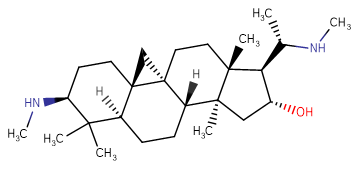
Cyclovirobuxin D
CAS No. 860-79-7
Cyclovirobuxin D( CVB-D | NSC 91722 )
Catalog No. M16237 CAS No. 860-79-7
Extracted from Buxus microphylla.
Purity : >98% (HPLC)
 COA
Datasheet
HNMR
HPLC
MSDS
Handing Instructions
COA
Datasheet
HNMR
HPLC
MSDS
Handing Instructions
| Size | Price / USD | Stock | Quantity |
| 10MG | 35 | In Stock |


|
| 25MG | 53 | In Stock |
|
| 50MG | 73 | In Stock |
|
| 100MG | 105 | In Stock |
|
| 200MG | Get Quote | In Stock |
|
| 500MG | 254 | In Stock |
|
| 1G | Get Quote | In Stock |
|
Biological Information
-
Product NameCyclovirobuxin D
-
NoteResearch use only, not for human use.
-
Brief DescriptionExtracted from Buxus microphylla.
-
DescriptionExtracted from Buxus microphylla;Suitability:Chloroform,methanol and ethanol;Store the product in sealed,cool and dry condition.
-
In VitroCyclovirobuxine D (0-240 μM ;24-72 hours) shows a concentration- and time-dependent reduced cell viability after CVB-D treatment, only 10% MGC-803 cells and 20% MKN28 cells are alive at 72 h after treatment with 240 μM.Cyclovirobuxine D (0-120 μM; 48 hours) arrests the cell cycle of gastric cancer cells at S phase in a concentration-dependent manner.Cyclovirobuxine D (0-120 μM; 48 hours) leads to apoptosis in gastric cancer cells in a concentration-dependent manner, especially early stage apoptosis.Cyclovirobuxine D (0-120 μM; 48 hours) causes apoptosis via up-regulation of the apoptosis- related proteins, cleaved Caspase-3 and ratio of Bax/Bcl-2, in gastric cancer cells. Cell Viability Assay Cell Line:MGC-803 and MKN28 cells Concentration:0, 30, 60, 120 and 240 μM Incubation Time:24, 48, 72 hours Result:Reduced Cell Viability and Colony Formation Ability of Gastric Cancer Cells Cell Cycle Analysis Cell Line:MGC-803 and MKN28 cells Concentration:0, 30, 60, and 120 μM Incubation Time:48 hours Result:Arrested cell cycle progressions of MGC-803 and MKN28 cells.Apoptosis Analysis Cell Line:MGC-803 and MKN28 cells Concentration:0, 30, 60, and 120 μM Incubation Time:48 hours Result:Induced apoptosis of MGC-803 and MKN28 cells.Western Blot Analysis Cell Line:MGC-803 and MKN28 cells Concentration:0, 30, 60, and 120 μM Incubation Time:48 hoursResult:Up-regulated cleaved Caspase-3 and Bax and decreased the expression of Bcl-2 expression.
-
In Vivo——
-
SynonymsCVB-D | NSC 91722
-
PathwayOthers
-
TargetOther Targets
-
RecptorOthers
-
Research AreaOther Indications
-
Indication——
Chemical Information
-
CAS Number860-79-7
-
Formula Weight402.66
-
Molecular FormulaC26H46N2O
-
Purity>98% (HPLC)
-
SolubilityEthanol: 20 mg/mL (49.66 mM)
-
SMILESC[C@H](NC)[C@H]1[C@H](O)C[C@@]2(C)[C@]3([H])CC[C@@]4([H])C(C)(C)[C@@H](NC)CC[C@]4(C5)[C@@]35CC[C@]12C
-
Chemical Name9,19-Cyclo-5-alpha,9-beta-pregnan-16-alpha-ol, 4,4,14-trimethyl-3-beta,20-alpha-bis(methylamino)-
Shipping & Storage Information
-
Storage(-20℃)
-
ShippingWith Ice Pack
-
Stability≥ 2 years
Reference
1.Hu D, et al. Eur J Pharmacol, 2007, 569(1-2), 103-109.
molnova catalog



related products
-
Magnesium glycinate
Magnesium glycinate is a supplement that boost magnesium levels in people with a deficiency of the mineral.
-
Enmein, 13-deoxy-19-...
Enmein, 13-deoxy-19-hydroxy-, (19R)- is an Enmein-?type diterpene derivative and can be used in the preparation of antitumor drugs.
-
Licarin A b
Licarin A ((+)-Licarin A), a neolignan, significantly and dose-dependently reduces TNF-α production (IC50=12.6 μM) in dinitrophenyl-human serum albumin (DNP-HSA)-stimulated RBL-2H3 cells. Anti-allergic effects. Licarin A reduces TNF-α and PGD2 production, and COX-2 expression.
