


 Cart
Cart
 sales@molnova.com


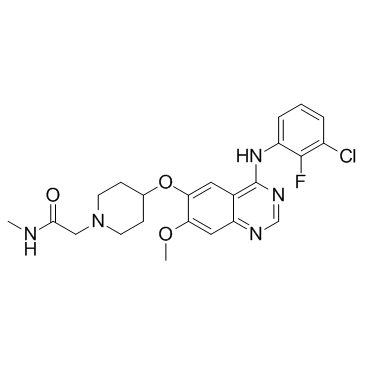
Sapitinib
CAS No. 848942-61-0
Sapitinib( AZD-8931 | AZD8931 )
Catalog No. M16163 CAS No. 848942-61-0
Sapitinib (AZD-8931, AZD8931) is a equipotent, reversible inhibitor of EGFR, ErbB2 and ErbB3 with IC50 of 4. 3 and 4 nM (phosphorylation inhibition), respectively.
Purity : >98% (HPLC)
 COA
Datasheet
HNMR
HPLC
MSDS
Handing Instructions
COA
Datasheet
HNMR
HPLC
MSDS
Handing Instructions
| Size | Price / USD | Stock | Quantity |
| 1 mL x 10 mM in DMSO | 51 | In Stock |


|
| 2MG | 30 | In Stock |
|
| 5MG | 49 | In Stock |
|
| 10MG | 75 | In Stock |
|
| 25MG | 107 | In Stock |
|
| 50MG | 157 | In Stock |
|
| 100MG | 234 | In Stock |
|
| 200MG | Get Quote | In Stock |
|
| 500MG | Get Quote | In Stock |
|
| 1G | Get Quote | In Stock |
|
Biological Information
-
Product NameSapitinib
-
NoteResearch use only, not for human use.
-
Brief DescriptionSapitinib (AZD-8931, AZD8931) is a equipotent, reversible inhibitor of EGFR, ErbB2 and ErbB3 with IC50 of 4. 3 and 4 nM (phosphorylation inhibition), respectively.
-
DescriptionSapitinib (AZD-8931, AZD8931) is a equipotent, reversible inhibitor of EGFR, ErbB2 and ErbB3 with IC50 of 4. 3 and 4 nM (phosphorylation inhibition), respectively; displays >1,000-fold selectivity over a panel of 206 of kinases, >100-fold selectivity for MNK1 and Flt3; AZD8931 is significantly more potent than gefitinib or lapatinib in specific squamous cell carcinoma of the head and neck and non-small cell lung carcinoma cell lines; inhibits xenograft growth in a range of models while significantly affecting EGFR, erbB2, and erbB3 phosphorylation and downstream signaling pathways, apoptosis, and proliferation.Colon Cancer Phase 2 Clinical(In Vitro):AZD8931 shows potent inhibitory effect on erbB2 in the ligand-independent MCF-7 cl24 cells, with IC50 of 59 nM. AZD8931 (1 μM) has no significant effect on EGFR expression level, but significantly inhibitsphosphorylation of Akt in a time- and dose-dependent manner in both SUM149 and FC-IBC-02 cells. AZD8931 (0.01, 0.1, 1, or 2 μM) inhibits proliferation and induces apoptosis in human IBC cells. At the cellular level, AZD8931 inhibits EGF-stimulated phosphorylation of EGFR in the KB cell line (IC50: 4 nM) and heregulin-stimulated phosphorylation of HER2 (IC50: 3 nM) and HER3 (IC50: 4 nM) in the MCF-7 cell line. However, AZD8931 exhibits no CYP P450 inhibition (IC50 > 10 μM against 1A2, 2C9, 2C19, 2D6, and 3A4). (In Vivo):AZD8931 (6.25-50 mg/kg, p.o.) significantly inhibits BT474c (breast), Calu-3 (NSCLC), LoVo (colorectal), FaDu (SCCHN), and PC-9 (NSCLC) tumor xenograft growth. AZD8931 is active in xenograft tumor models responsive to EGFR inhibition alone (LoVo and PC-9) or EGFR or erbB2 inhibition (BT474c, Calu-3, and FaDu). AZD8931 causes pharmacodynamic changes in proliferation and apoptosis markers in human tumor xenograft models. AZD8931 (25 mg/kg, p.o.) significantly inhibits the growth of SUM149 and FC-IBC-02 cells in vivo in SCID mice. AZD8931 displays favorable oral pharmacokinetics in rat and dog (low clearance and good bioavailability) and low human hepatocyte turnover (Clint < 4.5 μL/min/106 cells). In nude mouse after oral administration at 50 mg/kg, AZD8931 shows improved exposure, and at at 100 mg/kg oral dose once daily, it shows potent tumor growth inhibition activity in the LoVo mouse xenograft model.
-
In VitroAZD8931 shows potent inhibitory effect on erbB2 in the ligand-independent MCF-7 cl24 cells, with IC50 of 59 nM. AZD8931 (1 μM) has no significant effect on EGFR expression level, but significantly inhibits phosphorylation of Akt in a time- and dose-dependent manner in both SUM149 and FC-IBC-02 cells. AZD8931 (0.01, 0.1, 1, or 2 μM) inhibits proliferation and induces apoptosis in human IBC cells. At the cellular level, AZD8931 inhibits EGF-stimulated phosphorylation of EGFR in the KB cell line (IC50: 4 nM) and heregulin-stimulated phosphorylation of HER2 (IC50: 3 nM) and HER3 (IC50: 4 nM) in the MCF-7 cell line. However, AZD8931 exhibits no CYP P450 inhibition (IC50 > 10 μM against 1A2, 2C9, 2C19, 2D6, and 3A4).
-
In VivoAZD8931 (6.25-50 mg/kg, p.o.) significantly inhibits BT474c (breast), Calu-3 (NSCLC), LoVo (colorectal), FaDu (SCCHN), and PC-9 (NSCLC) tumor xenograft growth. AZD8931 is active in xenograft tumor models responsive to EGFR inhibition alone (LoVo and PC-9) or EGFR or erbB2 inhibition (BT474c, Calu-3, and FaDu). AZD8931 causes pharmacodynamic changes in proliferation and apoptosis markers in human tumor xenograft models. AZD8931 (25 mg/kg, p.o.) significantly inhibits the growth of SUM149 and FC-IBC-02 cells in vivo in SCID mice. AZD8931 displays favorable oral pharmacokinetics in rat and dog (low clearance and good bioavailability) and low human hepatocyte turnover (Clint < 4.5 μL/min/106 cells). In nude mouse after oral administration at 50 mg/kg, AZD8931 shows improved exposure, and at at 100 mg/kg oral dose once daily, it shows potent tumor growth inhibition activity in the LoVo mouse xenograft model.
-
SynonymsAZD-8931 | AZD8931
-
PathwayAngiogenesis
-
TargetEGFR
-
RecptorEGFR|HER2/ErbB2
-
Research AreaCancer
-
IndicationColon Cancer
Chemical Information
-
CAS Number848942-61-0
-
Formula Weight473.9277
-
Molecular FormulaC23H25ClFN5O3
-
Purity>98% (HPLC)
-
SolubilityDMSO: ≥ 33 mg/mL
-
SMILESO=C(NC)CN1CCC(OC2=CC3=C(NC4=CC=CC(Cl)=C4F)N=CN=C3C=C2OC)CC1
-
Chemical Name1-Piperidineacetamide, 4-[[4-[(3-chloro-2-fluorophenyl)amino]-7-methoxy-6-quinazolinyl]oxy]-N-methyl-
Shipping & Storage Information
-
Storage(-20℃)
-
ShippingWith Ice Pack
-
Stability≥ 2 years
Reference
1. Hickinson DM, et al. Clin Cancer Res. 2010 Feb 15;16(4):1159-69.
2. Singleton KR, et al. Mol Pharmacol. 2013 Apr;83(4):882-93.
3. Barlaam B, et al. ACS Med Chem Lett. 2013 May 31;4(8):742-6.
4. Mu Z, et al. J Exp Clin Cancer Res. 2014 May 30;33:47.
molnova catalog



related products
-
Cimigenoside
Cimigenoside is an active compound from genus Cimicifuga.
-
OBX02-011
OBX02-011 is an effective and reversible inhibitor of EGFR tyrosine kinase with IC50s of 0.134 and 2.09 nM for triple mutants Del19/T790M/C797S and L858R/T790M/C797S.
-
AZ7550
AZ7550 is an active metabolite of AZD9291 and inhibits the activity of IGF1R with an IC50 of 1.6 μM.
