


 Cart
Cart
 sales@molnova.com


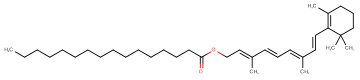
Retinol palmitate
CAS No. 79-81-2
Retinol palmitate( all-trans Retinyl Palmitate | Vitamin A Palmitate )
Catalog No. M15988 CAS No. 79-81-2
Vitamin A palmitate is a more stable, synthetic version of the essential nutrient vitamin A joined to palmitic acid.
Purity : >98% (HPLC)
 COA
Datasheet
HNMR
HPLC
MSDS
Handing Instructions
COA
Datasheet
HNMR
HPLC
MSDS
Handing Instructions
| Size | Price / USD | Stock | Quantity |
| 50MG | 28 | In Stock |


|
| 100MG | 39 | In Stock |
|
| 200MG | Get Quote | In Stock |
|
| 500MG | Get Quote | In Stock |
|
| 1G | Get Quote | In Stock |
|
Biological Information
-
Product NameRetinol palmitate
-
NoteResearch use only, not for human use.
-
Brief DescriptionVitamin A palmitate is a more stable, synthetic version of the essential nutrient vitamin A joined to palmitic acid.
-
DescriptionVitamin A palmitate is a more stable, synthetic version of the essential nutrient vitamin A joined to palmitic acid.
-
In VitroRetinyl palmitate has a high molecular weight and a stable formulation. To be active, Retinyl palmitate should be enzymatically converted in the skin to retinol by cleavage of the ester linkage and must then be converted to tretinoin via oxidative processes.
-
In VivoThe topical administration of Retinyl palmitate in rats results in increased protein and collagen and an epidermal thickening.
-
Synonymsall-trans Retinyl Palmitate | Vitamin A Palmitate
-
PathwayOthers
-
TargetOther Targets
-
RecptorOthers
-
Research AreaOther Indications
-
Indication——
Chemical Information
-
CAS Number79-81-2
-
Formula Weight524.86
-
Molecular FormulaC36H60O2
-
Purity>98% (HPLC)
-
SolubilitySoluble in hydrocarbons
-
SMILESCCCCCCCCCCCCCCCC(=O)OC/C=C(\C)/C=C/C=C(\C)/C=C/C1=C(CCCC1(C)C)C
-
Chemical Name——
Shipping & Storage Information
-
Storage(-20℃)
-
ShippingWith Ice Pack
-
Stability≥ 2 years
Reference
1.Athanassiades TJ, et al. J Natl Y Inst, 1981, 67(5), 1153-1156.
molnova catalog



related products
-
(D-Trp11)-Neurotensi...
(D-Trp11)-Neurotensin
-
Pramipexole 2HCl Mon...
Pramipexole Dihydrochloride is the hydrochloride salt of pramipexole, a benzothiazole derivative. As a nonergot dopamine agonist, pramipexole binds to D2 and D3 dopamine receptors in the striatum and substantia nigra of the brain.
-
Ishophloroglucin A
Ishophloroglucin A
