


 Cart
Cart
 sales@molnova.com


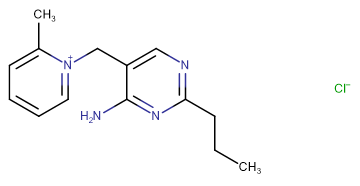
Amprolium
CAS No. 121-25-5
Amprolium( Amprolium )
Catalog No. M10792 CAS No. 121-25-5
Amprolium is a coccidiostat used in poultry, is a thiamine analogue and blocks the thiamine transporter of Eimeria species by blocking thiamine uptake it prevents carbohydrate synthesis.
Purity : >98% (HPLC)
 COA
Datasheet
HNMR
HPLC
MSDS
Handing Instructions
COA
Datasheet
HNMR
HPLC
MSDS
Handing Instructions
| Size | Price / USD | Stock | Quantity |
| 5MG | 54 | In Stock |


|
| 10MG | 85 | In Stock |
|
| 50MG | 236 | In Stock |
|
| 100MG | 369 | In Stock |
|
| 200MG | Get Quote | In Stock |
|
| 500MG | Get Quote | In Stock |
|
| 1G | Get Quote | In Stock |
|
Biological Information
-
Product NameAmprolium
-
NoteResearch use only, not for human use.
-
Brief DescriptionAmprolium is a coccidiostat used in poultry, is a thiamine analogue and blocks the thiamine transporter of Eimeria species by blocking thiamine uptake it prevents carbohydrate synthesis.
-
DescriptionAmprolium is a coccidiostat used in poultry, is a thiamine analogue and blocks the thiamine transporter of Eimeria species by blocking thiamine uptake it prevents carbohydrate synthesis.
-
In Vitro——
-
In Vivo——
-
SynonymsAmprolium
-
PathwayOthers
-
TargetOther Targets
-
Recptorthiamine
-
Research AreaInfection
-
Indication——
Chemical Information
-
CAS Number121-25-5
-
Formula Weight278.79
-
Molecular FormulaC14H19N4·Cl
-
Purity>98% (HPLC)
-
SolubilityWater: 10 mM
-
SMILESCC1=CC=CC=[N+]1CC2=CN=C(CCC)N=C2N.[Cl-]
-
Chemical Name2-Picolinium, 1-((4-amino-2-propyl-5-pyrimidinyl)methyl)-, chloride
Shipping & Storage Information
-
Storage(-20℃)
-
ShippingWith Ice Pack
-
Stability≥ 2 years
Reference
1.Iqbal A, et al. J Parasit Dis. 2013 Apr;37(1):88-93.
molnova catalog



related products
-
3,6-O-Diferuloyl-4-O...
3-O-Feruloyl-6′-O-(4-O-β-D-glucopyranosylferuloyl)sucrose is a natural compound that can be isolated from Lilium henryi Baker .
-
Bephenium Hydroxynap...
Bephenium hydroxynaphthoate (INN, trade names Alcopara, Alcopar, Befenium, Debefenium, Francin, Nemex) is an anthelmintic agent formerly used in the treatment of hookworm infections and ascariasis.
-
2-(2,6-dioxopiperidi...
2-(2,6-dioxopiperidin-3-yl)-4-((7-hydrox is protac.
