


 Cart
Cart
 sales@molnova.com


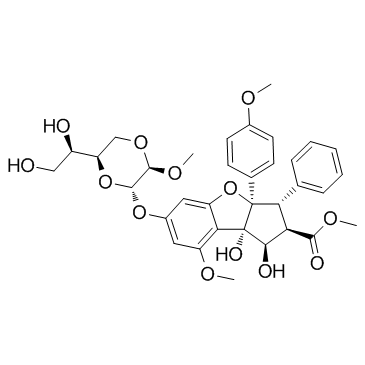
Silvestrol
CAS No. 697235-38-4
Silvestrol( -)-Silvestrol )
Catalog No. M15673 CAS No. 697235-38-4
Silvestrol is a potential anticancer rocaglate derivative from Aglaia foveolata, induces apoptosis in cancer cells through the mitochondrial/apoptosome pathway.
Purity : >98% (HPLC)
 COA
Datasheet
HNMR
HPLC
MSDS
Handing Instructions
COA
Datasheet
HNMR
HPLC
MSDS
Handing Instructions
| Size | Price / USD | Stock | Quantity |
| 5MG | 2133 | Get Quote |


|
| 50MG | 4302 | Get Quote |
|
| 100MG | 6030 | Get Quote |
|
| 200MG | Get Quote | Get Quote |
|
| 500MG | Get Quote | Get Quote |
|
| 1G | Get Quote | Get Quote |
|
Biological Information
-
Product NameSilvestrol
-
NoteResearch use only, not for human use.
-
Brief DescriptionSilvestrol is a potential anticancer rocaglate derivative from Aglaia foveolata, induces apoptosis in cancer cells through the mitochondrial/apoptosome pathway.
-
DescriptionSilvestrol is a potential anticancer rocaglate derivative from Aglaia foveolata, induces apoptosis in cancer cells through the mitochondrial/apoptosome pathway; effectively targets the cyclin/CDK/Rb pathway, and additionally induces cytotoxicity via intrinsic apoptosis, exhibits low nanomolar potency both in MCL cell lines and primary MCL tumor cells; demonstrates B-cell selective activity in chronic lymphocytic leukemia and acute lymphoblastic leukemia in vitro and in vivo.
-
In VitroSilvestrol is a specific eIF4A-targeting translation inhibitor. Silvestrol exhibits significant cytotoxic activity against many human cancer cell lines, such as lung, prostate, and breast cancer with IC50 values ranging from 1 to 7 nM. Silvestrol significantly reduces the number of LNCaP cell colonies. Silvestrol (30 nM, 120 nM) induces apoptosis in LNCaP cells, through the mitochondrial pathway. Apaf-1, Caspase-2, caspase-9, and caspase-10 are involved in Silvestrol-induced apoptosis but caspase-3 and 7 are not. Silvestrol induces caspase-3 activation and apoptotic cell death in a time- and dose-dependent manner. Silvestrol-mediated cell death is attenuated in ATG7-null mouse embryonic fibroblasts (MEFs) lacking a functional autophagy protein.Silvestrol (50 nM) exerts an immediate inhibitory effect and causes near-static cell index compared with the control cells. Silvestrol (6.25 nM) enhances proliferation more than the vehicle control-treated cells, whereas a higher concentration of Silvestrol (50 nM) can inhibit cell proliferation. Silvestrol and episilvestrol display synergistic effects in combination with CDDP.
-
In VivoSilvestrol (1.5 mg/kg, i.p.) does not adversely affect production of human IgG by xenografted B-lymphocytes in mice. Silvestrol significantly prolongs survival compared to vehicle. There is no such lymphocyte infiltration detected in the spleens of any of the Silvestrol-treated mice, and nor do these animals exhibit any other obvious signs of lymphoma upon necropsy.
-
Synonyms-)-Silvestrol
-
PathwayApoptosis
-
TargetApoptosis
-
RecptorApoptosis
-
Research AreaCancer
-
Indication——
Chemical Information
-
CAS Number697235-38-4
-
Formula Weight654.665
-
Molecular FormulaC34H38O13
-
Purity>98% (HPLC)
-
SolubilityDMSO; H2O: < 1 mg/mL
-
SMILESO=C([C@H]([C@H]1C2=CC=CC=C2)[C@@H](O)[C@]3(O)[C@@]1(C4=CC=C(OC)C=C4)OC5=C3C(OC)=CC(OC6O[C@@H]([C@H](O)CO)CO[C@H]6OC)=C5)OC
-
Chemical Name1H-Cyclopenta[b]benzofuran-2-carboxylic acid, 6-[[(2S,3R,6R)-6-[(1R)-1,2-dihydroxyethyl]-3-methoxy-1,4-dioxan-2-yl]oxy]-2,3,3a,8b-tetrahydro-1,8b-dihydroxy-8-methoxy-3a-(4-methoxyphenyl)-3-phenyl-, methyl ester, (1R,2R,3S,3aR,8bS)-
Shipping & Storage Information
-
Storage(-20℃)
-
ShippingWith Ice Pack
-
Stability≥ 2 years
Reference



-
HYPOCRELLIN B
HYPOCRELLIN B are photosensitive pigments isolated from Hypocrella bambusae Sacc. Hypocrellin B causes DNA strand breakage induces apoptosis in ovarian cancer cells and inhibits proliferation of Staphylococcus by increasing ROS levels and damaging cell walls.
-
AEG 3482
AEG 3482 is a potent antiapoptotic compound. AEG 3482 inhibits Jun kinase (JNK) activity through induced expression of heat shock protein 70 (HSP70). AEG 3482 directly binds HSP90, thereby facilitating HSF1-dependent expression of HSP70 and HSP25.
-
1-[2,4-Dihydroxy-6-m...
Xanthohumol, prenylchacone flavonoid, is a natural product with multi-biofunctions purified from Hops Humulus lupulus. Xanthohumol is effective against HIV-1 and might serve as an interesting lead compound. It may represent a novel chemotherapeutic agent for HIV-1 infection.
