


 Cart
Cart
 sales@molnova.com


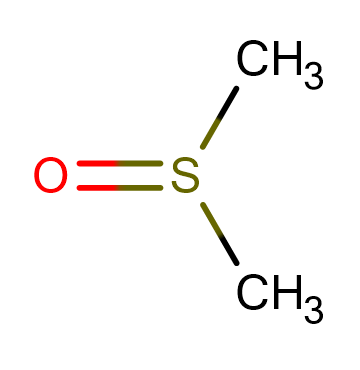
Dimethyl sulfoxide
CAS No. 67-68-5
Dimethyl sulfoxide( —— )
Catalog No. M15586 CAS No. 67-68-5
A highly polar organic liquid, that is used widely as a chemical solvent.
Purity : >98% (HPLC)
 COA
Datasheet
HNMR
HPLC
MSDS
Handing Instructions
COA
Datasheet
HNMR
HPLC
MSDS
Handing Instructions
| Size | Price / USD | Stock | Quantity |
| 100MG | Get Quote | In Stock |


|
| 200MG | Get Quote | In Stock |
|
| 500MG | Get Quote | In Stock |
|
| 1G | Get Quote | In Stock |
|
Biological Information
-
Product NameDimethyl sulfoxide
-
NoteResearch use only, not for human use.
-
Brief DescriptionA highly polar organic liquid, that is used widely as a chemical solvent.
-
DescriptionA highly polar organic liquid, that is used widely as a chemical solvent. Because of its ability to penetrate biological membranes, it is used as a vehicle for topical application of pharmaceuticals. It is also used to protect tissue during CRYOPRESERVATION. Dimethyl sulfoxide shows a range of pharmacological activity including analgesia and anti-inflammation.
-
In Vitro——
-
In Vivo——
-
Synonyms——
-
PathwayOthers
-
TargetOther Targets
-
RecptorOthers
-
Research Area——
-
Indication——
Chemical Information
-
CAS Number67-68-5
-
Formula Weight78.13
-
Molecular FormulaC2H6OS
-
Purity>98% (HPLC)
-
Solubilitysoluble in Water
-
SMILESCS(C)=O
-
Chemical Name——
Shipping & Storage Information
-
Storage(-20℃)
-
ShippingWith Ice Pack
-
Stability≥ 2 years
Reference
1. Lehigh Shirey EA, et al. Environ Res. 2006 Oct;102(2):205-14.
molnova catalog



related products
-
CRCD2
1H-Benzimidazole-6-carboxamide, N-[3-(aminocarbonyl)-4,5,6,7-tetrahydrobenzo[b]thien-2-yl]- may have antitumor activity.
-
Acetyl-Amylin (8-37)...
Acetyl-Amylin (8-37) (mouse, rat)
-
Leptin Receptor Prec...
Leptin Receptor Precursor
