


 Cart
Cart
 sales@molnova.com


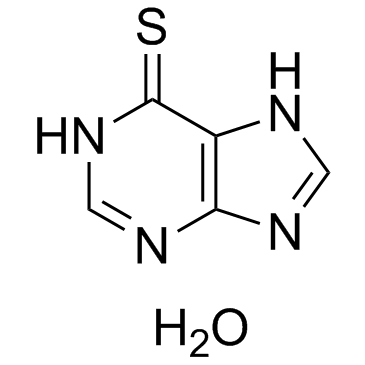
6-Mercaptopurine monohydrate
CAS No. 6112-76-1
6-Mercaptopurine monohydrate( 6-MP )
Catalog No. M15299 CAS No. 6112-76-1
ercaptopurine is a widely used antileukemic agent and immunosuppressive drug that inhibits de novo purine synthesis through incorporation of thiopurine methyltransferase metabolites into DNA and RNA.
Purity : >98% (HPLC)
 COA
Datasheet
HNMR
HPLC
MSDS
Handing Instructions
COA
Datasheet
HNMR
HPLC
MSDS
Handing Instructions
| Size | Price / USD | Stock | Quantity |
| 50MG | 28 | In Stock |


|
| 100MG | 34 | In Stock |
|
| 200MG | Get Quote | In Stock |
|
| 500MG | 45 | In Stock |
|
| 1G | 65 | In Stock |
|
Biological Information
-
Product Name6-Mercaptopurine monohydrate
-
NoteResearch use only, not for human use.
-
Brief Descriptionercaptopurine is a widely used antileukemic agent and immunosuppressive drug that inhibits de novo purine synthesis through incorporation of thiopurine methyltransferase metabolites into DNA and RNA.
-
Descriptionercaptopurine is a widely used antileukemic agent and immunosuppressive drug that inhibits de novo purine synthesis through incorporation of thiopurine methyltransferase metabolites into DNA and RNA.(In Vitro):6-Mercaptopurine hydrate (Mercaptopurine hydrate; 6-MP hydrate) induces NR4A3 transcriptional activity 1.6- to 11-fold (P<0.01) in a dose-responsive manner. It is found that 6-Mercaptopurine hydrate leads to a dose-dependent increase in NR4A3 protein levels.6-Mercaptopurine hydrate treatment increases cell surface GLUT4 in both basal cells 1.8- to 3.6-fold (P<0.01) and insulin-stimulated cells 2.9- to 4.4-fold (P<0.01) over that in controls. It is also found that 6-Mercaptopurine hydrate increases phospho-AS160 significantly in a dose-responsive manner under both basal and insulin-stimulated conditions.(In Vivo):In the fetal telencephalons of the 6-Mercaptopurine hydrate (6-MP)-treated group, the S phase cell population increases at 36 and 48 h and returns to the control level at 72 h after treatment. The G2/M phase cell population begins to increase at 24 h, peaks at 36 h, decreases at 48 h, and finally returnes to the control level at 72 h. On the other hand, the sub-G1 phase cell population (apoptotic cells) begins to increase at 36 h, peaks at 48 h, and then decreases at 72 h.
-
In Vitro6-Mercaptopurine hydrate (Mercaptopurine hydrate; 6-MP hydrate) induces NR4A3 transcriptional activity 1.6- to 11-fold (P<0.01) in a dose-responsive manner. It is found that 6-Mercaptopurine hydrate leads to a dose-dependent increase in NR4A3 protein levels. 6-Mercaptopurine hydrate treatment increases cell surface GLUT4 in both basal cells 1.8- to 3.6-fold (P<0.01) and insulin-stimulated cells 2.9- to 4.4-fold (P<0.01) over that in controls. It is also found that 6-Mercaptopurine hydrate increases phospho-AS160 significantly in a dose-responsive manner under both basal and insulin-stimulated conditions.
-
In VivoIn the fetal telencephalons of the 6-Mercaptopurine hydrate (6-MP)-treated group, the S phase cell population increases at 36 and 48 h and returns to the control level at 72 h after treatment. The G2/M phase cell population begins to increase at 24 h, peaks at 36 h, decreases at 48 h, and finally returnes to the control level at 72 h. On the other hand, the sub-G1 phase cell population (apoptotic cells) begins to increase at 36 h, peaks at 48 h, and then decreases at 72 h.
-
Synonyms6-MP
-
PathwayCell Cycle/DNA Damage
-
TargetDNA/RNA Synthesis
-
RecptorDNA synthesis| PRPP Amidotransferase
-
Research AreaOther Indications
-
Indication——
Chemical Information
-
CAS Number6112-76-1
-
Formula Weight170.19
-
Molecular FormulaC5H6N4OS
-
Purity>98% (HPLC)
-
SolubilityDMSO: 100 mg/mL; Water <1 mg/mL
-
SMILESO.S=C1N=CNC2=C1NC=N2
-
Chemical Name——
Shipping & Storage Information
-
Storage(-20℃)
-
ShippingWith Ice Pack
-
Stability≥ 2 years
Reference
1.Sahasranaman S, et al. Eur J Clin Pharmacol, 2008, 64(8), 753-767.
molnova catalog



related products
-
Calcium folinate
Leucovorin Calcium is a reduced folic acid.
-
2-Deoxyadenosine-5-t...
2'-Deoxyadenosine-5'-triphosphate trisodium (dATP trisodium) is a nucleotide substrate for DNA polymerase, essential for DNA synthesis and replication in cells.
-
Treosulfan
Treosulfan is a bifunctional alkylating agent. It also has activity in ovarian cancer and other solid tumor types.
