


 Cart
Cart
 sales@molnova.com


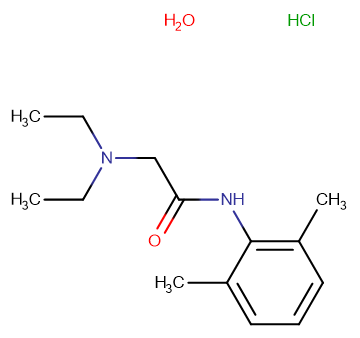
Lidocaine Hydrochloride hydrate
CAS No. 6108-05-0
Lidocaine Hydrochloride hydrate( —— )
Catalog No. M15297 CAS No. 6108-05-0
Lidocaine, an amide local anesthetic, has anti-inflammatory properties in vitro and in vivo.
Purity : >98% (HPLC)
 COA
Datasheet
HNMR
HPLC
MSDS
Handing Instructions
COA
Datasheet
HNMR
HPLC
MSDS
Handing Instructions
| Size | Price / USD | Stock | Quantity |
| 1 mL x 10 mM in DMSO | 28 | In Stock |


|
| 50MG | 28 | In Stock |
|
| 100MG | 39 | In Stock |
|
| 200MG | Get Quote | In Stock |
|
| 500MG | 89 | In Stock |
|
| 1G | 132 | In Stock |
|
Biological Information
-
Product NameLidocaine Hydrochloride hydrate
-
NoteResearch use only, not for human use.
-
Brief DescriptionLidocaine, an amide local anesthetic, has anti-inflammatory properties in vitro and in vivo.
-
DescriptionLidocaine, an amide local anesthetic, has anti-inflammatory properties in vitro and in vivo, possibly due to an attenuation of pro-inflammatory cytokines, intracellular adhesion molecule-1 (ICAM-1), and reduction of neutrophils influx.(In Vitro):Lidocaine (Lignocaine) (10 nM; 48 hours) decreases significantly cell proliferation.Lidocaine (1-10 nM; 24-72 hours) inhibits cell viability and achieves the most suppressing effects at the concentration of 10 nM and treatment time 48 hours.Lidocaine (10 nM; 48 hours) increases significantly the apoptotic cell rate.Lidocaine (10 nM; 48 hours) down-regulates Cyclin D1 and up-regulates p21 expression significantly.(In Vivo):Lidocaine (Lignocaine) causes completely reversible tail nerve block in rats. Mechanical nociception block produced by lidocaine has slower onset and faster recovery compared with thermal nociception block.
-
In VitroLidocaine (Lignocaine) (10 nM; 48 hours) decreases significantly cell proliferation. Lidocaine (1-10 nM; 24-72 hours) inhibits cell viability and achieves the most suppressing effects at the concentration of 10?nM and treatment time 48?hours. Lidocaine (10 nM; 48 hours) increases significantly the apoptotic cell rate. Lidocaine (10 nM; 48 hours) down-regulates Cyclin D1 and up-regulates p21 expression significantly. Cell Proliferation Assay Cell Line:The human gastric cancer cell line MKN45 Concentration:10?nM Incubation Time:48 hours Result:Decreased significantly cell proliferation.Cell Viability Assay Cell Line:The human gastric cancer cell line MKN45 Concentration:1, 5 and 10?nMIncubation Time:24, 48, 72 hours Result:Inhibited MKN45 cell viability.Apoptosis Analysis Cell Line:The human gastric cancer cell line MKN45 Concentration:10?nM Incubation Time:48 hours Result:Increased significantly the apoptotic cell rate.Western Blot Analysis Cell Line:The human gastric cancer cell line MKN45 Concentration:10?nM Incubation Time:48 hours Result:Down-regulated Cyclin D1 and up-regulated p21 expression significantly.
-
In VivoLidocaine (Lignocaine) causes completely reversible tail nerve block in rats. Mechanical nociception block produced by lidocaine has slower onset and faster recovery compared with thermal nociception block.
-
Synonyms——
-
PathwayAngiogenesis
-
TargetEGFR
-
RecptorEGFR| Sodium Channel
-
Research AreaCardiovascular Disease
-
Indication——
Chemical Information
-
CAS Number6108-05-0
-
Formula Weight288.82
-
Molecular FormulaC14H22N2O·HCl·H2O
-
Purity>98% (HPLC)
-
SolubilityDMSO: 10 mM
-
SMILESO.Cl.CCN(CC)CC(=O)NC1=C(C)C=CC=C1C
-
Chemical Name——
Shipping & Storage Information
-
Storage(-20℃)
-
ShippingWith Ice Pack
-
Stability≥ 2 years
Reference
1.Sheets PL, et al. J Physiol. 2007 Jun 15;581(Pt 3):1019-3
molnova catalog



related products
-
SDZ281-977
SDZ 281-977 is a derivative of Lavendustin A, an EGF receptor tyrosine kinase inhibitor.
-
UNC0631
UNC0631 is a effectvie histone methyltransferase G9a inhibitor (IC50=4 nM).
-
Daphnetin
Daphnetin, a natural coumarin derivative, is a protein kinase inhibitor, inhibits EGFR, PKA and PKC with IC50 of 7.67 μM, 9.33 μM and 25.01 μM, respectively, also known to exhibit anti-inflammatory and anti-oxidant activities.
