


 Cart
Cart
 sales@molnova.com


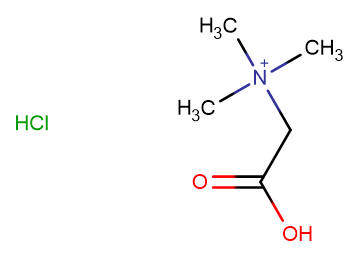
Betaine hydrochloride
CAS No. 590-46-5
Betaine hydrochloride( —— )
Catalog No. M15185 CAS No. 590-46-5
Betaine hydrochloride is an acidic form of betaine, a vitamin-like substance found in grains and other foods.
Purity : >98% (HPLC)
 COA
Datasheet
HNMR
HPLC
MSDS
Handing Instructions
COA
Datasheet
HNMR
HPLC
MSDS
Handing Instructions
| Size | Price / USD | Stock | Quantity |
| 50MG | 45 | In Stock |


|
| 100MG | Get Quote | In Stock |
|
| 200MG | Get Quote | In Stock |
|
| 500MG | Get Quote | In Stock |
|
| 1G | Get Quote | In Stock |
|
Biological Information
-
Product NameBetaine hydrochloride
-
NoteResearch use only, not for human use.
-
Brief DescriptionBetaine hydrochloride is an acidic form of betaine, a vitamin-like substance found in grains and other foods.
-
DescriptionBetaine hydrochloride is an acidic form of betaine, a vitamin-like substance found in grains and other foods; improves the amplification of DNA by reducing the formation of secondary structure in GC-rich regions.(In Vitro):It is found that proliferation of HeLa cells is inhibited significantly upon exposure to increasing Betaine hydrochloride levels with the MTT test (p<0.05). The percentage of S phase cells in the low dose groups (<5 mg/mL) are distinctly higher than in high dose groups, and the rates of Sub-G1 phase are the opposite (p<0.05). A high concentration of Betaine hydrochloride (>5.0 mg/mL) significantly promotes the apoptosis of HeLa cells (p<0.01). SOD activities of the low dose groups are slightly higher than the control group (p<0.05), and there are obvious synchronicity and correlation among the expression of promoting apoptosis genes Bax, P53, Caspase 3 and apoptosis suppression gene Bcl-2. In response to an apoptosis-inducing stimulus, p53 and cyclin D1 can be activated with blockage of the cell cycle at G1/S or S/G2 checkpoints. (In Vivo):Liver-to-body weight ratio is attenuated by Betaine hydrochloride supplementation. When Betaine hydrochloride is added to the alcohol-containing liquid diet, both hepatic triglyceride (TG) accumulation and liver injury are significantly reduced. Betaine hydrochloride supplementation attenuates epididymal fat pad mass loss induced by chronic alcohol feeding. Betaine hydrochloride supplementation prevents the depletion of S-adenosylhomocysteine (SAM) and reduces the increase in S-adenosylhomocysteine (SAH), thereby improving the methylation state of the adipose tissue.
-
In VitroIt is found that proliferation of HeLa cells is inhibited significantly upon exposure to increasing Betaine hydrochloride levels with the MTT test (p<0.05). The percentage of S phase cells in the low dose groups (<5 mg/mL) are distinctly higher than in high dose groups, and the rates of Sub-G1 phase are the opposite (p<0.05). A high concentration of Betaine hydrochloride (>5.0 mg/mL) significantly promotes the apoptosis of HeLa cells (p<0.01). SOD activities of the low dose groups are slightly higher than the control group (p<0.05), and there are obvious synchronicity and correlation among the expression of promoting apoptosis genes Bax, P53, Caspase 3 and apoptosis suppression gene Bcl-2. In response to an apoptosis-inducing stimulus, p53 and cyclin D1 can be activated with blockage of the cell cycle at G1/S or S/G2 checkpoints.
-
In VivoLiver-to-body weight ratio is attenuated by Betaine hydrochloride supplementation. When Betaine hydrochloride is added to the alcohol-containing liquid diet, both hepatic triglyceride (TG) accumulation and liver injury are significantly reduced. Betaine hydrochloride supplementation attenuates epididymal fat pad mass loss induced by chronic alcohol feeding. Betaine hydrochloride supplementation prevents the depletion of S-adenosylhomocysteine (SAM) and reduces the increase in S-adenosylhomocysteine (SAH), thereby improving the methylation state of the adipose tissue.
-
Synonyms——
-
PathwayMembrane Transporter/Ion Channel
-
TargetChloride Channel
-
RecptorGlycine betaine-binding periplasmic protein| Circadian clock protein KaiB
-
Research AreaOther Indications
-
Indication——
Chemical Information
-
CAS Number590-46-5
-
Formula Weight153.61
-
Molecular FormulaC5H12ClNO2
-
Purity>98% (HPLC)
-
SolubilitySoluble in DMSO
-
SMILESCl.C[N+](C)(C)CC(O)=O
-
Chemical Name——
Shipping & Storage Information
-
Storage(-20℃)
-
ShippingWith Ice Pack
-
Stability≥ 2 years
Reference
1.Lee I. Biochem Biophys Res Commun. 2015 Jan 9;456(2):621-5.
molnova catalog



related products
-
Irisolidone
Irisolidone is a potent volume-regulated anion channel (VRAC) current inhibitor, it exhibits high efficacy for VRAC blockade with IC50s of 5-13 μM.
-
Eact
Eact is a selective and potent TMEM16A activator. It directly activates the TRPV1 channels in sensory nociceptors. Which also produces itch, acute nociception and thermal hypersensitivity.
-
Brucine sulfate hept...
Brucine is an alkaloid that acts as an antagonist at glycine receptors and paralyzes inhibitory neurons.
