


 Cart
Cart
 sales@molnova.com


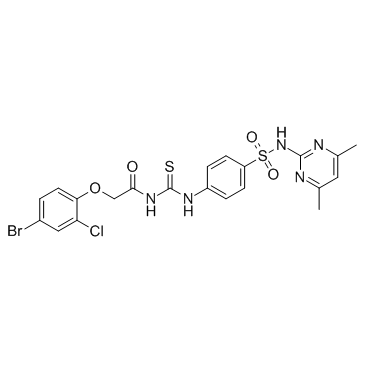
ZCL278
CAS No. 587841-73-4
ZCL278( ZCL 278 | ZCL-278 )
Catalog No. M15167 CAS No. 587841-73-4
A potent, cell-permeable Cdc42-specific small-molecule inhibitor (Kd=6.4 uM).
Purity : >98% (HPLC)
 COA
Datasheet
HNMR
HPLC
MSDS
Handing Instructions
COA
Datasheet
HNMR
HPLC
MSDS
Handing Instructions
| Size | Price / USD | Stock | Quantity |
| 5MG | 41 | In Stock |


|
| 10MG | 65 | In Stock |
|
| 25MG | 124 | In Stock |
|
| 50MG | 210 | In Stock |
|
| 100MG | 294 | In Stock |
|
| 200MG | 471 | In Stock |
|
| 500MG | 763 | In Stock |
|
| 1G | Get Quote | In Stock |
|
Biological Information
-
Product NameZCL278
-
NoteResearch use only, not for human use.
-
Brief DescriptionA potent, cell-permeable Cdc42-specific small-molecule inhibitor (Kd=6.4 uM).
-
DescriptionA potent, cell-permeable Cdc42-specific small-molecule inhibitor (Kd=6.4 uM); specifically targets Cdc42–intersectin interaction and inhibits Cdc42-mediated cellular processes, including Golgi organization and cell motility.
-
In VitroZCL278 as a potent, cell-permeable Cdc42-specific inhibitor that suppresses actin-based cellular functions, including Golgi organization and cell motility.In Swiss 3T3 fibroblast cultures, ZCL278 abolishes microspike formation and disrupted GM130-docked Golgi structures, two of the most prominent Cdc42-mediated subcellular events. ZCL278 reduces the perinuclear accumulation of active Cdc42 in contrast to NSC23766, a selective Rac inhibitor. ZCL278 suppresses Cdc42-mediated neuronal branching and growth cone dynamics as well as actin-based motility and migration in a metastatic prostate cancer cell line (i.e., PC-3) without disrupting cell viability. ZCL278 inhibits Cdc42 function as an entry inhibitor for Junin virus (JUNV) and for vesicular stomatitis virus, lymphocytic choriomeningitis virus, and dengue virus but not for the nonenveloped poliovirus. In cells, ZCL278 is shown to efficiently inhibit chemically induced filopodium formation, a process dependent on Cdc42 activity. Dose-response experiments are first carried out in Vero cells, and while ZCL278 is not toxic at concentrations up to 200 μM, ZCL278 inhibits JUNV with IC50 of ~14 μM, as measured by flow cytometry.
-
In VivoZCL278 reduces the JUNV RNA load in the spleen more than 33-fold, with JUNV RNA being undetectable in 5 out of 8 mice. These results are similar to those seen in Gabapentin-treated mice, demonstrating that ZCL278 can abrogate JUNV replication.
-
SynonymsZCL 278 | ZCL-278
-
PathwayMAPK/ERK Signaling
-
TargetRas
-
RecptorCdc42GTPase
-
Research AreaCancer
-
Indication——
Chemical Information
-
CAS Number587841-73-4
-
Formula Weight584.8937
-
Molecular FormulaC21H19BrClN5O4S2
-
Purity>98% (HPLC)
-
Solubility10 mM in DMSO
-
SMILESO=C(NC(NC1=CC=C(S(=O)(NC2=NC(C)=CC(C)=N2)=O)C=C1)=S)COC3=CC=C(Br)C=C3Cl
-
Chemical NameAcetamide, 2-(4-bromo-2-chlorophenoxy)-N-[[[4-[[(4,6-dimethyl-2-pyrimidinyl)amino]sulfonyl]phenyl]amino]thioxomethyl]-
Shipping & Storage Information
-
Storage(-20℃)
-
ShippingWith Ice Pack
-
Stability≥ 2 years
Reference
1. Friesland A, et al. Proc Natl Acad Sci U S A. 2013 Jan 22;110(4):1261-6.
2. Liu X, et al. Cell Physiol Biochem. 2015;36(4):1613-27.
molnova catalog



related products
-
KRAS inhibitor-9
KRAS inhibitor-9 is a potent KRAS inhibitor with Kd of 92 μM that blocks the formation of GTP-KRAS and downstream activation of KRAS.?
-
J-104871
J-104871 (UNII-6137X5QNJF) is a novel farnesyltransferase (FTase) inhibitor that competitively blocks Ras farnesylation in vivo, inhibits Ras processing in activated H-ras-transformed NIH3T3 cells, and suppresses tumor growth in nude mice transplanted with activated H-ras-transformed NIH3T3 cells.
-
(S)-BAY-293
(S)-BAY-293 (BAY293 S-enantiomer) is the S-enantiomer of BAY-293 as a negative control compound.
