


 Cart
Cart
 sales@molnova.com


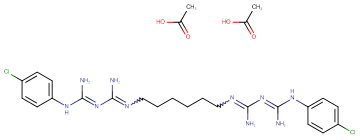
Chlorhexidine Acetate
CAS No. 56-95-1
Chlorhexidine Acetate( —— )
Catalog No. M15073 CAS No. 56-95-1
Chlorhexidine acetate is a disinfectant and topical anti-infective agent used also as mouthwash to prevent oral plaque.
Purity : >98% (HPLC)
 COA
Datasheet
HNMR
HPLC
MSDS
Handing Instructions
COA
Datasheet
HNMR
HPLC
MSDS
Handing Instructions
| Size | Price / USD | Stock | Quantity |
| 100MG | Get Quote | In Stock |


|
| 200MG | Get Quote | In Stock |
|
| 500MG | 37 | In Stock |
|
| 1G | 52 | In Stock |
|
Biological Information
-
Product NameChlorhexidine Acetate
-
NoteResearch use only, not for human use.
-
Brief DescriptionChlorhexidine acetate is a disinfectant and topical anti-infective agent used also as mouthwash to prevent oral plaque.
-
DescriptionChlorhexidine acetate is a disinfectant and topical anti-infective agent used also as mouthwash to prevent oral plaque.
-
In Vitro——
-
In Vivo——
-
Synonyms——
-
PathwayMicrobiology/Virology
-
TargetAntifection
-
RecptorHNMT| CAT
-
Research Area——
-
Indication——
Chemical Information
-
CAS Number56-95-1
-
Formula Weight625.55
-
Molecular FormulaC26H38Cl2N10O4
-
Purity>98% (HPLC)
-
SolubilitySoluble in DMSO
-
SMILESCC(=O)O.CC(=O)O.C1=CC(=CC=C1N/C(=N/C(=NCCCCCCN=C(/N=C(/NC2=CC=C(C=C2)Cl)\N)N)N)/N)Cl
-
Chemical Name——
Shipping & Storage Information
-
Storage(-20℃)
-
ShippingWith Ice Pack
-
Stability≥ 2 years
Reference
1.Solov'eva NN, et al. Antibiotiki. 1979 Jun;24(6):436-40.
molnova catalog



related products
-
Niazinin
Niazinin is a thiocarbamate glycoside with antileishmanial activities, with an IC50 value of 5.25 μM. Niazinin also shows a binding affinity with the target protein 3CL protease. Niazinin has promising leishmanicidal, anti-inflammatory and anti-pyretic activity.
-
paulownin
Paulownin a furofuran lignan from Paulownia tomentosahas the action of anti-inflammationanalgesiaimmunityhypoglycemia and has little toxicity.?
-
2-Furoic acid
2-Furoic acid an orally active selective human cathepsin K inhibitor may have the therapeutic potential for the treatment of diseases characterized by excessive bone loss including osteoporosis.Furan-2-carboxylic acid also has anti-bacterial effect.
