


 Cart
Cart
 sales@molnova.com


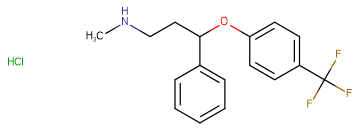
Fluoxetine hydrochloride
CAS No. 56296-78-7
Fluoxetine hydrochloride( LY110140 )
Catalog No. M15048 CAS No. 56296-78-7
Fluoxetine HCl is an antidepressant of the selective serotonin reuptake inhibitor (SSRI) class.
Purity : >98% (HPLC)
 COA
Datasheet
HNMR
HPLC
MSDS
Handing Instructions
COA
Datasheet
HNMR
HPLC
MSDS
Handing Instructions
| Size | Price / USD | Stock | Quantity |
| 1 mL x 10 mM in DMSO | 28 | In Stock |


|
| 25MG | 38 | In Stock |
|
| 50MG | 51 | In Stock |
|
| 100MG | 65 | In Stock |
|
| 200MG | Get Quote | In Stock |
|
| 500MG | 184 | In Stock |
|
| 1G | Get Quote | In Stock |
|
Biological Information
-
Product NameFluoxetine hydrochloride
-
NoteResearch use only, not for human use.
-
Brief DescriptionFluoxetine HCl is an antidepressant of the selective serotonin reuptake inhibitor (SSRI) class.
-
DescriptionFluoxetine HCl is an antidepressant of the selective serotonin reuptake inhibitor (SSRI) class.(In Vitro):Fluoxetine hydrochloride (LY 110140) blocks the downregulation of cell proliferation resulting from inescapable shock (IS) of hippocampal cell. Fluoxetine increases the number of newborn cells in the dentate gyrus of the hippocampus of adult rat. Fluoxetine also increases the number of proliferating cells in the prelimbic cortex. Fluoxetine accelerates the maturation of immature neurons. Fluoxetine enhances neurogenesis-dependent long-term potentiation (LTP) in the dentate gyrus. Fluoxetine, but not citalopram, fluvoxamine, paroxetine and sertraline, increases norepinephrine and dopamine extracellular levels in prefrontal cortex. Fluoxetine produces robust and sustained increases in extracellular concentrations of norepinephrine and dopamine after acute systemic administration. (In Vivo):Fluoxetine hydrochloride (LY 110140) treatment also reverses the deficit in escape latency observed in animals exposed to inescapable shock in adult male Sprague-Dawley rats. Fluoxetine (5 mg/kg) alone increases cell proliferation in the dentate gyrus. Coadministration (fluoxetine 5 mg/kg + olanzapine) also significantly increases the number of BrdU-positive cells compared with the control group. Fluoxetine combined with Olanzapine produces robust, sustained increases of extracellular levels of dopamine ([DA](ex)) and norepinephrine ([NE](ex)) up to 361% and 272% of the baseline, respectively, which are significantly greater than either drug alone.
-
In Vitro——
-
In Vivo——
-
SynonymsLY110140
-
PathwayEndocrinology/Hormones
-
Target5-HT Receptor
-
Recptor5-HT| Sert (Sodium-dependent)
-
Research AreaNeurological Disease
-
Indication——
Chemical Information
-
CAS Number56296-78-7
-
Formula Weight345.79
-
Molecular FormulaC17H18F3NO·HCl
-
Purity>98% (HPLC)
-
SolubilityEthanol: 69 mg/mL (199.54 mM); Water: 4 mg/mL (11.56 mM); DMSO: 69 mg/mL (199.54 mM)
-
SMILESCl.CNCCC(OC1=CC=C(C=C1)C(F)(F)F)C1=CC=CC=C1
-
Chemical Name——
Shipping & Storage Information
-
Storage(-20℃)
-
ShippingWith Ice Pack
-
Stability≥ 2 years
Reference
1.Richman A, et al. Epilepsy Res. 2007 Apr;74(1):19-27.
molnova catalog



related products
-
5-Methoxytryptamine
5-Methoxytryptamine is a tryptamine derivative that acts as a full agonist at the 5-HT1 5-HT2 5-HT4 5-HT6 and 5-HT7 receptors.
-
XEN-445
XEN445, a potent and selective endothelial lipase(EL) inhibitor (IC50=0.237 uM), exhibitis good ADME and PK properties.
-
SNAP-8
SNAP-8 is a mimic of the N-terminal end of SNAP-25 which competes with SNAP-25 for a position in the SNARE complex, thereby modulating its formation.
