


 Cart
Cart
 sales@molnova.com


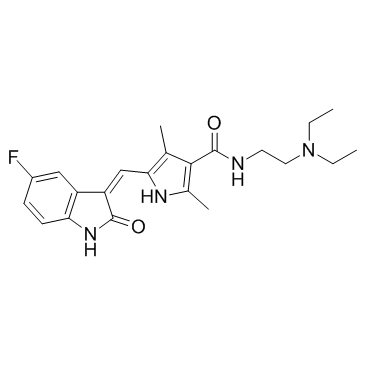
Sunitinib
CAS No. 557795-19-4
Sunitinib( SU 11248 | SU-11248 )
Catalog No. M15028 CAS No. 557795-19-4
A multi-targeted RTK inhibitor that targets VEGFR2 (Flk-1) and PDGFRβ with Ki of 8 nM and 9 nM respectively.
Purity : >98% (HPLC)
 COA
Datasheet
HNMR
HPLC
MSDS
Handing Instructions
COA
Datasheet
HNMR
HPLC
MSDS
Handing Instructions
| Size | Price / USD | Stock | Quantity |
| 1 mL x 10 mM in DMSO | 37 | In Stock |


|
| 25MG | 29 | In Stock |
|
| 50MG | 36 | In Stock |
|
| 100MG | 49 | In Stock |
|
| 200MG | Get Quote | In Stock |
|
| 500MG | 89 | In Stock |
|
| 1G | 129 | In Stock |
|
Biological Information
-
Product NameSunitinib
-
NoteResearch use only, not for human use.
-
Brief DescriptionA multi-targeted RTK inhibitor that targets VEGFR2 (Flk-1) and PDGFRβ with Ki of 8 nM and 9 nM respectively.
-
DescriptionA multi-targeted RTK inhibitor that targets VEGFR2 (Flk-1) and PDGFRβ with Ki of 8 nM and 9 nM respectively; displays >10-fold higher selectivity over FGFR-1, EGFR, Cdk2, Met, IGFR-1, Abl, and Src; also inhibits phosphorylation of wild-type FLT3, FLT3-ITD, and FLT3-Asp835 with IC50 of 250 nM, 50 nM, and 30 nM; regresses FLT3-ITD tumors in the subcutaneous tumor xenograft model.Gastric Cancer Approved(In Vitro):Sunitinib Malate is also a good inhibitor of KIT and FLT-3. In RS4;11 cells (FLT3-WT), treatment with Sunitinib (SU11248) inhibits FLT3-WT phosphorylation in a dose-dependent manner with IC50 of approximately 250 nM. In MV4;11 cells that express FLT3-ITD, Sunitinib inhibits FLT3-ITD phosphorylation in a dose-dependent manner with an IC50 of 50 nM following a 2-hour treatment.In biochemical assays, Sunitinib (SU11248) exhibits competitive inhibition (with regard to ATP) against Flk-1 and PDGFRβ with Ki values of 9 nM and 8 nM, respectively. Sunitinib is also a competitive, albeit less potent, inhibitor of FGFR1 tyrosine kinase activity, with a Ki value of 0.83 μM. In addition to these three structurally related split kinase domain RTKs, the activity of Sunitinib has also been evaluated against a broad panel of additional tyrosine and serine/threonine kinases. In these biochemical assays, the IC50 values for Sunitinib are generally at least 10-fold higher than those for Flk-1 and PDGFR (e.g., IC50values of: >10 μM for EGFR and Cdk2; 4 μM for Met; 2.4 μM for IGFR-1; 0.8 μM for Abl; and 0.6 μM for Src).(In Vivo):Sunitinib Malate has very good oral bioavailability, is highly efficacious in a number of preclinical tumor models, and is well tolerated at efficacious doses. Sunitinib (80 mg/kg/day) inhibits the growth of established SF763T and Colo205 tumor xenografts in athymic mice. Sunitinib (SU11248) treatment effectively inhibits the growth of established tumor xenografts.
-
In VitroSunitinib Malate is also a good inhibitor of KIT and FLT-3. In RS4;11 cells (FLT3-WT), treatment with Sunitinib (SU11248) inhibits FLT3-WT phosphorylation in a dose-dependent manner with IC50 of approximately 250 nM. In MV4;11 cells that express FLT3-ITD, Sunitinib inhibits FLT3-ITD phosphorylation in a dose-dependent manner with an IC50 of 50 nM following a 2-hour treatment.In biochemical assays, Sunitinib (SU11248) exhibits competitive inhibition (with regard to ATP) against Flk-1 and PDGFRβ with Ki values of 9 nM and 8 nM, respectively. Sunitinib is also a competitive, albeit less potent, inhibitor of FGFR1 tyrosine kinase activity, with a Ki value of 0.83 μM. In addition to these three structurally related split kinase domain RTKs, the activity of Sunitinib has also been evaluated against a broad panel of additional tyrosine and serine/threonine kinases. In these biochemical assays, the IC50 values for Sunitinib are generally at least 10-fold higher than those for Flk-1 and PDGFR (e.g., IC50values of: >10 μM for EGFR and Cdk2; 4 μM for Met; 2.4 μM for IGFR-1; 0.8 μM for Abl; and 0.6 μM for Src).
-
In VivoSunitinib Malate has very good oral bioavailability, is highly efficacious in a number of preclinical tumor models, and is well tolerated at efficacious doses. Sunitinib (80 mg/kg/day) inhibits the growth of established SF763T and Colo205 tumor xenografts in athymic mice. Sunitinib (SU11248) treatment effectively inhibits the growth of established tumor xenografts.
-
SynonymsSU 11248 | SU-11248
-
PathwayAngiogenesis
-
TargetPDGFR
-
Recptorc-Kit|FLT3|PDGFRβ|VEGFR2
-
Research AreaCancer
-
IndicationGastric Cancer
Chemical Information
-
CAS Number557795-19-4
-
Formula Weight398.4738
-
Molecular FormulaC22H27FN4O2
-
Purity>98% (HPLC)
-
SolubilityDMSO: 25 mg/mL
-
SMILESCCN(CC)CCNC(=O)C1=C(NC(=C1C)/C=C\2/C3=C(C=CC(=C3)F)NC2=O)C
-
Chemical Name1H-Pyrrole-3-carboxamide, N-[2-(diethylamino)ethyl]-5-[(Z)-(5-fluoro-1,2-dihydro-2-oxo-3H-indol-3-ylidene)methyl]-2,4-dimethyl-
Shipping & Storage Information
-
Storage(-20℃)
-
ShippingWith Ice Pack
-
Stability≥ 2 years
Reference
1. Sun L, et al. J Med Chem. 2003 Mar 27;46(7):1116-9.
2. O'Farrell AM, et al. Blood. 2003 May 1;101(9):3597-605.
3. Mendel DB, et al. Clin Cancer Res. 2003 Jan;9(1):327-37.
molnova catalog



related products
-
Flumatinib mesylate
Flumatinib mesylate is a selective inhibitor of c-Abl PDGFRβ and c-Kit effectively overcomes drug resistance of certain KIT mutants.
-
PDGFRα kinase inhibi...
PDGFRα kinase inhibitor 1 is a highly selective inhibitor of type II PDGFRα kinase (PDGFRα and PDGFRβ) with IC50 values of 132 nM and 6115 nM, respectively.
-
Regorafénib N-oxyde ...
Regorafénib N-oxyde M2 is an active metabolite of Regorafenib. Regorafenib is a multi-target inhibitor for VEGFR1/2/3, PDGFRβ, RET, Kit, and Raf-1.
