


 Cart
Cart
 sales@molnova.com


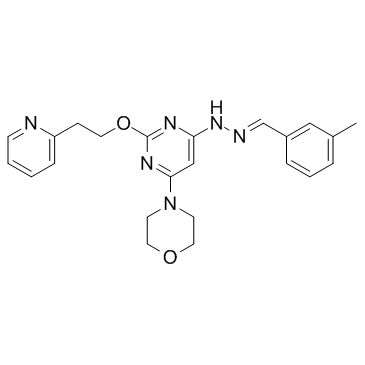
Apilimod
CAS No. 541550-19-0
Apilimod( —— )
Catalog No. M14939 CAS No. 541550-19-0
Apilimod inhibits the production of IL-12 and IL-23 and reduces dendritic cell infiltration in psoriasis.
Purity : >98% (HPLC)
 COA
Datasheet
HNMR
HPLC
MSDS
Handing Instructions
COA
Datasheet
HNMR
HPLC
MSDS
Handing Instructions
| Size | Price / USD | Stock | Quantity |
| 1 mL x 10 mM in DMSO | 46 | In Stock |


|
| 5MG | 41 | In Stock |
|
| 10MG | 65 | In Stock |
|
| 25MG | 77 | In Stock |
|
| 50MG | 90 | In Stock |
|
| 100MG | 147 | In Stock |
|
| 200MG | Get Quote | In Stock |
|
| 500MG | Get Quote | In Stock |
|
| 1G | Get Quote | In Stock |
|
Biological Information
-
Product NameApilimod
-
NoteResearch use only, not for human use.
-
Brief DescriptionApilimod inhibits the production of IL-12 and IL-23 and reduces dendritic cell infiltration in psoriasis.
-
DescriptionApilimod inhibits the production of IL-12 and IL-23 and reduces dendritic cell infiltration in psoriasis.(In Vitro):Apilimod inhibits IFN-γ production induced by either IFN-γ/SAC or SAC in human PBMCs, with an IC50 of approximately 20 nM. Apilimod show some inhibition against IFN-γ/SAC-induced TNF-α and ConA-induced IL-5 from human PBMCs at high concentrations, but no suppressive effect against IL-1β, IL-2, IL-4, IL-8, and IL-18 in all cultures tested. The p35 and p40 promoter-driven luciferase activities are significantly induced after stimulation with IFN-γ/LPS or IFN-γ/SAC, and are completely suppressed by 100 nM Apilimod. (In Vivo):Apilimod (10 mg/kg, p.o.) is effective not only when administered throughout the entire experiment, but also when administration is initiated on day 30 when disease is clearly measurable but not maximal. TA-5326 causes a significant reduction in cell number only in the Th1 model, with an average percentage of inhibition of 51%±8% relative to the vehicle control. Apilimod treatment has no effect in the Th2 setting. Apilimod (5 or 20 mg/kg, p.o.) reduces the level of IL-12 p40 in serum without altering body weight in EAU mice. Oral administration of Apilimod reduces the severity of experimental autoimmune uveoretinitis (EAU) by clinical and histopathological analysis.
-
In VitroApilimod inhibits IFN-γ production induced by either IFN-γ/SAC or SAC in human PBMCs, with an IC50 of approximately 20 nM. Apilimod show some inhibition against IFN-γ/SAC-induced TNF-α and ConA-induced IL-5 from human PBMCs at high concentrations, but no suppressive effect against IL-1β, IL-2, IL-4, IL-8, and IL-18 in all cultures tested. The p35 and p40 promoter-driven luciferase activities are significantly induced after stimulation with IFN-γ/LPS or IFN-γ/SAC, and are completely suppressed by 100 nM Apilimod.
-
In VivoApilimod (10 mg/kg, p.o.) is effective not only when administered throughout the entire experiment, but also when administration is initiated on day 30 when disease is clearly measurable but not maximal. TA-5326 causes a significant reduction in cell number only in the Th1 model, with an average percentage of inhibition of 51%±8% relative to the vehicle control. Apilimod treatment has no effect in the Th2 setting. Apilimod (5 or 20 mg/kg, p.o.) reduces the level of IL-12 p40 in serum without altering body weight in EAU mice. Oral administration of Apilimod reduces the severity of experimental autoimmune uveoretinitis (EAU) by clinical and histopathological analysis.
-
Synonyms——
-
PathwayApoptosis
-
TargetIL Receptor
-
RecptorIL-12| IL-23
-
Research AreaCancer
-
IndicationBlood cancer
Chemical Information
-
CAS Number541550-19-0
-
Formula Weight418.49
-
Molecular FormulaC23H26N6O2
-
Purity>98% (HPLC)
-
SolubilityDMSO: 10 mM
-
SMILESCC1=CC=CC(=C1)/C=N/NC2=NC(=NC(=C2)N3CCOCC3)OCCC4=CC=CC=N4
-
Chemical Name——
Shipping & Storage Information
-
Storage(-20℃)
-
ShippingWith Ice Pack
-
Stability≥ 2 years
Reference
1.Wada Y, et al. PLoS One. 2012;7(4):e35069.
molnova catalog



related products
-
IL-4-inhibitor-1
IL-4 inhibitor is an inhibitor of IL-4.1It binds to IL-4 with a Kdvalue of 1.8 μM and inhibits IL-4 activity in a cell-based reporter assay (EC50= 1.81 μM).
-
Pascolizumab
Pascolizumab (SB-240683) is a humanized monoclonal antibody targeting IL-4, exhibiting asthmatic effects and useful for studying allergic rhinitis.
-
YQ128
YQ128 is a potent and selective inhibitor of second-generation NLRP3 (NOD-like receptor P3) inflammasome(IC50 of 0.30 μM), with anti-inflammatory activity.
