


 Cart
 sales@molnova.com


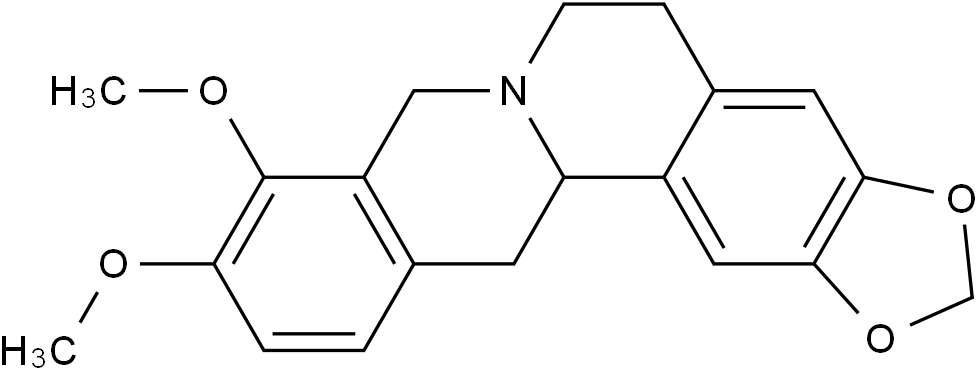
Tetrahydroberberine
CAS No. 522-97-4
Tetrahydroberberine( —— )
Catalog No. M14848 CAS No. 522-97-4
Tetrahydroberberine is an isoquinoline alkaloid isolated from corydalis tuber.
Purity : >98% (HPLC)
 COA
Datasheet
HNMR
HPLC
MSDS
Handing Instructions
| Size | Price / USD | Stock | Quantity |
| 1 mL x 10 mM in DMSO | 28 | In Stock |


|
| 10MG | 35 | In Stock |
|
| 25MG | 56 | In Stock |
|
| 50MG | 79 | In Stock |
|
| 100MG | 114 | In Stock |
|
| 200MG | Get Quote | In Stock |
|
| 500MG | 276 | In Stock |
|
| 1G | Get Quote | In Stock |
|
Biological Information
-
Product NameTetrahydroberberine
-
NoteResearch use only, not for human use.
-
Brief DescriptionTetrahydroberberine is an isoquinoline alkaloid isolated from corydalis tuber.
-
DescriptionTetrahydroberberine is an isoquinoline alkaloid isolated from corydalis tuber; has micromolar affinity for dopamine D(2) (pK(i) = 6.08) and 5-HT(1A) (pK(i) = 5.38) receptors but moderate to no affinity for other relevant serotonin receptors (5-HT(1B), 5-HT(1D), 5-HT(3), and 5-HT(4); pK(i) < 5.00).
-
In Vitro——
-
In Vivo——
-
Synonyms——
-
PathwayEndocrinology/Hormones
-
Target5-HT Receptor
-
Recptor5-HT| Dopamine
-
Research AreaNeurological Disease
-
Indication——
Chemical Information
-
CAS Number522-97-4
-
Formula Weight339.39
-
Molecular FormulaC20H21O4N
-
Purity>98% (HPLC)
-
SolubilityDMSO: 10 mM
-
SMILESCOC1=C(OC)C2=C(CC3N(CCC4=CC5=C(OCO5)C=C34)C2)C=C1
-
Chemical Name——
Shipping & Storage Information
-
Storage(-20℃)
-
ShippingWith Ice Pack
-
Stability≥ 2 years
Reference
1. Pingali S, et al. Acta Crystallogr C Struct Chem. 2015 Apr;71(Pt 4):262-5.
molnova catalog



related products
-
Palonosetron hydroch...
Palonosetron (INN, trade name Aloxi) is a 5-HT3 antagonist used in the prevention and treatment of chemotherapy-induced nausea and vomiting (CINV).
-
CART (62-76) (rat, h...
Cocaine- and amphetamine-regulated transcript (CART) peptide fragment that inhibits food intake. Attenuates NPY-induced feeding and decreases food intake in food-restricted goldfish, and induces anxiogenic-like effects in elevated plus-maze test in rats. Modulates the activity of striatal noradrenergic, and corticostrial and hypothalamic serotoninergic systems, with no major effect on dopaminergic pathways in rat brain.
-
Amikacin disulfate
Amikacin sulfate(BAY416651 sulfate) is a semi-synthetic aminoglycoside antibiotic derived from kanamycin A.
