


 Cart
Cart
 sales@molnova.com


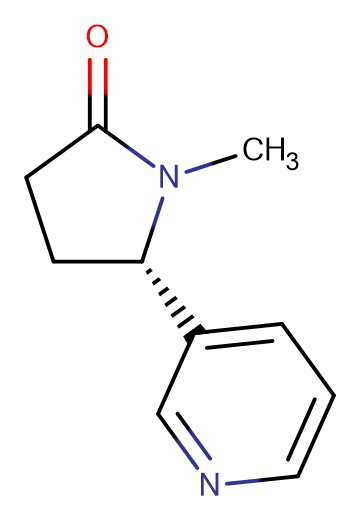
(-)-Cotinine
CAS No. 486-56-6
(-)-Cotinine( NIH 10498 )
Catalog No. M14630 CAS No. 486-56-6
Cotinine is an alkaloid found in tobacco and is also the predominant metabolite of nicotine, used as a biomarker for exposure to tobacco smoke.
Purity : >98% (HPLC)
 COA
Datasheet
HNMR
HPLC
MSDS
Handing Instructions
COA
Datasheet
HNMR
HPLC
MSDS
Handing Instructions
| Size | Price / USD | Stock | Quantity |
| 1 mL x 10 mM in DMSO | 28 | In Stock |


|
| 50MG | 35 | In Stock |
|
| 100MG | 55 | In Stock |
|
| 200MG | Get Quote | In Stock |
|
| 500MG | Get Quote | In Stock |
|
| 1G | Get Quote | In Stock |
|
Biological Information
-
Product Name(-)-Cotinine
-
NoteResearch use only, not for human use.
-
Brief DescriptionCotinine is an alkaloid found in tobacco and is also the predominant metabolite of nicotine, used as a biomarker for exposure to tobacco smoke.
-
DescriptionCotinine is an alkaloid found in tobacco and is also the predominant metabolite of nicotine, used as a biomarker for exposure to tobacco smoke.
-
In Vitro——
-
In Vivo——
-
SynonymsNIH 10498
-
PathwayEndocrinology/Hormones
-
TargetAChR
-
RecptorNicotinic Receptor
-
Research AreaOther Indications
-
Indication——
Chemical Information
-
CAS Number486-56-6
-
Formula Weight176.22
-
Molecular FormulaC10H12N2O
-
Purity>98% (HPLC)
-
Solubilitysoluble in Water
-
SMILESO=C1N(C)[C@H](C2=CC=CN=C2)CC1
-
Chemical Name(S)-1-methyl-5-(pyridin-3-yl)pyrrolidin-2-one
Shipping & Storage Information
-
Storage(-20℃)
-
ShippingWith Ice Pack
-
Stability≥ 2 years
Reference
1.Sánchez-Rodríguez JE, et al. Environ Res. 2015 Jan;136:227-33.
molnova catalog



related products
-
Edrophonium chloride
Edrophonium chloride is an acetylcholinesterase (AChE) inhibitor that is known to prevent the breakdown of the neurotransmitter acetylcholine by binding specifically to its catalytic site.
-
Anisotropine Methylb...
Anisotropine Methylbromide is an anticholinergic agent and has been used for relief of gastrointestinal spasm and for the suppression of gastric acid secretion.
-
G007-LK
G007-LK is a selective inhibitor of TNKS1 and TNKS2, with IC50s of 46 nM and 25 nM, respectively.
