


 Cart
Cart
 sales@molnova.com


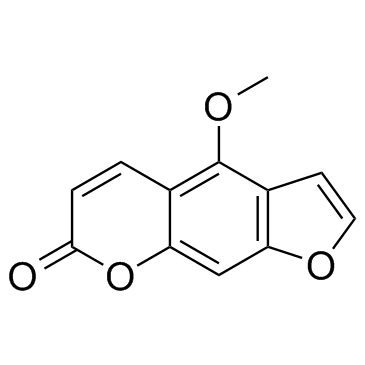
Bergapten
CAS No. 484-20-8
Bergapten( —— )
Catalog No. M14621 CAS No. 484-20-8
5-Methoxypsoralen, a naturally occurring linear furocoumarin, has been successfully used in combination with ultraviolet (UV) A irradiation [psoralen plus UV (PUVA)] to manage psoriasis and vitiligo.
Purity : >98% (HPLC)
 COA
Datasheet
HNMR
HPLC
MSDS
Handing Instructions
COA
Datasheet
HNMR
HPLC
MSDS
Handing Instructions
| Size | Price / USD | Stock | Quantity |
| 1 mL x 10 mM in DMSO | 41 | In Stock |


|
| 100MG | 28 | In Stock |
|
| 200MG | Get Quote | In Stock |
|
| 500MG | 63 | In Stock |
|
| 1G | 83 | In Stock |
|
Biological Information
-
Product NameBergapten
-
NoteResearch use only, not for human use.
-
Brief Description5-Methoxypsoralen, a naturally occurring linear furocoumarin, has been successfully used in combination with ultraviolet (UV) A irradiation [psoralen plus UV (PUVA)] to manage psoriasis and vitiligo.
-
Description5-Methoxypsoralen, a naturally occurring linear furocoumarin, has been successfully used in combination with ultraviolet (UV) A irradiation [psoralen plus UV (PUVA)] to manage psoriasis and vitiligo; inhibit proliferation in the human hepatocellular carcinoma cell line.(In Vitro):There is decreased N-acetyltransferase (NAT) activity in SC-M1 cells at concentrations of Bergapten (5-Methoxypsoralen, 5-MOP) from 0.05 mM to 25 mM, but no obvious dose-dependent effect is found between these doses (r=0.5687). In COLO 205 cells, there is decreased NAT activity at low doses of Bergapten (0.05 mM and 0.5 mM) and increased NAT activity at a high dose (50 mM). Bergapten induces a dosedependent effect in our experimental concentrations on COLO 205 cells (r=0.8912); a promotion effect at a higher dose (50 mM) and an inhibition effect at lower doses (0.05-0.5 mM), while the concentrations 5-25 mM has no significant difference compared with the control regimen. Bergapten (5-Methoxypsoralen) exerts inhibitory effects on diabetes-related osteoporosis via the regulation of the PI3K/AKT, JNK/MAPK and NF-κB signaling pathways in osteoprotegerin knockout mice. Bergapten has also been shown to significantly inhibit the production of pro-inflammatory cytokines. Bergapten exhibits the ability to significantly inhibit RANKL-RANK signaling transduction, and to suppress the activation of the PI3K/AKT, JNK/MAPK and NF-κB signaling pathways, thus protecting trabecular structure and decreasing osteoclastogenic differentiation. (In Vivo):The metabolic activity of NAT of the rat colon is higher than that of the stomach, and Bergapten (5-Methoxypsoralen, 5-MOP) causes a decrease of AF concentration in the stomach at the 24-h time-period. The concentrations of AAF in the stomach and colon are low. Although DMSO (solvent) influenced the metabolism of AAF, compared with the control regimen, Bergapten still causes an increase in the further metabolism of AAF, and a decrease in the concentration of AAF in the stomach at 24 h, and in the colon during the 24- to 72-h time-period.
-
In VitroThere is decreased N-acetyltransferase (NAT) activity in SC-M1 cells at concentrations of Bergapten (5-Methoxypsoralen, 5-MOP) from 0.05 mM to 25 mM, but no obvious dose-dependent effect is found between these doses (r=0.5687). In COLO 205 cells, there is decreased NAT activity at low doses of Bergapten (0.05 mM and 0.5 mM) and increased NAT activity at a high dose (50 mM). Bergapten induces a dosedependent effect in our experimental concentrations on COLO 205 cells (r=0.8912); a promotion effect at a higher dose (50 mM) and an inhibition effect at lower doses (0.05-0.5 mM), while the concentrations 5-25 mM has no significant difference compared with the control regimen. Bergapten (5-Methoxypsoralen) exerts inhibitory effects on diabetes-related osteoporosis via the regulation of the PI3K/AKT, JNK/MAPK and NF-κB signaling pathways in osteoprotegerin knockout mice. Bergapten has also been shown to significantly inhibit the production of pro-inflammatory cytokines. Bergapten exhibits the ability to significantly inhibit RANKL-RANK signaling transduction, and to suppress the activation of the PI3K/AKT, JNK/MAPK and NF-κB signaling pathways, thus protecting trabecular structure and decreasing osteoclastogenic differentiation.
-
In VivoThe metabolic activity of NAT of the rat colon is higher than that of the stomach, and Bergapten (5-Methoxypsoralen, 5-MOP) causes a decrease of AF concentration in the stomach at the 24-h time-period. The concentrations of AAF in the stomach and colon are low. Although DMSO (solvent) influenced the metabolism of AAF, compared with the control regimen, Bergapten still causes an increase in the further metabolism of AAF, and a decrease in the concentration of AAF in the stomach at 24 h, and in the colon during the 24- to 72-h time-period.
-
Synonyms——
-
PathwayMetabolic Enzyme/Protease
-
TargetP450
-
RecptorCYP
-
Research AreaCancer
-
Indication——
Chemical Information
-
CAS Number484-20-8
-
Formula Weight216.19
-
Molecular FormulaC12H8O4
-
Purity>98% (HPLC)
-
SolubilityDMSO: 5 mg/mL (23.12 mM)
-
SMILESCOC1=C2C=CC(=O)OC2=CC2=C1C=CO2
-
Chemical Name——
Shipping & Storage Information
-
Storage(-20℃)
-
ShippingWith Ice Pack
-
Stability≥ 2 years
Reference
1.Panno ML, et al. Breast Y Res Treat, 2012, 136(2), 443-455.
molnova catalog



related products
-
Gomisin G
Gomisin G is a natural compound and exhibits potent anti-HIV activity (EC50: 0.006 μg/mL; therapeutic index: 300). It is a good substrate of CYP2C9.
-
Ambroxol
Ambroxol is indicated as "secretolytic therapy in bronchopulmonary diseases associated with abnormal mucus secretion and impaired mucus transport.
-
Harman hydrochloride
Harman hydrochloride can directly induce CYP1A1 gene expression in an AhR-dependent manner and may represent a novel mechanism by which harman promotes mutagenicity, co-mutagenicity and carcinogenicity.
